Thank you for visiting SNEWPapers!
Sign up free
Literary
February 22, 1832
Republican Herald
Providence, Providence County, Rhode Island
What is this article about?
Essay by Cobbett advocating the advantages of married life for farmers and tradesmen, emphasizing a wife's irreplaceable support during illness, shared interests, cost savings, family motivation, and emotional companionship over the lonely, inefficient existence of a bachelor.
Clipping
OCR Quality
98%
Excellent
Full Text
Miscellaneous Selections.
MARRIED LIFE.
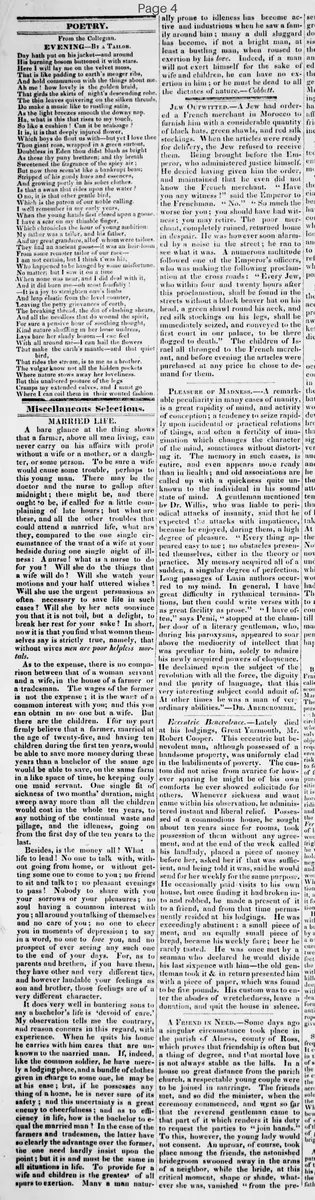
A bare glance at the thing shows that a farmer, above all men living, can never carry on his affairs with profit without a wife or a mother, or a daughter, or some person. To be sure a wife would cause some trouble, perhaps to this young man. There may be the doctor and the nurse to gallop after midnight; there might be, and there ought to be, if called for a little complaining of late hours; but what are these, and all the other troubles that could attend a married life, what are they, compared to the one single circumstance of the want of a wife at your bedside during one single night of illness: A nurse! what is a nurse to do for you? Will she do the things that a wife will do? Will she watch your motions and your half uttered wishes? Will she use the urgent persuasions so often necessary to save life in such cases? Will she by her acts convince you that it is not toil, but a delight, to break her rest for your sake? In short, now it is that you find what woman themselves say is strictly true, namely, that without wives men are poor helpless mortals.
As to the expense, there is no comparison between that of a woman servant and a wife, in the house of a farmer or a tradesman. The wages of the former is not the expense; it is the want of a common interest with you; and this you can obtain in no one but a wife. But there are the children. For my part I firmly believe that a farmer, married at the age of twenty-five, and having ten children during the first ten years, would be able to save more money during these years than a bachelor of the same age would be able to save, on the same farm in a like space of time, he keeping only one maid servant. One single fit of sickness of two months' duration, might sweep away more than all three children would cost in the whole ten years, to say nothing of the continual waste and pillage, and the idleness, going on from the first day of the ten years to the last.
Besides, is the money all? What a life to lead! No one to talk with, without going from home, or without getting some one to come to you; no friend to sit and talk to; no pleasant evenings to pass! Nobody to share with you your sorrows or your pleasures; no soul having a common interest with you; all around you talking of themselves and no care of you; no one to cheer you in moments of depression; to say in a word, no one to love you, and no prospect of ever seeing any such one to the end of your days. For, as to parents and brethren, if you have them, they have other and very different ties, and however laudable your feelings as son and brother, those feelings are of a very different character.
It does very well in bantering sons to say a bachelor's life is 'devoid of care.' My observation tells me the contrary, and reason concurs in this regard, with experience. When he quits his home he carries with him cares that are unknown to the married man. If, indeed, like the common soldier, he have merely a lodging place, and a bundle of clothes given in charge to some one, he may be at his ease; but, if he possesses any thing of a home, he is never sure of its safety; and this uncertainty is a great enemy to cheerfulness; and as to efficiency in life, how is the bachelor to equal the married man? In the case of the farmers and tradesmen, the latter have so clearly the advantage over the former, the one need hardly insist upon the point; but it is and must be the same in all situations in life. To provide for a wife and children is the greatest of all spurs to exertion. Many a man naturally prone to idleness has become active and industrious when he saw a family around him; many a dull sluggard has become, if not a bright man, at least a bustling man, when roused to exertion by his love. Indeed, if a man will not exert himself for the sake of wife and children, he can have no exertion in him; or he must be dead to all the dictates of nature.—Cobbett.
MARRIED LIFE.
A bare glance at the thing shows that a farmer, above all men living, can never carry on his affairs with profit without a wife or a mother, or a daughter, or some person. To be sure a wife would cause some trouble, perhaps to this young man. There may be the doctor and the nurse to gallop after midnight; there might be, and there ought to be, if called for a little complaining of late hours; but what are these, and all the other troubles that could attend a married life, what are they, compared to the one single circumstance of the want of a wife at your bedside during one single night of illness: A nurse! what is a nurse to do for you? Will she do the things that a wife will do? Will she watch your motions and your half uttered wishes? Will she use the urgent persuasions so often necessary to save life in such cases? Will she by her acts convince you that it is not toil, but a delight, to break her rest for your sake? In short, now it is that you find what woman themselves say is strictly true, namely, that without wives men are poor helpless mortals.
As to the expense, there is no comparison between that of a woman servant and a wife, in the house of a farmer or a tradesman. The wages of the former is not the expense; it is the want of a common interest with you; and this you can obtain in no one but a wife. But there are the children. For my part I firmly believe that a farmer, married at the age of twenty-five, and having ten children during the first ten years, would be able to save more money during these years than a bachelor of the same age would be able to save, on the same farm in a like space of time, he keeping only one maid servant. One single fit of sickness of two months' duration, might sweep away more than all three children would cost in the whole ten years, to say nothing of the continual waste and pillage, and the idleness, going on from the first day of the ten years to the last.
Besides, is the money all? What a life to lead! No one to talk with, without going from home, or without getting some one to come to you; no friend to sit and talk to; no pleasant evenings to pass! Nobody to share with you your sorrows or your pleasures; no soul having a common interest with you; all around you talking of themselves and no care of you; no one to cheer you in moments of depression; to say in a word, no one to love you, and no prospect of ever seeing any such one to the end of your days. For, as to parents and brethren, if you have them, they have other and very different ties, and however laudable your feelings as son and brother, those feelings are of a very different character.
It does very well in bantering sons to say a bachelor's life is 'devoid of care.' My observation tells me the contrary, and reason concurs in this regard, with experience. When he quits his home he carries with him cares that are unknown to the married man. If, indeed, like the common soldier, he have merely a lodging place, and a bundle of clothes given in charge to some one, he may be at his ease; but, if he possesses any thing of a home, he is never sure of its safety; and this uncertainty is a great enemy to cheerfulness; and as to efficiency in life, how is the bachelor to equal the married man? In the case of the farmers and tradesmen, the latter have so clearly the advantage over the former, the one need hardly insist upon the point; but it is and must be the same in all situations in life. To provide for a wife and children is the greatest of all spurs to exertion. Many a man naturally prone to idleness has become active and industrious when he saw a family around him; many a dull sluggard has become, if not a bright man, at least a bustling man, when roused to exertion by his love. Indeed, if a man will not exert himself for the sake of wife and children, he can have no exertion in him; or he must be dead to all the dictates of nature.—Cobbett.
What sub-type of article is it?
Essay
What themes does it cover?
Social Manners
Moral Virtue
Agriculture Rural
What keywords are associated?
Married Life
Farmers
Bachelorhood
Family Benefits
Wife Support
Moral Duty
Rural Economy
What entities or persons were involved?
Cobbett
Literary Details
Title
Married Life.
Author
Cobbett
Subject
Advantages Of Marriage For Farmers And Tradesmen
Key Lines
A Nurse! What Is A Nurse To Do For You? Will She Do The Things That A Wife Will Do? Will She Watch Your Motions And Your Half Uttered Wishes?
Without Wives Men Are Poor Helpless Mortals.
To Provide For A Wife And Children Is The Greatest Of All Spurs To Exertion.
Many A Man Naturally Prone To Idleness Has Become Active And Industrious When He Saw A Family Around Him;