Thank you for visiting SNEWPapers!
Sign up free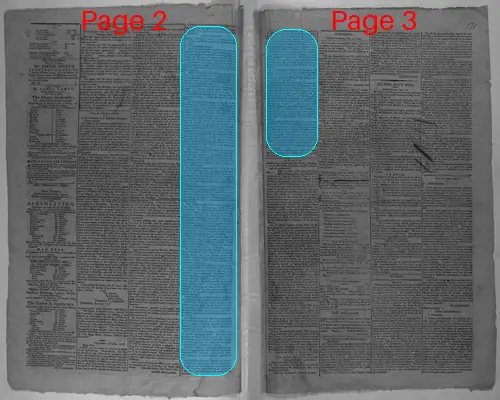
Gazette Of The United States
Philadelphia, Philadelphia County, Pennsylvania
What is this article about?
Petition from freeholders and inhabitants of Westmoreland County, Virginia, to the U.S. House of Representatives, expressing sorrow over the constitutional debate on a treaty, urging the House to avoid discord by upholding precedents, referring issues to amendments, and preventing the risk of war to preserve national harmony and union.
Merged-components note: Continuation of the Westmoreland County petition letter across pages, sequential reading order and textual flow.
Clippings

1 of 2
OCR Quality
Full Text
THE PETITION
Of the Freeholders and other inhabitants of the County of Westmoreland, in the state of Virginia.
Respectfully sheweth,
That your petitioners are penetrated with the deepest sorrow from their apprehensions, that heavy national distress must result to the United States from the difference of opinion which exists between the Executive and Representative branches of government, on a great constitutional point, unless a temperate review of the subject, on the part of your Honorable House, soon restore the wanted harmony.
While we applaud the fair and manly examination, by every branch of government, of all matters which affect the people, and are the proper objects of their respective deliberations; while we reckon an accidental difference of sentiment between the constituted authorities, from our knowledge that free men cannot always think alike, when influenced by pure motives; we never can commend that policy which, by seeking theoretic disputations, goes to plunge the nation in actual misery.
We refrained from giving any opinion on the constitutional question, which has lately engaged the attention of your honorable body, from that delicacy which we hope ever to feel when the conduct of government becomes the subject of our enquiry, always commanding in our judgment, full deliberation before decision; for which deliberation we have not time on the present occasion.—
But, we should be criminally inattentive to our dearest interests, if we hesitated on this awful crisis, from declaring in unequivocal language our disapprobation of the election of the period which seems to have been made for the discussion of a momentous constitutional question, and we conceive too, that the election of the particular treaty which introduced this discussion, discovers inattention to that purity and fairness which ought ever to mark legislative enquiry.
From a beginning so inauspicious, we are led to dread the issue; unless love of country and obedience to duty supplant in the breasts of your Honorable House those personal rivalries and foreign predilections which, unfortunately for our fellow citizens, appear to have held for some time past transcendent domination.
It is not less strange than true; it is not less true than afflicting to our feelings, and derogatory to our honor, that from the whole tenor of congressional debates, as published to the world, foreign nations evidently occupy more of the time of your Honorable House, than do the people of the United States.
While we admire that political conduct which is bottomed on fidelity to our allies, and a desire to preserve friendship with the whole human race; we cannot but express our chagrin at the apparent disregard of the concerns of the people of the United States, through your tender care of those of other nations.
With Europe we have little to do, and ought to have less to do: with our own country we have much to do. To strengthen the bands of the happy union which embraces the states, to encourage morality, to diffuse the blessings of literature throughout our republic, and to add to the general convenience by constant attention to the general melioration, seemeth to us the proper objects of legislative meditation; and promise to lead to the consummation of our signal felicity, with rather more certainty than zealous discussions of the relative claims of foreign nations on our friendship.
Returning from this digression which, respect to our fellow citizens, and solicitude for the perpetuation of our present happiness dictated, we beg leave frankly to declare our mind on the particular subject which called us from our ploughs.
We humbly conceive, that inasmuch as treaties heretofore made by the President, with the consent of the Senate, have been deemed complete and binding, a deviation from that usage on the present occasion would be unwise, because pregnant with pernicious consequences.
The proper line of conduct on the part of your Honorable House, in our humble opinion, would be to save our country from those calamities which must flow from contradiction to established precedent at this time, and to refer to a proper tribunal at a proper time, the decision of those doubts with which you charge the constitution in respect to the treaty making power. If the people should think proper to explain by amendment their will on the subject, they have the power, and the road to the attainment of the object is plain, because it is constitutionally fixed.
The introduction of discord into our land is by no means a necessary prelude to their decision.
Should your Honorable House persevere in the course you have taken, the nation must inevitably be exposed, not only to the evils of internal discord, but also to the ravages of foreign war; for national disputes can only be settled either by treaty or by the sword.
The first has been tried with success, unless you counteract its completion; if you do, the sword is the only appeal; a bloody, expensive and tedious, war may be the consequence, which at last must be, terminated by treaty.
The perils of war are many, and victory does not always accompany justice. We should after much loss of blood and money enter into negotiations for peace, with increase of debt, with decrease of resources, and with the addition of new topics of disputation to those already existing.
Humanity shudders at the horrors of a war, the genius of republicanism forbids war; our signally happy condition commands us, in the most impetuous language, to avoid even the possibility of war.
Stop, then, we pray you. Small is the boundary between peace and war. One step farther, on your part, and our doom may be irretrievably sealed. We therefore conjure you by the sacred ties of duty and common country, not to hazard our unrivaled felicity.
By a victory over your own passions, you save from every chance of misery your friends and fellow citizens, and at the same time stamp your own character with glory. Do it, and while you receive the benedictions of a happy people, you will enjoy the exalted satisfaction which flows from a consciousness of having greatly contributed to their felicity, by the timely resumption of self command.
Remember too, we entreat you, that the birth of our nation consecrated the principle for which we fought, and for which we shall always firmly contend. The capacity of man to govern himself—murd er not this principle in its infancy—the happiness of the human race is staked on its preservation.
If the experiment made by the People of the United States should fail, the dominion of reason must be supplanted by the dominion of force, and nations be again only distinguishable from nations by their superlative misery.
Forget not also we beseech you, that your fellow citizens have trusted their sovereignty to three distinct branches of government, each of which is equally the object of their confidence, and all of which necessary to their good—derange not the wise distribution, nor listen to the idea sometimes pressed in support of the authority of your Honorable House, that because you spring immediately, and the other branches of government mediately from the people, you therefore possess the superior confidence of your constituents. The admission of a doctrine so hostile to the principles of our constitution gives cause of suspicion, that its annihilation would not be a disagreeable event to those who urge it.
The greatest possible evil which, in our judgment can befall our country, is the dissolution of the union of the United States; next to that is, the destruction of our government; and next in the doleful recital is war. The last (if your choice) will very probably produce the first. On the decision of your honorable body, upon this momentous question rests, our destiny—Regard with affection your fellow citizens—We commend you to the protection of the Supreme Ruler of the Universe—and as in duty bound will ever pray.
The above was signed by all the inhabitants convened, excepting 3, and thro' the county, with the same unanimity.
What sub-type of article is it?
What themes does it cover?
What keywords are associated?
What entities or persons were involved?
Letter to Editor Details
Author
Freeholders And Other Inhabitants Of The County Of Westmoreland, In The State Of Virginia
Recipient
The Hon. The Speaker And House Of Representatives Of The United States In Congress Assembled
Main Argument
the house should cease debating the treaty's constitutionality to avoid national discord and war, uphold established precedents for treaty-making, and refer constitutional doubts to amendments or proper tribunals rather than risking the union and felicity of the united states.
Notable Details