Thank you for visiting SNEWPapers!
Sign up free
Western Statesman
Carrollton, Carroll County, Mississippi
What is this article about?
In a U.S. House debate on the General Appropriation Bill, Rep. Payne (AL) praises James K. Polk's nomination and views on free trade and Texas. Rep. Hardin (IL) counters with a scathing critique of Polk's inconsistent stances on tariff, banks, sub-Treasury, and Oregon, accusing Democrats of opportunism.
Clipping
OCR Quality
Full Text
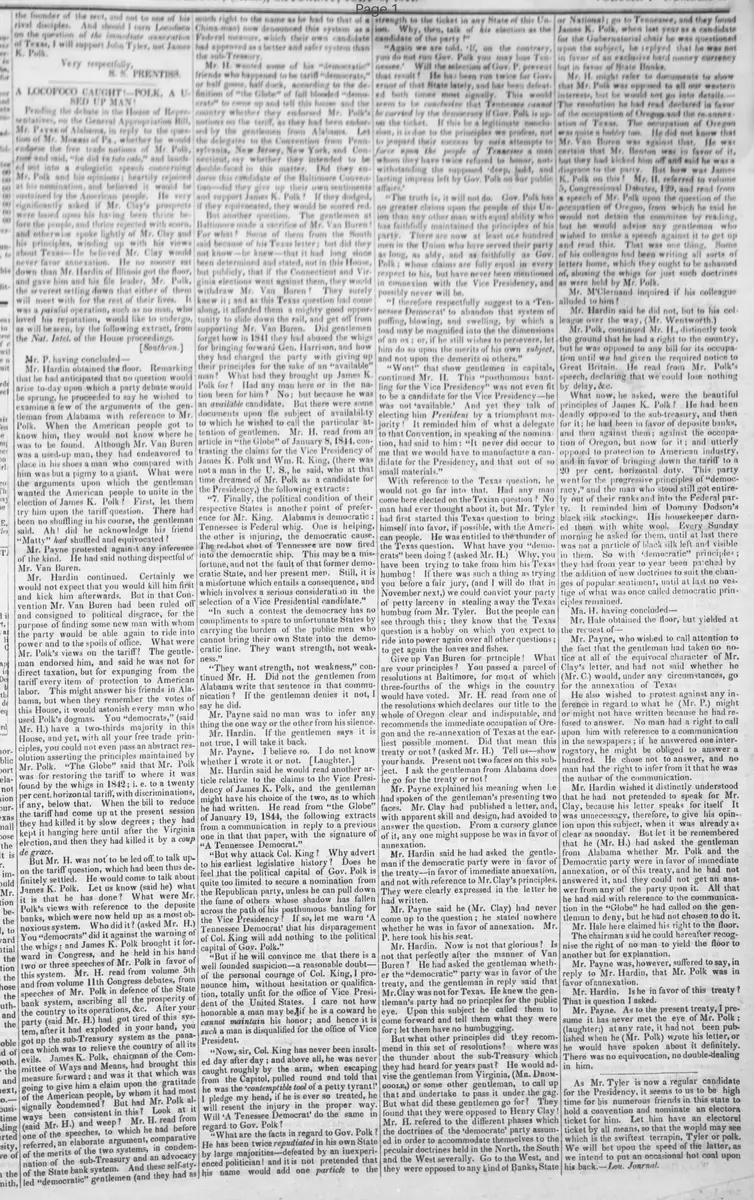
Pending the debate in the House of Representatives, on the General Appropriation Bill, Mr. Payne of Alabama, in reply to the question of Mr. Innes of Pa., whether he would endorse the free trade notions of Mr. Polk, rose and said, 'he did in toto,' and launched out into a eulogistic speech concerning Mr. Polk—and his opinions. He heartily rejoiced at his nomination, and believed it would be sustained by the American people. He very significantly asked if Mr. Clay's prospects were based upon his having been thrice before the people, and thrice rejected with scorn; and otherwise spoke lightly of Mr. Clay and his principles, winding up with his views about Texas. He believed Mr. Clay would never favor annexation. He no sooner sat down than Mr. Hardin of Illinois got the floor, and gave him and his file leader, Mr. Polk, the severest setting down that either of them will meet with for the rest of their lives. It was a painful operation, such as no man, who loved his reputation, would like to undergo, as will be seen, by the following extract, from the Nat. Intel, of the House proceedings.
[Southron.]
Mr. P. having concluded—
Mr. Hardin obtained the floor. Remarking that he had anticipated that no question would arise to-day upon which a party debate would be sprung, he proceeded to say he wished to examine a few of the arguments of the gentleman from Alabama with reference to Mr. Polk. When the American people got to know him, they would not know where he was to be found. Although Mr. Van Buren was a used-up man, they had endeavored to place in his shoes a man who compared with him was but a pigmy to a giant. What were the arguments upon which the gentleman wanted the American people to unite in the election of James K. Polk? First, let them try him upon the tariff question. There had been no shuffling in his course, the gentleman said. Ah! did he acknowledge his friend 'Matty' had shuffled and equivocated?
Mr. Payne protested against any inference of the kind. He had said nothing disrespectful of Mr. Van Buren.
Mr. Hardin continued. Certainly we would not expect that you would kill him first and kick him afterwards. But in that Convention Mr. Van Buren had been ruled off and consigned to political disgrace, for the purpose of finding some new man with whom the party would be able again to ride into power and to the spoils of office. What were Mr. Polk's views on the tariff? The gentleman endorsed him, and said he was not for direct taxation, but for expunging from the tariff every item of protection to American labor. This might answer his friends in Alabama, but when they remember the votes of this House, it would astonish every man who used Polk's dogmas. You 'democrats,' (said Mr. H.) have a two-thirds majority in this House, and yet, with all your free trade principles, you could not even pass an abstract resolution asserting the principles maintained by Mr. Polk. 'The Globe' said that Mr. Polk was for restoring the tariff to where it was found by the whigs in 1842; i. e. to a twenty per cent. horizontal tariff, with discriminations, if any, below that. When the bill to reduce the tariff had come up at the present session they had killed it by slow degrees; they had kept it hanging here until after the Virginia election, and then they had killed it by a coup de grace.
But Mr. H. was not to be led off to talk upon the tariff question, which had been thus definitely settled. He would come to talk about James K. Polk. Let us know (said he) what it is that he has done? What were Mr. Polk's views with reference to the deposit banks, which were now held up as a most obnoxious system. Who did it? (asked Mr. H.) You 'democrats' did it against the warning of the whigs; and James K. Polk brought it forward in Congress, and he held in his hand two or three speeches of Mr. Polk in favor of this system. Mr. H. read from volume 5th Congress debates, from speeches of Mr. Polk in defence of the State bank system, ascribing all the prosperity of the country to its operations, &c. After your party (said Mr. H.) had got tired of this system, after it had exploded in your hand, you got up the sub-Treasury system as the panacea which was to relieve the country of all its evils. James K. Polk, chairman of the Committee of Ways and Means, had brought this measure forward; and was it that which was going to give him a claim upon the gratitude of the American people, by whom it had most signally condemned? But had Mr. Polk always been consistent in this? Look at it (said Mr. H.) and weep? Mr. H. read from one of the speeches, to which he had before referred, an elaborate argument, comparative of the merits of the two systems, in condemnation of the sub-Treasury and an advocacy of the State bank system. And these self-styled 'democratic' gentlemen (and they had as much right to the name as he had to that of a Chinaman) now denounced this system as a Federal measure, which their own candidate had approved as a better and safer system than the sub-Treasury.
Mr. H. wanted some of his 'democratic' friends who happened to be tariff democrats, or half horse, half alligator, according to the definition of 'the Globe' of full blooded 'democrats' to come up and tell this House and the country whether they endorsed Mr. Polk's notions on the tariff, as they had been endorsed by the gentleman from Alabama. Let the delegates to the Convention from Pennsylvania, New Jersey, New York, and Connecticut, say whether they intended to be double-faced in this matter. Did they endorse this candidate of the Baltimore Convention? Did they give up their own sentiments and support James K. Polk! If they dodged, if they equivocated, they would be scored red hot.
But another question. The gentlemen at Baltimore made a sacrifice of Mr. Van Buren! For what! None of them from the South said because of his Texas letter; but did they not know—he knew—that it had long since been determined and stated, not in this House, but publicly, that if the Connecticut and Virginia elections went against them, they would withdraw Mr. Van Buren! They surely knew it: and as this Texas question had come along, it afforded them a mighty good opportunity to slide down the rail, and get off from supporting Mr. Van Buren. Did gentlemen forget how in 1840 they had abused the whigs for bringing forward Gen. Harrison, and how they had charged the party with giving up their principles for the sake of an 'available' man? What had they brought up James K. Polk for? Had any man here or in the nation been for him? No: but because he was an available candidate. But there were some documents upon the subject of availability to which he wished to call the particular attention of gentlemen. Mr. H. read from an article in 'the Globe' of January 8, 1844, contrasting the claims for the Vice Presidency of James K. Polk and Wm. R. King. (there was not a man in the U. S. he said, who at that time dreamed of Mr. Polk as a candidate for the Presidency,) the following extracts:
'7. Finally, the political condition of their respective States is another point of preference for Mr. King. Alabama is democratic; Tennessee is Federal whig. One is helping, the other is injuring, the democratic cause. The red-hot shot of Tennessee are now fired into the democratic ship. This may be a misfortune, and not the fault of that former democratic State, and her present men. Still, it is a misfortune which entails a consequence, and which involves a serious consideration in the selection of a Vice Presidential candidate.'
'In such a contest the democracy has no compliments to spare to unfortunate States by carrying the burden of the public men who cannot bring their own State into the democratic line. They want strength, not weakness.'
'They want strength, not weakness,' continued Mr. H. Did not the gentlemen from Alabama write that sentence in that communication? If the gentleman denies it not, I say he did.
Mr. Payne said no man was to infer anything the one way or the other from his silence.
Mr. Hardin. If the gentlemen says it is not true, I will take it back.
Mr. Payne. I believe so. I do not know whether I wrote it or not. [Laughter.]
Mr. Hardin said he would read another article relative to the claims to the Vice Presidency of James K. Polk, and the gentleman might have his choice of the two, as to which he had written. He read from 'the Globe' of January 19, 1844, the following extracts from a communication in reply to a previous one in that paper, with the signature of 'A Tennessee Democrat.'
'But why attack Col. King? Why advert to his earliest legislative history? Does he feel that the political capital of Gov. Polk is quite too limited to secure a nomination from the Republican party, unless he can pull down the fame of others whose shadow has fallen across the path of his posthumous bantling for the Vice Presidency? If so, let me warn 'A Tennessee Democrat' that his disparagement of Col. King will add nothing to the political capital of Gov. Polk.'
'But if he will convince me that there is a well founded suspicion—a reasonable doubt—of the personal courage of Col. King, I pronounce him, without hesitation or qualification, totally unfit for the office of Vice President of the United States. I care not how honorable a man may be, if he is a coward he cannot maintain his honor; and hence it is such a man is disqualified for the office of Vice President.
'Now, sir, Col. King has never been insulted day after day; and above all, he was never caught roughly by the arm, when escaping from the Capitol, pulled round and told that he was the 'contemptible tool of a petty tyrant!' I pledge my head, if he is ever so treated, he will resent the injury in the proper way. Will 'A Tennessee Democrat' do the same in regard to Gov. Polk?
'What are the facts in regard to Gov. Polk? He has been twice repudiated in his own State by large majorities—defeated by an inexperienced politician! and it is not pretended that his name would add one particle to the strength of the ticket in any State of this Union.
Why, then, talk of his election as the candidate of the party?
'Again we are told, If on the contrary, you do not run Gov. Polk you may lose Tennessee! Will the election of Gov. P. prevent that result? He has been run twice for Governor of that State lately, and has met defeat both times most signally. This would seem to conclude that Tennessee cannot be carried by the democracy if Gov. Polk is on the ticket. If this be a legitimate conclusion, it is due to the principles professed, not to jeopardize their success by attempts to force upon the people of Tennessee a man whom they have twice refused to honor, notwithstanding the deep, bold, and lasting impression left by Gov. Polk on our public affairs.
'The truth is, it will not do. Gov. Polk has no greater claims upon the people of this Union than any other man with equal ability who has faithfully maintained the principles of his party.
There are now at least one hundred men in the Union who have served their party as long, as ably, and as faithfully as Gov. Polk, whose claims are fully equal in every respect to his, but have never been mentioned in connexion with the Vice Presidency, and possibly never will be.
'I therefore respectfully suggest to a 'Tennessee Democrat' to abandon that system of puffing, blowing, and swelling, by which a toad may be magnified into the dimensions of an ox; or, if he still wishes to persevere, let him do so upon the merits of his own subject, and not upon the demerits of others.'
'Won't that show gentlemen in capitals,' continued Mr. H. This 'posthumous bantling for the Vice Presidency' was not even fit to be a candidate for the Vice Presidency—he was not 'available.' And yet they talk of electing him President by a triumphant majority! It reminded him of what a delegate to that Convention, in speaking of the nomination, had said to him: 'It never did occur to me that we would have to manufacture a candidate for the Presidency, and that out of so small materials.'
With reference to the Texas question, he would not go far into that. Had any man come here elected on the Texian question? No man had ever thought about it, but Mr. Tyler had first started this Texas question to bring himself into favor, if possible, with the American people. He was entitled to the thunder of the Texas question. What have you 'democrats' been doing? (asked Mr. H.) 'Why, you have been trying to take from him his Texas humbug! If there was such a thing as trying you before a fair jury, (and I will do that in November next,) we could convict your party of petty larceny in stealing away the Texas humbug from Mr. Tyler. But the people can see through this; they know that the Texas question is a hobby on which you expect to ride into power again over all other questions; to get again the loaves and fishes.
Give up Van Buren for principle! What are your principles? You passed a parcel of resolutions at Baltimore, for most of which three-fourths of the whigs in the country would have voted. Mr. H. read from one of the resolutions which declares our title to the whole of Oregon clear and indisputable, and recommends the immediate occupation of Oregon and the re-annexation of Texas at the earliest possible moment. Did that mean this treaty or not? (asked Mr. H.) Tell us—show your hands. Present not two faces on this subject. I ask the gentleman from Alabama does he go for the treaty or not?
Mr. Payne explained his meaning when he had spoken of the gentleman's presenting two faces. Mr. Clay had published a letter, and, with apparent skill and design, had avoided to answer the question. From a cursory glance of it, any one might suppose he was in favor of annexation.
Mr. Hardin said he had asked the gentleman if the democratic party were in favor of the treaty—in favor of immediate annexation, and not with reference to Mr. Clay's principles. They were clearly expressed in the letter he had written.
Mr. Payne said he (Mr. Clay) had never come up to the question; he stated nowhere whether he was in favor of annexation. Mr. P. here took his seat.
Mr. Hardin. Now is not that glorious? Is not that perfectly after the manner of Van Buren? He had asked the gentleman whether the 'democratic' party was in favor of the treaty, and the gentleman in reply said that Mr. Clay was not for Texas. He knew the gentleman's party had no principles for the public eye. Upon this subject he called them to come forward and tell them what they were for; let them have no humbugging.
But what other principles did they recommend in this set of resolutions? where was the thunder about the sub-Treasury which they had heard for years past? He would advise the gentleman from Virginia, (Mr. Dromgoole,) or some other gentleman, to call up that and undertake to pass it under the gag. But what did these gentlemen go for? They found that they were opposed to Henry Clay! Mr. H. referred to the different phases which the doctrines of the 'democratic' party assumed in order to accommodate themselves to the peculiar doctrines held in the North, the South and the West severally. Go to the West, and they were opposed to any kind of Banks, State or National; go to Tennessee, and they found James K. Polk, when last year as a candidate for the Gubernatorial chair he was questioned upon the subject, he replied that he was not in favor of an exclusive hard money currency but in favor of State Banks.
Mr. H. might refer to documents to show that Mr. Polk was opposed to all our western interests, but he would not go into details. The resolution he had read declared in favor of the occupation of Oregon and the re-annexation of Texas. The occupation of Oregon was quite a hobby too. He did not know that Mr. Van Buren was against that. He was certain that Mr. Benton was in favor of it, but they had kicked him off and said he was a disgrace to the party. But how was James K. Polk on this! Mr. H. referred to volume 9, Congressional Debates, p. 129, and read from a speech of Mr. Polk upon the question of the occupation of Oregon, from which he said he would not detain the committee by reading, but he would advise any gentleman who wished to make a speech against it to get up and read this. That was one thing. Some of his colleagues had been writing all sorts of letters home, which they ought to be ashamed of, abusing the whigs for just such doctrines as were held by Mr. Polk.
Mr. M'Clernand inquired if his colleague alluded to him?
Mr. Hardin said he did not, but to his colleague over the way, (Mr. Wentworth.)
Mr. Polk, continued Mr. H., distinctly took the ground that he had a right to the country but he was opposed to any bill for its occupation until we had given the required notice to Great Britain. He read from Mr. Polk's speech, declaring that we could lose nothing by delay, &c.
What now, he asked, were the beautiful principles of James K. Polk? He had been deadly opposed to the sub-treasury, and then for it; he had been in favor of deposit banks, and then against them; against the occupation of Oregon, but now for it; and utterly opposed to protection to American industry, and in favor of bringing down the tariff to a 20 per cent. horizontal duty. This party went for the progressive principles of 'democracy,' and the man who stood still got entirely out of their ranks and into the Federal party. It reminded him of Dominie Dodson's black silk stockings. His housekeeper darned them with white wool. Every Sunday morning he asked for them, until at last there was not a particle of black silk left and visible in them. So with 'democratic' principles; they had from year to year been patched by the addition of new doctrines to suit the changes of popular sentiment, until at last no vestige of what was once called democratic principles remained.
Mr. H. having concluded—
Mr. Hale obtained the floor, but yielded at the request of—
Mr. Payne, who wished to call attention to the fact that the gentleman had taken no notice at all of the equivocal character of Mr. Clay's letter, and had not said whether he (Mr. C.) would, under any circumstances, go for the annexation of Texas.
He also wished to protest against any inference in regard to what he (Mr. P.) might or might not have written because he had refused to answer. No man had a right to call upon him with reference to a communication in the newspapers; if he answered one interrogatory, he might be obliged to answer a hundred. He chose not to answer, and no man had the right to infer from it that he was the author of the communication.
Mr. Hardin wished it distinctly understood that he had not pretended to speak for Mr. Clay, because his letter speaks for itself. It was unnecessary, therefore, to give his opinion upon this subject, when it was already as clear as noonday. But let it be remembered that he (Mr. H.) had asked the gentleman from Alabama whether Mr. Polk and the Democratic party were in favor of immediate annexation, or of this treaty, and he had not answered it, and they could not get an answer from any of the party upon it. All that he had said with reference to the communication in the 'Globe' he had called on the gentleman to deny, but he had not chosen to do it.
Mr. Hale here claimed his right to the floor.
The chairman said he could hereafter recognise the right of no man to yield the floor to another but for explanation.
Mr. Payne was, however, suffered to say, in reply to Mr. Hardin, that Mr. Polk was in favor of annexation.
Mr. Hardin. Is he in favor of this treaty? That is the question I asked.
Mr. Payne. As to the present treaty, I presume it has never met the eye of Mr. Polk; (laughter;) at any rate, it had not been published when he (Mr. Polk) wrote his letter, or he would have spoken about it definitely. There was no equivocation, no double-dealing in him.
What sub-type of article is it?
What keywords are associated?
What entities or persons were involved?
Where did it happen?
Domestic News Details
Primary Location
U.S. House Of Representatives
Key Persons
Outcome
rep. hardin delivers a severe critique of polk's political inconsistencies; debate continues without resolution on key issues like texas annexation.
Event Details
During debate on the General Appropriation Bill, Rep. Payne endorses Polk's free trade and Texas views. Rep. Hardin responds by attacking Polk's shifting positions on tariff, banks, sub-Treasury, Oregon occupation, and availability as a candidate, citing past speeches and Globe articles to highlight Democratic opportunism.