Thank you for visiting SNEWPapers!
Sign up free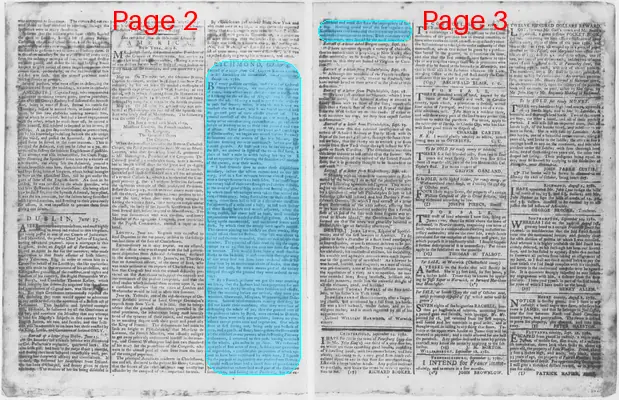
The Virginia Gazette
Richmond, Williamsburg, Richmond County, Virginia
What is this article about?
Extract of a letter from Col. George Rogers Clark to the Governor, dated August 22, 1780, describing a military expedition from Louisville against Shawnee and allied Indian settlements. The force of 1000 crossed the Ohio River on August 1, marched to Chillicothe and Piqua, destroyed crops and buildings, and engaged in a fierce battle on August 8 at Piqua, routing the enemy with minimal losses.
Merged-components note: Continuation of Colonel George Rogers Clarke's military report letter across pages 2 and 3; relabeled to 'story' as it is a full narrative account rather than brief domestic news.
Clippings
1 of 2
OCR Quality
Full Text
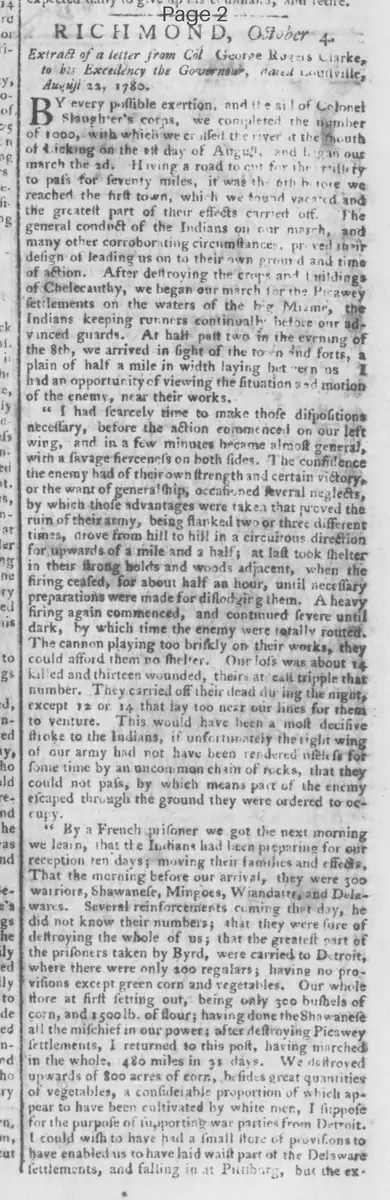
Extract of a letter from Col. George Rogers Clarke, to his Excellency the Governor, dated Louisville, August 22, 1780.
By every possible exertion, and the aid of Colonel Slaughter's corps, we completed the number of 1000, with which we crossed the river at the mouth of Licking on the first day of August, and began our march the 2d. Having a road to cut for the artillery to pass for seventy miles, it was the 6th before we reached the first town, which we found evacuated and the greatest part of their effects carried off. The general conduct of the Indians on our march, and many other corroborating circumstances, proved their design of leading us on to their own ground and time of action. After destroying the crops and buildings of Chillicothe, we began our march for the Piqua settlements on the waters of the big Miami, the Indians keeping runners continually before our advanced guards. At half past two in the evening of the 8th, we arrived in sight of the town and forts, a plain of half a mile in width laying between us. I had an opportunity of viewing the situation and motion of the enemy, near their works.
I had scarcely time to make those dispositions necessary, before the action commenced on our left wing, and in a few minutes became almost general, with a savage fierceness on both sides. The confidence the enemy had of their own strength and certain victory, or the want of generalship, occasioned several neglects, by which those advantages were taken that proved the ruin of their army, being flanked two or three different times, drove from hill to hill in a circuitous direction for upwards of a mile and a half; at last took shelter in their strong holds and woods adjacent, when the firing ceased, for about half an hour, until necessary preparations were made for dislodging them. A heavy firing again commenced, and continued severe until dark, by which time the enemy were totally routed. The cannon playing too briskly on their works, they could afford them no shelter. Our loss was about 14 killed and thirteen wounded, theirs at least triple that number. They carried off their dead during the night, except 12 or 14 that lay too near our lines for them to venture. This would have been a most decisive stroke to the Indians, if unfortunately the right wing of our army had not have been rendered useless for some time by an uncommon chain of rocks, that they could not pass, by which means part of the enemy escaped through the ground they were ordered to occupy.
By a French prisoner we got the next morning we learn, that the Indians had been preparing for our reception ten days; moving their families and effects. That the morning before our arrival, they were 300 warriors, Shawanese, Mingoes, Wyandots, and Delawares. Several reinforcements coming that day, he did not know their numbers; that they were sure of destroying the whole of us; that the greatest part of the prisoners taken by Byrd, were carried to Detroit, where there were only 200 regulars; having no provisions except green corn and vegetables. Our whole store at first setting out, being only 200 bushels of corn, and 1500 lb. of flour; having done the Shawanese all the mischief in our power; after destroying Piqua settlements, I returned to this post, having marched in the whole, 480 miles in 31 days. We destroyed upwards of 800 acres of corn, besides great quantities of vegetables, a considerable proportion of which appear to have been cultivated by white men, I suppose for the purpose of supporting war parties from Detroit. I could wish to have had a small store of provisions to have enabled us to have laid waste part of the Delaware settlements, and falling in at Pittsburgh, but the ex...
Excessive heat and weak diet show the impropriety of such a step. Nothing could excel the few regulars and Kentuckians that composed this little army in bravery and implicit obedience to orders. Each company vying with the other, who shall be the most subordinate.
What sub-type of article is it?
What themes does it cover?
What keywords are associated?
What entities or persons were involved?
Where did it happen?
Story Details
Key Persons
Location
Louisville, Mouth Of Licking, Chillicothe, Piqua Settlements On The Waters Of The Big Miami, Detroit
Event Date
August 1780
Story Details
Col. Clarke's force of 1000 crossed the Ohio on August 1, marched to Chillicothe by August 6, destroyed it, then to Piqua where on August 8 they fought and routed 300+ Indian warriors despite terrain challenges, destroying settlements and crops before returning after 480 miles in 31 days.