Thank you for visiting SNEWPapers!
Sign up free
Literary
April 3, 1911
The Cairo Bulletin
Cairo, Alexander County County, Illinois
What is this article about?
Tona Watson's instructional essay explains how to cultivate the 'soul' of one's voice through anatomical understanding, exercises for respiratory and vocal organs, and achieving ideal tone qualities: metallic, strong, full, firm, and durable. Draws from her experience in 'The Golden Girl.'
Clipping
OCR Quality
95%
Excellent
Full Text
HOW TO FIND THE SOUL OF YOUR VOICE
BY TONA WATSON
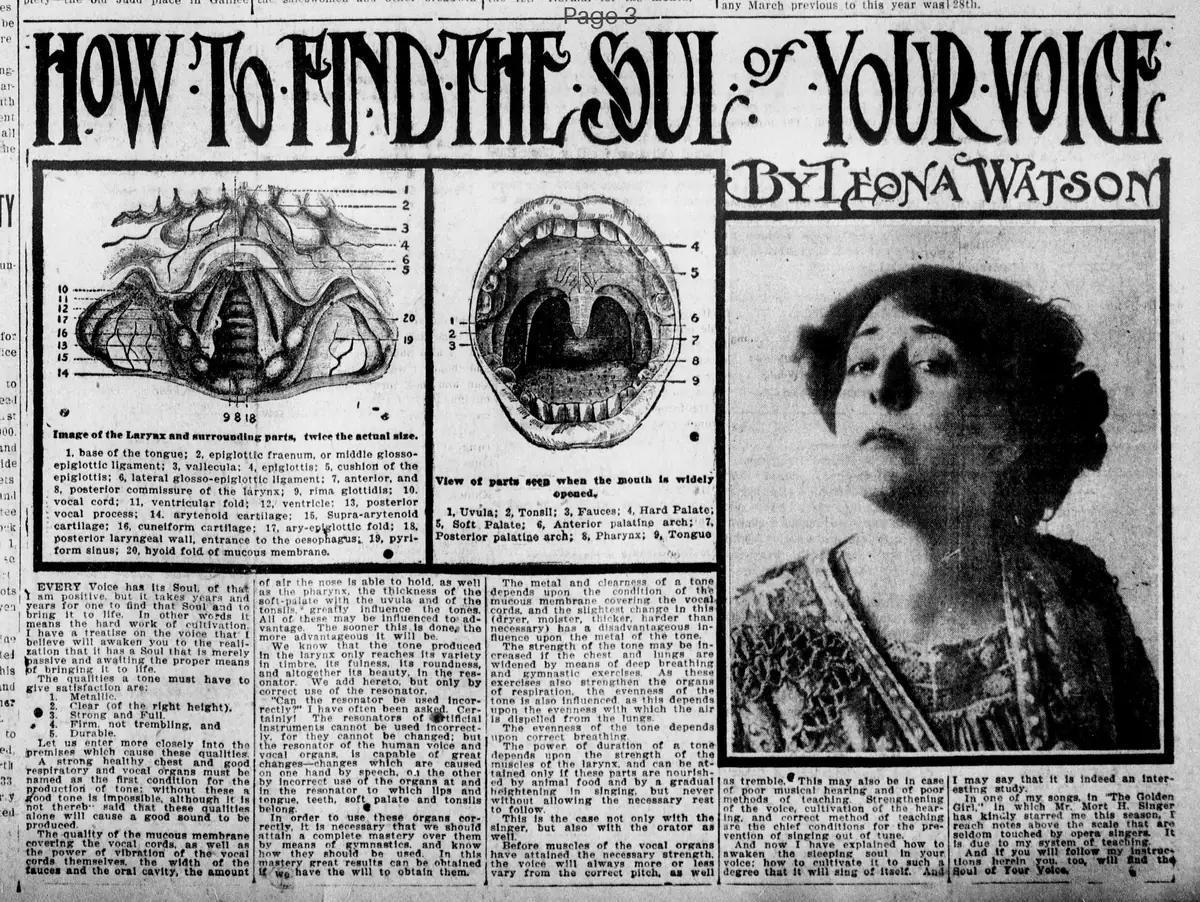
Image of the Larynx and surrounding parts, twice the actual size.
1, base of the tongue; 2, epiglottic fraenum, or middle glosso-epiglottic ligament; 3, vallecula; 4, epiglottis; 5, cushion of the epiglottis; 6, lateral glosso-epiglottic ligament: 7, anterior, and 8. posterior commissure of the larynx; 9, rima glottidis; 10. vocal cord; 11, ventricular fold: 12, ventricle; 13, posterior vocal process; 14. arytenoid cartilage: 15, Supra-arytenoid cartilage; 16, cuneiform cartilage: 17. ary-epiglottic fold; 18, posterior laryngeal wall, entrance to the oesophagus; 19, pyri-form sinus; 20, hyoid fold of mucous membrane.
View of parts seen when the mouth is widely opened.
1, Uvula; 2. Tonsil; 3, Fauces; 4, Hard Palate; 5, Soft Palate: 6, Anterior palatine arch; 7, Posterior palatine arch; 8, Pharynx; 9, Tongue
EVERY Voice has its Soul, of that I am positive, but it takes years and years for one to find that Soul and to bring it to life. In other words it means the hard work of cultivation.
I have a treatise on the voice that I believe will awaken you to the realization that it has a Soul that is merely passive and awaiting the proper means of bringing it to life.
The qualities a tone must have to give satisfaction are:
Metallic.
Strong and Full
Firm, not trembling, and
Durable.
Let us enter more closely into the premises which cause these qualities.
A strong healthy chest and good respiratory and vocal organs must be named as the first condition for the production of tone; without these a good tone is impossible, although it is not thereby said that these qualities alone will cause a good sound to be produced.
The quality of the mucous membrane covering the vocal cords, as well as the power of vibration of the vocal cords themselves, the width of the fauces and the oral cavity, the amount of air the nose is able to hold, as well as the pharynx, the thickness of the soft-palate with the uvula and of the tonsils, greatly influence the tones.
All of these may be influenced to advantage. The sooner this is done the more advantageous it will be.
We know that the tone produced in the larynx only reaches its variety in timbre, its fulness, its roundness, and altogether its beauty, in the resonator. We add hereto, but only by correct use of the resonator.
"Can the resonator be used incorrectly?" I have often been asked. Certainly! The resonators of artificial instruments cannot be used incorrectly, for they cannot be changed; but the resonator of the human voice and vocal organs, is capable of great changes--changes which are caused on one hand by speech, on the other by incorrect use of the organs at and in the resonator to which lips and tongue, teeth, soft palate and tonsils belong.
In order to use these organs correctly, it is necessary that we should attain a complete mastery over them by means of gymnastics, and know how they should be used. In this mastery great results can be obtained if we have the will to obtain them.
The metal and clearness of a tone depends upon the condition of the mucous membrane covering the vocal cords, and the slightest change in this (dryer, moister, thicker, harder than necessary) has a disadvantageous influence upon the metal of the tone.
The strength of the tone may be increased if the chest and lungs are widened by means of deep breathing and gymnastic exercises. As these exercises also strengthen the organs of respiration, the evenness of the tone is also influenced, as this depends upon the evenness with which the air is dispelled from the lungs.
The evenness of the tone depends upon the smoothness.
The power of duration of a tone depends upon the strength of the muscles of the larynx, and can be attained only if these parts are nourished by animal food and by a gradual heightening in singing, but never without allowing the necessary rest to follow.
This is the case not only with the singer, but also with the orator as well.
Before muscles of the vocal organs have attained the necessary strength, the voice will always more or less vary from the correct pitch, as well as tremble. This may also be in case of poor musical hearing and of poor methods of teaching. Strengthening of the voice, cultivation of the hearing, and correct method of teaching are the chief conditions for the prevention of singing out of tune.
And now I have explained how to awaken the sleeping soul in your voice: how to cultivate it to such a degree that it will sing of itself. "And I may say that it is indeed an interesting study.
In one of my songs, in "The Golden Girl," in which Mr. Mort H. Singer has kindly starred me this season, I reach notes above the scale that are seldom touched by opera singers. It is due to my system of teaching.
And if you will follow my Instructions herein you, too, will find the Soul of Your Voice.
BY TONA WATSON
Image of the Larynx and surrounding parts, twice the actual size.
1, base of the tongue; 2, epiglottic fraenum, or middle glosso-epiglottic ligament; 3, vallecula; 4, epiglottis; 5, cushion of the epiglottis; 6, lateral glosso-epiglottic ligament: 7, anterior, and 8. posterior commissure of the larynx; 9, rima glottidis; 10. vocal cord; 11, ventricular fold: 12, ventricle; 13, posterior vocal process; 14. arytenoid cartilage: 15, Supra-arytenoid cartilage; 16, cuneiform cartilage: 17. ary-epiglottic fold; 18, posterior laryngeal wall, entrance to the oesophagus; 19, pyri-form sinus; 20, hyoid fold of mucous membrane.
View of parts seen when the mouth is widely opened.
1, Uvula; 2. Tonsil; 3, Fauces; 4, Hard Palate; 5, Soft Palate: 6, Anterior palatine arch; 7, Posterior palatine arch; 8, Pharynx; 9, Tongue
EVERY Voice has its Soul, of that I am positive, but it takes years and years for one to find that Soul and to bring it to life. In other words it means the hard work of cultivation.
I have a treatise on the voice that I believe will awaken you to the realization that it has a Soul that is merely passive and awaiting the proper means of bringing it to life.
The qualities a tone must have to give satisfaction are:
Metallic.
Strong and Full
Firm, not trembling, and
Durable.
Let us enter more closely into the premises which cause these qualities.
A strong healthy chest and good respiratory and vocal organs must be named as the first condition for the production of tone; without these a good tone is impossible, although it is not thereby said that these qualities alone will cause a good sound to be produced.
The quality of the mucous membrane covering the vocal cords, as well as the power of vibration of the vocal cords themselves, the width of the fauces and the oral cavity, the amount of air the nose is able to hold, as well as the pharynx, the thickness of the soft-palate with the uvula and of the tonsils, greatly influence the tones.
All of these may be influenced to advantage. The sooner this is done the more advantageous it will be.
We know that the tone produced in the larynx only reaches its variety in timbre, its fulness, its roundness, and altogether its beauty, in the resonator. We add hereto, but only by correct use of the resonator.
"Can the resonator be used incorrectly?" I have often been asked. Certainly! The resonators of artificial instruments cannot be used incorrectly, for they cannot be changed; but the resonator of the human voice and vocal organs, is capable of great changes--changes which are caused on one hand by speech, on the other by incorrect use of the organs at and in the resonator to which lips and tongue, teeth, soft palate and tonsils belong.
In order to use these organs correctly, it is necessary that we should attain a complete mastery over them by means of gymnastics, and know how they should be used. In this mastery great results can be obtained if we have the will to obtain them.
The metal and clearness of a tone depends upon the condition of the mucous membrane covering the vocal cords, and the slightest change in this (dryer, moister, thicker, harder than necessary) has a disadvantageous influence upon the metal of the tone.
The strength of the tone may be increased if the chest and lungs are widened by means of deep breathing and gymnastic exercises. As these exercises also strengthen the organs of respiration, the evenness of the tone is also influenced, as this depends upon the evenness with which the air is dispelled from the lungs.
The evenness of the tone depends upon the smoothness.
The power of duration of a tone depends upon the strength of the muscles of the larynx, and can be attained only if these parts are nourished by animal food and by a gradual heightening in singing, but never without allowing the necessary rest to follow.
This is the case not only with the singer, but also with the orator as well.
Before muscles of the vocal organs have attained the necessary strength, the voice will always more or less vary from the correct pitch, as well as tremble. This may also be in case of poor musical hearing and of poor methods of teaching. Strengthening of the voice, cultivation of the hearing, and correct method of teaching are the chief conditions for the prevention of singing out of tune.
And now I have explained how to awaken the sleeping soul in your voice: how to cultivate it to such a degree that it will sing of itself. "And I may say that it is indeed an interesting study.
In one of my songs, in "The Golden Girl," in which Mr. Mort H. Singer has kindly starred me this season, I reach notes above the scale that are seldom touched by opera singers. It is due to my system of teaching.
And if you will follow my Instructions herein you, too, will find the Soul of Your Voice.
What sub-type of article is it?
Essay
What keywords are associated?
Voice Soul
Tone Qualities
Vocal Cultivation
Larynx Anatomy
Resonator Use
Singing Training
What entities or persons were involved?
By Tona Watson
Literary Details
Title
How To Find The Soul Of Your Voice
Author
By Tona Watson
Subject
Treatise On The Voice
Key Lines
Every Voice Has Its Soul, Of That I Am Positive, But It Takes Years And Years For One To Find That Soul And To Bring It To Life. In Other Words It Means The Hard Work Of Cultivation.
The Qualities A Tone Must Have To Give Satisfaction Are: Metallic. Strong And Full Firm, Not Trembling, And Durable.
And Now I Have Explained How To Awaken The Sleeping Soul In Your Voice: How To Cultivate It To Such A Degree That It Will Sing Of Itself.