Thank you for visiting SNEWPapers!
Sign up free
Alexandria Gazette & Daily Advertiser
Alexandria, Virginia
What is this article about?
On July 24, 1820, in Madrid, the King of Spain opened the Cortes session by taking the oath to the 1812 Constitution, delivering a speech on national recovery, justice, economy, military, colonies, and foreign relations, and receiving thanks from President Don John Espiga. The event featured royal procession and public acclamations, concluding with a committee to address the speech.
Clipping
OCR Quality
Full Text
July 24, 1820.
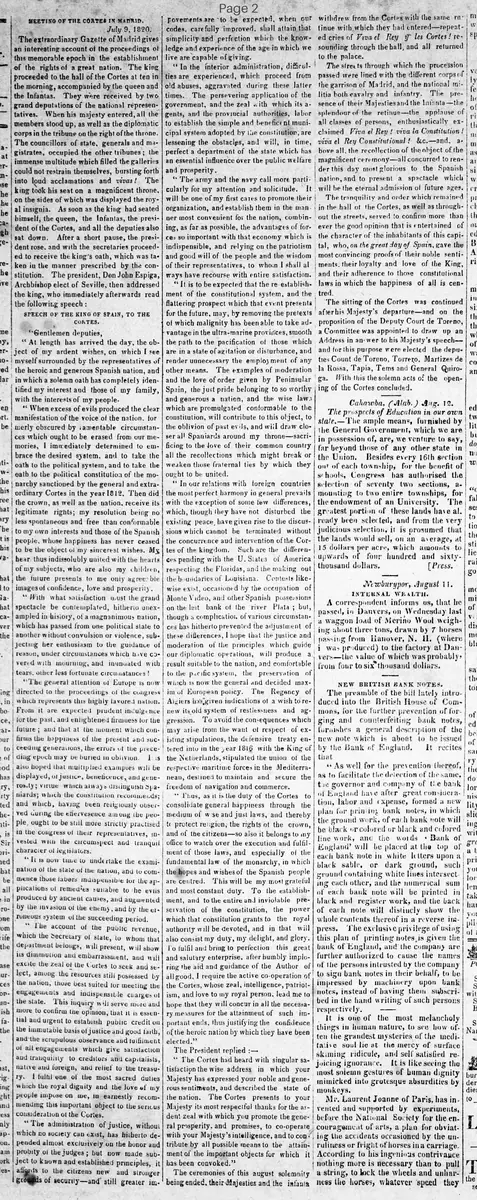
The extraordinary Gazette of Madrid gives an interesting account of the proceedings of this memorable epoch in the establishment of the rights of a great nation. The king proceeded to the hall of the Cortes at ten in the morning, accompanied by the queen and the Infantas. They were received by two grand deputations of the national representatives. When his majesty entered, all the members stood up, as well as the diplomatic corps in the tribune on the right of the throne. The councillors of state, generals and magistrates, occupied the other tribunes; the immense multitude which filled the galleries could not restrain themselves, bursting forth into loud acclamations and vivas! The king took his seat on a magnificent throne, on the sides of which was displayed the royal insignia. As soon as the king had seated himself, the queen, the Infantas, the president of the Cortes, and all the deputies also sat down. After a short pause, the president rose, and with the secretaries proceeded to receive the king's oath, which was taken in the manner prescribed by the constitution. The president, Don John Espiga, Archbishop elect of Seville, then addressed the king, who immediately afterwards read the following speech:
SPEECH OF THE KING OF SPAIN, TO THE CORTES.
"Gentlemen deputies.
"At length has arrived the day, the object of my ardent wishes, on which I see myself surrounded by the representatives of the heroic and generous Spanish nation, and in which a solemn oath has completely identified my interest and those of my family, with the interests of my people.
"When excess of evils produced the clear manifestation of the voice of the nation, formerly obscured by lamentable circumstances which ought to be erased from our memories, I immediately determined to embrace the desired system, and to take the oath to the political system, and to take the oath to the political constitution of the monarchy sanctioned by the general and extraordinary Cortes in the year 1812. Then did the crown, as well as the nation, receive its legitimate rights; my resolution being no less spontaneous and free than conformable to my own interests and those of the Spanish people, whose happiness has never ceased to be the object of my sincerest wishes. My heart thus indissolubly united with the hearts of my subjects, who are also my children, the future presents to me only agreeable images of confidence, love and prosperity.
"With what satisfaction must the grand spectacle be contemplated, hitherto unexampled in history, of a magnanimous nation, which has passed from one political state to another without convulsion or violence, subjecting her enthusiasm to the guidance of reason, under circumstances which have covered with mourning, and inundated with tears, other less fortunate circumstances!
"The general attention of Europe is now directed to the proceedings of the congress which represents this highly favored nation. From it are expected prudent indulgence for the past, and enlightened firmness for the future; and that at the moment which confirms the happiness of the present and succeeding generations, the errors of the preceding epoch may be buried in oblivion. It is also hoped that multiplied examples will be displayed, of justice, beneficence, and generosity; virtues which always distinguish Spaniards; which the constitution recommends; and which, having been religiously observed during the effervescence among the people, ought to be still more strictly practised in the congress of their representatives, invested with the circumspect and tranquil character of legislators.
"It is now time to undertake the examination of the state of the nation, and to commence those labors indispensable for the application of remedies suitable to the evils produced by ancient causes, and augmented by the invasion of the enemy, and by the erroneous system of the succeeding period.
"The account of the public revenue, which the Secretary of state, to whom that department belongs, will present, will show its diminution and embarrassment, and will excite the zeal of the Cortes to seek and select, among the resources still possessed by the nation, those best suited for meeting the engagements and indispensable charges of the state. This inquiry will serve more and more to confirm the opinion, that it is essential and urgent to establish public credit on the immutable basis of justice and good faith, and the scrupulous observance and fulfilment of all engagements which give satisfaction and tranquillity to creditors and capitalists, native and foreign, and relief to the treasury. I fulfil one of the most sacred duties which the royal dignity and the love of my people impose on me, in earnestly recommending this important object to the serious consideration of the Cortes.
"The administration of justice, without which no society can exist, has hitherto depended almost exclusively on the honor and probity of the judges; but now made subject to known and established principles, it affords to the citizens new and stronger grounds of security—and still greater improvements are to be expected, when our codes, carefully improved, shall attain that simplicity and perfection which the knowledge and experience of the age in which we live are capable of giving.
"In the interior administration, difficulties are experienced, which proceed from old abuses, aggravated during these latter times. The persevering application of the government, and the zeal with which its agents, and the provincial authorities, labor to establish the simple and beneficent municipal system adopted by the constitution, are lessening the obstacles, and will, in time, perfect a department of the state which has an essential influence over the public welfare and prosperity.
"The army and the navy call more particularly for my attention and solicitude. It will be one of my first cares to promote their organization, and establish them in the manner most convenient for the nation, combining, as far as possible, the advantages of forces so important with that economy which is indispensable, and relying on the patriotism and good will of the people and the wisdom of their representatives, to whom I shall always have recourse with entire satisfaction.
"It is to be expected that the re-establishment of the constitutional system, and the flattering prospect which that event presents for the future, may, by removing the pretexts of which malignity has been able to take advantage in the ultra-marine provinces, smooth the path to the pacification of those which are in a state of agitation or disturbance, and render unnecessary the employment of any other means. The examples of moderation and the love of order given by Peninsular Spain, the just pride belonging to so worthy and generous a nation, and the wise laws which are promulgated conformable to the constitution, will contribute to this object, to the oblivion of past evils, and will draw closer all Spaniards around my throne—sacrificing to the love of their common country all the recollections which might break or weaken those fraternal ties by which they ought to be united.
"In our relations with foreign countries the most perfect harmony in general prevails with the exception of some few differences, which, though they have not disturbed the existing peace have given rise to the discussions which cannot be terminated without the concurrence and intervention of the Cortes of the kingdom. Such are the differences pending with the United States of America respecting the Floridas, and the making out the boundaries of Louisiana. Contests likewise exist, occasioned by the occupation of Monte Video, and other Spanish possessions on the left bank of the river Plata; but, though a complication of various circumstances has hitherto prevented the adjustment of these differences, I hope that the justice and moderation of the principles which guide our diplomatic operations, will produce a result suitable to the nation, and comfortable to the pacific system, the preservation of which is now the general and decided maxim of European policy. The Regency of Algiers has given indications of a wish to renew its old system of restlessness and aggression. To avoid the consequences which may arise from the want of respect of existing stipulations, the defensive treaty entered into in the year 1816 with the King of the Netherlands, stipulated the union of the respective maritime forces in the Mediterranean, destined to maintain and secure the freedom of navigation and commerce.
"Thus, as it is the duty of the Cortes to consolidate general happiness through the medium of wise and just laws, and thereby to protect religion, the rights of the crown, and of the citizens—so also it belongs to my office to watch over the execution and fulfilment of those laws, and especially of the fundamental law of the monarchy, in which the hopes and wishes of the Spanish people are centred. This will be my most grateful and most constant duty. To the establishment, and to the entire and inviolable preservation of the constitution, the power which that constitution grants to the royal authority will be devoted, and in that will also consist my duty, my delight, and glory. To fulfil and bring to perfection this great and salutary enterprise, after humbly imploring the aid and guidance of the Author of all good, I require the active co-operation of the Cortes, whose zeal, intelligence, patriotism, and love to my royal person, lead me to hope that they will concur in all the necessary measures for the attainment of such important ends, thus justifying the confidence of the heroic nation by which they have been elected."
The President replied:
"The Cortes had heard with singular satisfaction the wise address in which your Majesty has expressed your noble and generous sentiments, and described the state of the nation. The Cortes presents to your Majesty its most respectful thanks for the ardent zeal with which you promote the general prosperity, and promises, to co-operate with your Majesty's intelligence, and to contribute by all possible means to the attainment of the important objects for which it has been convoked."
The ceremonies of this august solemnity being ended, their Majesties and the infanta withdrew from the Cortes with the same retinue with which they had entered—repeated cries of "Viva el Rey y las Cortes!" resounding through the hall, and all returned to the palace.
The streets through which the procession passed were lined with the different corps of the garrison of Madrid, and the national militia both cavalry and infantry. The presence of their Majesties and the Infanta—the splendour of the retinue—the applause of all classes of persons, enthusiastically exclaimed "Viva el Rey! viva la Constitution! viva el Rey Constitutional!" &c.—and, above all, the recollection of the object of the magnificent ceremony—all concurred to render this day most glorious to the Spanish nation, and to present a spectacle which will be the eternal admiration of future ages.
The tranquility and order which remained in the hall of the Cortes, as well as throughout the streets, served to confirm more than ever the good opinion that is entertained of the character of the inhabitants of this capital, who, on the great day of Spain, gave the most convincing proofs of their noble sentiments, their loyalty and love of the King, and their adherence to those constitutional laws in which the happiness of all is centred.
The sitting of the Cortes was continued after his Majesty's departure—and on the proposition of the Deputy Count de Toreno, a Committee was appointed to draw up an Address in answer to his Majesty's speech—and for this purpose were elected the deputies Count de Toreno, Tornero, Martinez de la Rosa, Tapia, Teran and General Quiroga. With this the solemn acts of the opening of the Cortes concluded.
What sub-type of article is it?
What keywords are associated?
What entities or persons were involved?
Where did it happen?
Foreign News Details
Primary Location
Madrid
Event Date
July 24, 1820
Key Persons
Outcome
king took oath to 1812 constitution; cortes to examine national state, revenue, justice, administration, military, colonies, and foreign relations; committee appointed to address king's speech; event marked by public order and acclamations.
Event Details
The King of Spain, accompanied by the Queen and Infantas, opened the Cortes in Madrid with a ceremonial procession and public acclaim. He took the constitutional oath administered by President Don John Espiga, then delivered a speech pledging adherence to the 1812 Constitution, outlining national recovery from past evils, economic challenges, justice reforms, administrative improvements, military organization, colonial pacification, and diplomatic harmony with mentions of disputes over Floridas, Louisiana, Monte Video, Plata, and Algiers. The President responded with thanks and cooperation pledge. After withdrawal, a committee was formed to reply to the speech.