Thank you for visiting SNEWPapers!
Sign up free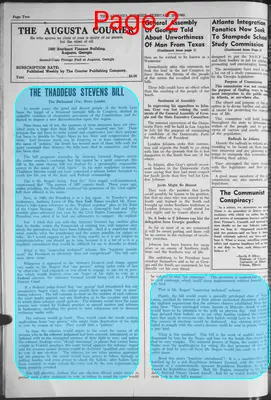
Editorial
February 29, 1960
The Augusta Courier
Augusta, Richmond County, Georgia
What is this article about?
The Richmond News Leader editorial vehemently opposes Attorney General Rogers' 1960 civil rights bill, which proposes federal voting referees to enroll Negro voters in the South, bypassing state laws. It criticizes the bill as unconstitutional overreach, comparing it to Thaddeus Stevens' Reconstruction, and faults President Eisenhower for ignorance.
Clipping
OCR Quality
98%
Excellent
Full Text
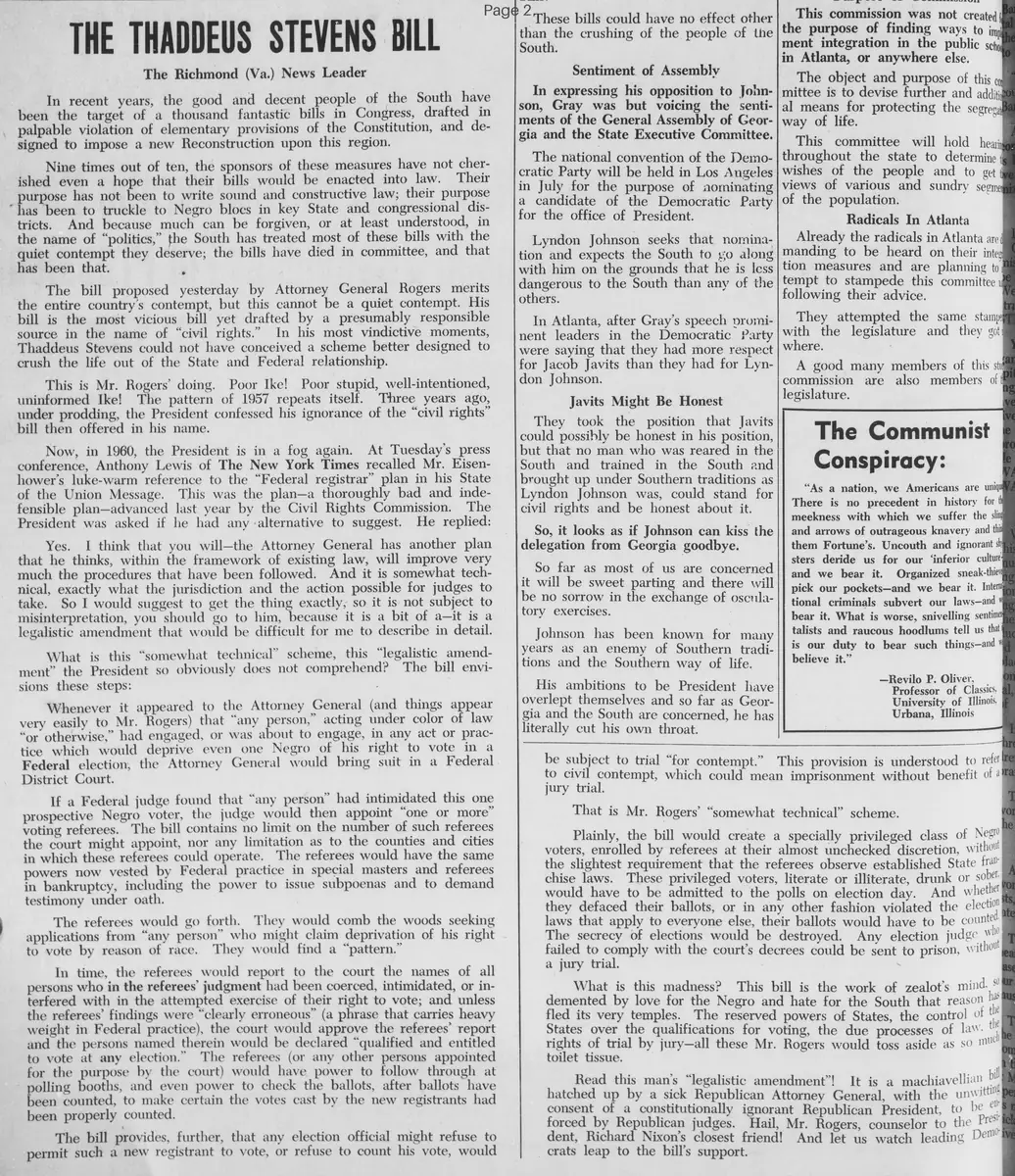
THE THADDEUS STEVENS BILL
The Richmond (Va.) News Leader
In recent years, the good and decent people of the South have been the target of a thousand fantastic bills in Congress, drafted in palpable violation of elementary provisions of the Constitution, and designed to impose a new Reconstruction upon this region.
Nine times out of ten, the sponsors of these measures have not cherished even a hope that their bills would be enacted into law. Their purpose has not been to write sound and constructive law; their purpose has been to truckle to Negro blocs in key State and congressional districts. And because much can be forgiven, or at least understood, in the name of "politics," the South has treated most of these bills with the quiet contempt they deserve; the bills have died in committee, and that has been that.
The bill proposed yesterday by Attorney General Rogers merits the entire country's contempt, but this cannot be a quiet contempt. His bill is the most vicious bill yet drafted by a presumably responsible source in the name of "civil rights." In his most vindictive moments, Thaddeus Stevens could not have conceived a scheme better designed to crush the life out of the State and Federal relationship.
This is Mr. Rogers' doing. Poor Ike! Poor stupid, well-intentioned, uninformed Ike! The pattern of 1957 repeats itself. Three years ago, under prodding, the President confessed his ignorance of the "civil rights" bill then offered in his name.
Now, in 1960, the President is in a fog again. At Tuesday's press conference, Anthony Lewis of The New York Times recalled Mr. Eisenhower's luke-warm reference to the "Federal registrar" plan in his State of the Union Message. This was the plan—a thoroughly bad and indefensible plan—advanced last year by the Civil Rights Commission. The President was asked if he had any alternative to suggest. He replied:
Yes. I think that you will—the Attorney General has another plan that he thinks, within the framework of existing law, will improve very much the procedures that have been followed. And it is somewhat technical, exactly what the jurisdiction and the action possible for judges to take. So I would suggest to get the thing exactly; so it is not subject to misinterpretation, you should go to him, because it is a bit of a—it is a legalistic amendment that would be difficult for me to describe in detail.
What is this "somewhat technical" scheme, this "legalistic amendment" the President so obviously does not comprehend? The bill envisions these steps:
Whenever it appeared to the Attorney General (and things appear very easily to Mr. Rogers) that "any person," acting under color of law "or otherwise," had engaged, or was about to engage, in any act or practice which would deprive even one Negro of his right to vote in a Federal election, the Attorney General would bring suit in a Federal District Court.
If a Federal judge found that "any person" had intimidated this one prospective Negro voter, the judge would then appoint "one or more voting referees." The bill contains no limit on the number of such referees the court might appoint, nor any limitation as to the counties and cities in which these referees could operate. The referees would have the same powers now vested by Federal practice in special masters and referees in bankruptcy, including the power to issue subpoenas and to demand testimony under oath.
The referees would go forth. They would comb the woods seeking applications from "any person" who might claim deprivation of his right to vote by reason of race. They would find a "pattern."
In time, the referees would report to the court the names of all persons who in the referees' judgment had been coerced, intimidated, or interfered with in the attempted exercise of their right to vote; and unless the referees' findings were "clearly erroneous" (a phrase that carries heavy weight in Federal practice), the court would approve the referees' report and the persons named therein would be declared "qualified and entitled to vote at any election." The referees (or any other persons appointed for the purpose by the court) would have power to follow through at polling booths, and even power to check the ballots, after ballots have been counted, to make certain the votes cast by the new registrants had been properly counted.
The bill provides, further, that any election official who might refuse to permit such a new registrant to vote, or refuse to count his vote, would be subject to trial "for contempt."
This provision is understood to refer to civil contempt, which could mean imprisonment without benefit of a jury trial.
That is Mr. Rogers' "somewhat technical" scheme.
Plainly, the bill would create a specially privileged class of Negro voters, enrolled by referees at their almost unchecked discretion, without the slightest requirement that the referees observe established State franchise laws. These privileged voters, literate or illiterate, drunk or sober, would have to be admitted to the polls on election day.
And whether they defaced their ballots, or in any other fashion violated the election laws that apply to everyone else, their ballots would have to be counted.
The secrecy of elections would be destroyed. Any election judge who failed to comply with the court's decrees could be sent to prison, without a jury trial.
What is this madness? This bill is the work of a zealot's mind, soured and demented by love for the Negro and hate for the South that reason has fled its very temples. The reserved powers of States, the control of the States over the qualifications for voting, the due processes of law, the rights of trial by jury—all these Mr. Rogers would toss aside as so much toilet tissue.
Read this man's "legalistic amendment"! It is a Machiavellian bill hatched up by a sick Republican Attorney General, with the unwitting consent of a constitutionally ignorant Republican President, to be enforced by Republican judges.
Hail, Mr. Rogers, counselor to the President, Richard Nixon's closest friend! And let us watch leading Democrats leap to the bill's support.
The Richmond (Va.) News Leader
In recent years, the good and decent people of the South have been the target of a thousand fantastic bills in Congress, drafted in palpable violation of elementary provisions of the Constitution, and designed to impose a new Reconstruction upon this region.
Nine times out of ten, the sponsors of these measures have not cherished even a hope that their bills would be enacted into law. Their purpose has not been to write sound and constructive law; their purpose has been to truckle to Negro blocs in key State and congressional districts. And because much can be forgiven, or at least understood, in the name of "politics," the South has treated most of these bills with the quiet contempt they deserve; the bills have died in committee, and that has been that.
The bill proposed yesterday by Attorney General Rogers merits the entire country's contempt, but this cannot be a quiet contempt. His bill is the most vicious bill yet drafted by a presumably responsible source in the name of "civil rights." In his most vindictive moments, Thaddeus Stevens could not have conceived a scheme better designed to crush the life out of the State and Federal relationship.
This is Mr. Rogers' doing. Poor Ike! Poor stupid, well-intentioned, uninformed Ike! The pattern of 1957 repeats itself. Three years ago, under prodding, the President confessed his ignorance of the "civil rights" bill then offered in his name.
Now, in 1960, the President is in a fog again. At Tuesday's press conference, Anthony Lewis of The New York Times recalled Mr. Eisenhower's luke-warm reference to the "Federal registrar" plan in his State of the Union Message. This was the plan—a thoroughly bad and indefensible plan—advanced last year by the Civil Rights Commission. The President was asked if he had any alternative to suggest. He replied:
Yes. I think that you will—the Attorney General has another plan that he thinks, within the framework of existing law, will improve very much the procedures that have been followed. And it is somewhat technical, exactly what the jurisdiction and the action possible for judges to take. So I would suggest to get the thing exactly; so it is not subject to misinterpretation, you should go to him, because it is a bit of a—it is a legalistic amendment that would be difficult for me to describe in detail.
What is this "somewhat technical" scheme, this "legalistic amendment" the President so obviously does not comprehend? The bill envisions these steps:
Whenever it appeared to the Attorney General (and things appear very easily to Mr. Rogers) that "any person," acting under color of law "or otherwise," had engaged, or was about to engage, in any act or practice which would deprive even one Negro of his right to vote in a Federal election, the Attorney General would bring suit in a Federal District Court.
If a Federal judge found that "any person" had intimidated this one prospective Negro voter, the judge would then appoint "one or more voting referees." The bill contains no limit on the number of such referees the court might appoint, nor any limitation as to the counties and cities in which these referees could operate. The referees would have the same powers now vested by Federal practice in special masters and referees in bankruptcy, including the power to issue subpoenas and to demand testimony under oath.
The referees would go forth. They would comb the woods seeking applications from "any person" who might claim deprivation of his right to vote by reason of race. They would find a "pattern."
In time, the referees would report to the court the names of all persons who in the referees' judgment had been coerced, intimidated, or interfered with in the attempted exercise of their right to vote; and unless the referees' findings were "clearly erroneous" (a phrase that carries heavy weight in Federal practice), the court would approve the referees' report and the persons named therein would be declared "qualified and entitled to vote at any election." The referees (or any other persons appointed for the purpose by the court) would have power to follow through at polling booths, and even power to check the ballots, after ballots have been counted, to make certain the votes cast by the new registrants had been properly counted.
The bill provides, further, that any election official who might refuse to permit such a new registrant to vote, or refuse to count his vote, would be subject to trial "for contempt."
This provision is understood to refer to civil contempt, which could mean imprisonment without benefit of a jury trial.
That is Mr. Rogers' "somewhat technical" scheme.
Plainly, the bill would create a specially privileged class of Negro voters, enrolled by referees at their almost unchecked discretion, without the slightest requirement that the referees observe established State franchise laws. These privileged voters, literate or illiterate, drunk or sober, would have to be admitted to the polls on election day.
And whether they defaced their ballots, or in any other fashion violated the election laws that apply to everyone else, their ballots would have to be counted.
The secrecy of elections would be destroyed. Any election judge who failed to comply with the court's decrees could be sent to prison, without a jury trial.
What is this madness? This bill is the work of a zealot's mind, soured and demented by love for the Negro and hate for the South that reason has fled its very temples. The reserved powers of States, the control of the States over the qualifications for voting, the due processes of law, the rights of trial by jury—all these Mr. Rogers would toss aside as so much toilet tissue.
Read this man's "legalistic amendment"! It is a Machiavellian bill hatched up by a sick Republican Attorney General, with the unwitting consent of a constitutionally ignorant Republican President, to be enforced by Republican judges.
Hail, Mr. Rogers, counselor to the President, Richard Nixon's closest friend! And let us watch leading Democrats leap to the bill's support.
What sub-type of article is it?
Constitutional
Suffrage
Partisan Politics
What keywords are associated?
Civil Rights Bill
Voting Referees
Southern Opposition
Federal Overreach
State Rights
Election Integrity
What entities or persons were involved?
Attorney General Rogers
President Eisenhower
Thaddeus Stevens
Anthony Lewis
Civil Rights Commission
Richard Nixon
Editorial Details
Primary Topic
Opposition To Attorney General Rogers' Civil Rights Voting Bill
Stance / Tone
Strongly Contemptuous And Opposed
Key Figures
Attorney General Rogers
President Eisenhower
Thaddeus Stevens
Anthony Lewis
Civil Rights Commission
Richard Nixon
Key Arguments
Bill Violates Constitution By Imposing Federal Control Over State Voting
Creates Privileged Class Of Negro Voters Bypassing State Laws
Destroys Election Secrecy And Due Process
Allows Imprisonment Without Jury Trial For Non Compliance
Driven By Political Pandering To Negro Blocs
President Eisenhower Ignorant Of The Bill's Details