Thank you for visiting SNEWPapers!
Sign up free
Berkeley And Jefferson Intelligencer
Martinsburg, Berkeley County, Virginia
What is this article about?
A Federalist essay in the New-York Evening-Post urges patience regarding the Louisiana Purchase treaty, advising against premature criticism by Federalists and suggesting waiting for Congress's review to assess its merits, while addressing objections on price, honor, and territorial grants.
Merged-components note: This is a single letter to the editor continued across pages; the second part was incorrectly labeled as editorial and is now merged and relabeled to letter_to_editor.
Clippings
1 of 2
OCR Quality
Full Text
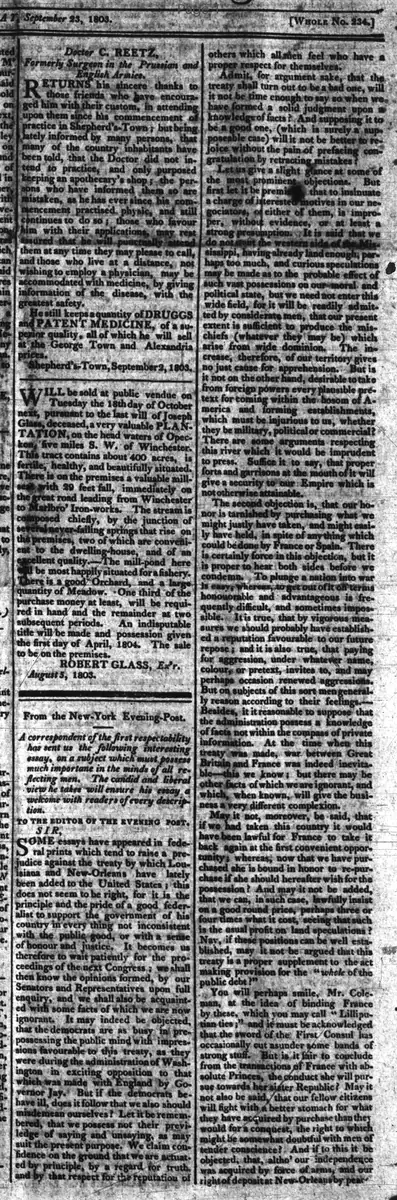
A correspondent of the first respectability has sent us the following interesting essay, on a subject which must possess much importance in the minds of all reflecting men. The candid and liberal view he takes will ensure his essay a welcome with readers of every description
TO THE EDITOR OF THE EVENING POST
SIR,
Some essays have appeared in federal prints which tend to raise a prejudice against the treaty by which Louisiana and New Orleans have lately been added to the United States: this does not seem to be right for it is the principle and the pride of a good federalist to support the government of his country in every thing not inconsistent with the public good, or with a sense of honour and justice. It becomes us therefore to wait patiently for the proceedings of the next Congress.; we shall then know the opinions formed, by our Senators and Representatives upon full enquiry and we shall also be acquainted with some facts of which we are now ignorant. It may indeed be objected, that the democrats are as busy in prepossessing the public mind with impressions favourable to this treaty, as they were during the administration of Washington in exciting opposition to that which was made with England by Governor Jay. But if the democrats behave ill, does it follow that we also should misdemean ourselves? Let it be remembered that we possess not their privilege of saying and unsaying, as may suit the present purpose. We claim confidence on the ground that we are actuated by principle, by a regard for truth. and by that respect for the reputation of others which all men feel who have proper respect for themselves.
Admit, for argument sake that the treaty shall turn out to be a bad one will it not be time enough to say so when we have formed a solid judgement upon knowledge of facts? And supposing it to be a good one, (which is surely a supposable case) will it not be better to rejoice without the pain of prefacing congratulation by retracting mistakes?
Let us give a slight glance at some of the most prominent objections. But first let it be premised that to insinuate a charge of interested motives in our negotiators, of either of them, in improper, without evidence, or at least a strong presumption. It is said that we do not want the western side of the Mississippi, having already land enough, perhaps too much, and curious speculations may be made as to the probable effect of such vast possessions on our moral. and political state, but we need not enter this wide field, for it will be readily admitted by considerate men, that our present extent is sufficient to produce the mischiefs (whatever they may be) which arise from wide dominion. The increase therefore, of our territory gives no just cause for apprehension. But is it not on the other hand, desirable to take from foreign powers every plausible pretext for coming within the bosom of America—and forming establishments which must be injurious to us, whether they be military, political or commercial?
There are some arguments respecting this river which it would be imprudent to press. Suffice it to say, that proper forts and garrisons at the mouth of it will give a security to our Empire which is not otherwise attainable.
The second objection is, that our honour is tarnished by purchasing what we might justly have taken, and might easily have held, in spite of any thing which could be done by France or Spain. There is certainly force in this objection, but it is proper to hear both sides before we condemn. To plunge a nation into war is easy everywhere as, to get out of it on terms honourable and advantageous - is frequently difficult, and sometimes impossible. It is true that by vigorous measures we should probably have established a reputation favourable to our future repose; and it is also true, that paying for aggression, under whatever name, colour or pretext, invites to, and may perhaps occasion renewed aggressions.
But on subjects of this sort men generally reason according to their feelings. Besides, is it reasonable to suppose that the administration possess a knowledge of facts not within the compass of private information. At. the time when this treaty was made, war between Great Britain and France was indeed inevitable this we know; but there may be other facts of which we are ignorant and which, when known, will give the business a very different complexion.
May it not, moreover, be said, that if we had taken this country it would have been lawful for France to take it back again at the first convenient opportunity; whereas; now that we have purchased she is bound in honor to re-purchase if she should hereafter wish for the possession? And may it not be added. that we can, in such case, lawfully insist on a good round price perhaps three or four times what it cost, seeing that such is the usual profit on land speculations Nav, if these positions can be well established, may it not be argued that this treaty is a proper supplement to the act making provision for the "whole of the public debt?"
You will perhaps smile, Mr. Coleman, at the idea of binding France by these, which you may call "Lilliputian ties," and it must be acknowledged that the sword of the First Consul has occasionally cut asunder some bands of strong stuff. But is it fair to conclude from the transactions of France with absolute Princes, the conduct she will pursue towards her sister Republic? May it not also be said that our fellow citizens will fight with a better stomach for what they have acquired by purchase than they would for a conquest, the right to which might be somewhat doubtful with men of tender conscience? And if to this it be objected, that, altho' our independence was acquired by force of arms, and our right of deposit at New-Orleans by peace
full treaty yet an administration which would not have borne the slightest question on as to our independence, (unless perhaps from some sister republic) felt most pacifically inclined when the right of deposit was infringed; let it be remembered, that men have different ways of viewing and estimating the same things. Hence it has long been a proverb, De Gustibus non est disputandum: in other words— Every man has his own way of riding his own hobby.
One clause has been somewhere mentioned, which will not, on examination, be found in the treaty. It is a stipulation as to what shall be done with the country hereafter. A stipulation of this sort would furnish to France a pretext, and perhaps a right, to meddle in our domestic concerns; it is therefore to be presumed, both from the talents and the patriotism of our ministers, that nothing of the sort exists. But if, unfortunately, such a clause should have slipt in, the wisdom of our Government will unquestionably strike it out, and the First Consul will hardly insist on prescribing to us the manner in which we shall dispose of settle, and govern our own territory.
The great objection remains to be considered. It is said we have paid too much for this country—that France, in the conviction she could neither take nor hold possession, has ordered the troops destined for that quarter to be disembarked before the treaty was made—that she would rather have given it to America than have suffered it to be taken, as it must have been, by England—that the French government after having rejected haughtily every overture of Mr. Livingston, came all at once round, and made him the tender of Louisiana as soon as the King of England's Message to his Parliament reached Paris and that after all, Mr. Livingston had no power to strike a bargain, by reason whereof it was deferred till Mr. Monroe's arrival, so that this happy statesman might say with Cæsar veni vidi vici. All this and much more is said, but is all this true? and if true is it the whole truth?
Prudence requires that we suspend our belief till after the meeting of Congress. The Treaty will then be laid before the Senate, and with it the instructions to our ministers, their correspondence, &c. &c. such being the usage. It will then most probably, appear (according to assertions made on democratic authority) that Mr. Livingston was duly authorized. How else could he have made the overtures which are spoken of? It is indeed to be presumed that ample instructions were given to him long before, in which the various contingencies appertaining to the subject were ably discussed. The abilities of the President and Secretary of State, leave little room for doubt. And however we may differ from those gentlemen, we cannot but acknowledge that they have a considerable share of talents.
But although for the reasons already assigned, it is improper to examine the above assertions, we ought to give full weight to the observations made on the other side, viz. That the value of the acquired territory so far exceeds the price, that the United States cannot fail of eventual reimbursement. It must indeed be admitted, that the present sale of that land will prevent the sale of an equal quantity within our limits; and of course, that the benefit to be derived is somewhat remote: But what are twenty or thirty years in the life of an empire? If it can be shewn, that we only make a small advance now, to secure an immense return—forty or fifty years hence, what will become of the cavil about price? One objection, indeed, has been hinted, which, if founded, would be somewhat serious It is, that all the valuable part of this country was granted before the cession, and that these grants are confirmed by a special clause in the treaty so that the grantees will be able to undersell on the west, the United States on the east of the Mississippi. As to the supposed confirmation, nothing need be said about it, for the plain reason that such clauses are generally understood, even when not expressed. And as to the existence of the supposed grants, it remains to be proved. But whether they exist or not what ground is there for apprehension? Can it be for a moment supposed, that provision is not made in the treaty for a case so palpable? When the instructions given to our ministers are produced it will doubtless appear that it has been specifically provided for. The President's attachment to public property must have presented to him the idea by mere instinct. Neither great genius nor profound political science, was necessary because the train of thought is so natural that it runs of itself from the pen. He would of course say to his plenipotentiary In authorizing you "to give so large a sum for the acquisition of Louisiana it is specifically contemplated to reimburse the treasury by a sale of the lands to be acquired. Now since it is possible that an abuse of his confidence, by those who surround the First Consul may induce him to make such previous grants to individuals as would defeat this economical plan, you must take especial care, by a precise clause in the treaty, to confine such grants within narrow limits. They must not exceed millions of acres; or if they should, a proportionate deduction must be made from the above sum : and should the grants extend to millions of acres, it will not be advisable to make the purchase at all, you will in such case confine your views to the Island of Orleans." It is not pretended that these are the words of the instructions, but unquestionably the idea will be found in them clearly expressed because should it even have escaped his excellency, it would not have escaped the studious reflection of his secretary of state. Admitting, however, the bare possibility that both of them, occupied by domestic cares, should have nodded a little over foreign concerns; admitting too, that Chancellor Livingston, in his eagerness to acquire fame, should have overlooked every smaller circumstance, can it be believed that the penetration of gentleman, selected by the wisdom of government for this and other important missions, would not perceive that material defect? The acuteness of Mr. Monroe, would have seized the object instantaneously, and we cannot therefore have any ground for apprehension; more especially as there seems to be another clause in the treaty which would have suggested the precaution to the most inconsiderate. The claims of Americans to reimbursement, out of the price of this territory, for money due to them by France, is it seems limited to about four millions of dollars, nothing therefore could be more natural than to limit in like manner, the claims of French grantees; the more so as it will otherwise be in the power of the French government to go on granting, provided their patents be dated before the last of April Monsieur Talleyrand is too well-bred to date any of them on the first of that month. If then it be conceded that both the soil and jurisdiction of this vast country are acquired by the United States, the wisdom of the treaty so far as regards quantum of price and other conditions, must depend on that combination of circumstances with which Congress will, it is to be presumed, be duly made acquainted; and on which that much respected body, will according to its constitutional rights and authorities, make sound and proper decisions. Some gentlemen indeed suppose that a veil of secrecy will be thrown over these transactions; but this seems unlikely, first, because a display of facts will tend it is supposed, to the honour of government, and secondly, because members of Congress will not easily be persuaded to vote in the dark, when they may afterwards be called on for explanation by their constituents. On the whole, therefore, it seems to be the duty of every good federalist, and indeed of every good Citizen, patiently to wait, for the investigation will soon take place. In all human probability, where every thing is known, the great majority of the people will be of one opinion, and who is there so insensible to the interests of his country as not to wish that this well founded opinion may be favourable to those who administer our affairs?
An AMERICAN
What sub-type of article is it?
What themes does it cover?
What keywords are associated?
What entities or persons were involved?
Letter to Editor Details
Author
An American
Recipient
The Editor Of The Evening Post
Main Argument
federalists should support the government and wait patiently for congress to review the louisiana purchase treaty before forming judgments or criticisms, as premature opposition would undermine principles of honor and justice.
Notable Details