Thank you for visiting SNEWPapers!
Sign up free
The New Hampshire Gazette
Portsmouth, Rockingham County, New Hampshire
What is this article about?
French Foreign Minister Talleyrand responds to US Envoy Elbridge Gerry's demand for passports on July 10, 1798, granting them while urging reconciliation and criticizing US actions escalating tensions between France and the United States.
Merged-components note: Continuation of the article featuring Talleyrand's letter and related diplomatic correspondence from Europe.
Clippings
1 of 2
OCR Quality
Full Text
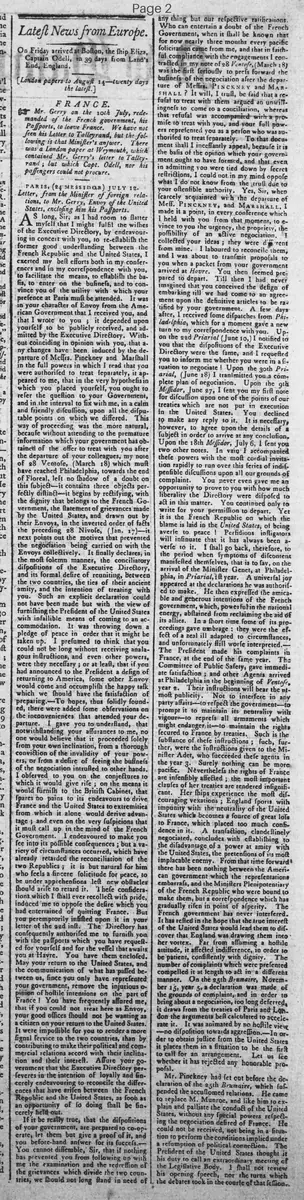
On Friday arrived at Boston, the ship Eliza, Captain Odell, in 39 days from Land's End, England.
[London papers to August 14-twenty days the latest.]
FRANCE.
Mr. Gerry on the 10th July, demanded of the French government, his Passports, to leave France. We have not seen his Letter to Talleyrand, but the following is that Minister's answer. There was a London paper at Weymouth, which contained Mr. Gerry's letter to Talleyrand; but which Capt. Odell, nor his passengers could not procure.
PARIS, (24 MESSIDOR) JULY 12.
Letter, from the Minister of foreign relations, to Mr. Gerry, Envoy of the United States, enclosing him his Passports.
Sir; as long, as I had room to flatter myself that I might fulfil the wishes of the Executive Directory, by endeavouring in concert with you, to re-establish the former good understanding between the French Republic and the United States, I exerted my best efforts both in my conferences and in my correspondence with you, to facilitate the means, to establish the basis, to enter on the business, and to convince you of the utility with which your presence at Paris must be attended. It was in your character of Envoy from the American Government that I received you, and that I wrote to you ; it depended upon yourself to be publicly received, and admitted by the Executive Directory. Without coinciding in opinion with you, -that any changes have been, induced by the departure of Messrs. Pinckney and Marshall in the full powers in which I read that you were authorized to treat separately, it appeared to me, that in the very hypothesis in which you placed yourself, you ought to refer the question to your Government, and in the interval to fix with me, in a calm and friendly discussion, upon all the disputable points on which we differed. This way of proceeding was the more natural, because without attending to the premature information which your government has obtained of the offer to treat with you after the departure of your colleagues, my note of 28 Ventose, (March 18 which must have reached Philadelphia, towards the end of Floreal, left no shadow of a doubt on this subject--it contains three objects perfectly distinct-it begins by rectifying, with the dignity that belongs to the French Government, the statement of grievances made by the United States, and drawn out by their Envoys, in the inverted order of facts the preceding 28 Nivose, (Jan. 17)-it next points out the motives that prevented the negociation being carried on with the Envoys collectively. It finally declares, in the most solemn manner, the conciliatory dispositions of the Executive Directory, and its formal desire of reuniting, between the two countries, the ties of their ancient amity, and the intention of treating with you. Such an explicit declaration could not have been made but with the view of furnishing the President of the United States with infallible means of coming to an accommodation. It was throwing down a pledge of peace in order that it might be taken up. I presumed to think that you could not be long without receiving analogous instructions, and even other powers, were they necessary ; or at least, that if you had announced to the President a design of returning to America, some other Envoy would come and accomplish the happy task which we should have the satisfaction of preparing.-To hopes, thus solidly founded, there were added some observations on the inconveniences that attended your departure. I gave you to understand, that notwithstanding your assurances to me, no one would believe that it proceeded solely from your own inclination, from a thorough conviction of the invalidity of your powers, or from a desire of seeing the business of the negociation intrusted to other hands. I observed to you on the conjectures to which it would give rise ; on the means it would furnish to the British Cabinet, that spares no pains in its endeavours to drive France and the United States to extremities from which it alone would derive advantage ; and even on the very suspicions that it must call up in the mind of the French Government. I endeavoured to make you see into its possible consequences ; but a variety of circumstances occurred, which have already retarded the reconciliation of the two Republics ; it is but natural for him who feels a sincere solicitude for peace, to be under apprehensions lest new obstacles should arise to retard it. These considerations which I shall ever recollect with pride, induced me to oppose the desire which you had entertained of quitting France. But you peremptorily insisted upon it in your letter of the 22d inst. The Directory has consequently authorized me to furnish you. with the passports which you have requested for yourself and for the vessel that awaits you at Havre. You have them enclosed.
May your return to the United States, and the communication of what has passed between us, since you only have represented your government, remove the injurious opinion of hostile intentions on the part of France ! You have frequently assured me, that if you could not treat here as Envoy. your good offices should not be wanting as a citizen on your return to the United States. It were impossible for you to render a more signal service to the two countries, than by contributing to make their political and commercial relations accord with their inclination and their interest. Assure your government that the Executive Directory perseveres in the intention of loyally and sincerely endeavouring to reconcile the differences that have arisen between the French Republic and the United States, as soon as an opportunity of so doing shall be sincerely held out.
If it be really true, that the dispositions of your government, are prepared to co-operate, let them but give a proof of it, and you before-hand answer for its success.- You cannot dissemble, Sir, that if nothing has prevented you from following up with me the examination and the version of the grievances which divide the two countries, we should not long stand in need of any thing but our respective ratifications Who can entertain a doubt of the French Government, when it shall be known that for now nearly three months every pacific solicitation came from me, and that in faithful compliance with the engagements I contracted in my note of 28 Ventose, (March 18) was the first seriously to press forward the business of the negociation after the departure of Messrs. Pinckney and MARSHALL ? It will, I trust, be said that a refusal to treat with them argued an unwillingness to come to a conciliation, whereas that refusal was accompanied with a promise to treat with you, and your full powers represented you as a person who was authorized to treat separately. To that document shall I incessantly appeal, because it is the basis of the opinion which your government ought to have formed, and that even in admitting you were tied down by secret restrictions, I could not. in my mind oppose what I do not know from the trust due to your ostensible authority. Yes, Sir, when scarcely acquainted with the departure of Mess. Pinckney, and Marshall, I made it a point, in every conference which I held with you from that moment, to evince to you the urgency, the propriety, the possibility of an active negociation. I collected your ideas ; they were different from mine. I laboured to reconcile them, and I was about to transmit proposals to you when a packet from your government arrived at Havre. You then seemed prepared to depart. Till then I had: never imagined that you conceived the design of embarking till we had come to an agreement upon the definitive articles to be ratified by your government. A few days after, I received some dispatches from Philadelphia, which for a moment gave a new turn to my correspondence with you. Upon the 22d Prairial ( June 10,) I notified to you that the dispositions of the Executive Directory were the same, and I requested you to inform me whether you were in a situation to negotiate ! Upon the 30th Prairial, (June 18) I transmitted you a complete plan of negociation. Upon the 9th Messidor, June 27, I sent you my first note for discussion upon one of the points of our treaties which are not put in execution in the United States. You declined to make any reply to it. It is necessary, however, to agree upon the details of subject in order to arrive at any conclusion. Upon the 18th Messidor, July 6, I sent you two other notes. In vain I accompanied these papers with the most cordial invitation rapidly to run over this series of indispensable discussions upon all our grounds of complaint. You never even gave me an opportunity to prove to you with how much liberality the Directory were disposed to act in this matter. You continued only to write for your permission to depart. Yet it is the French Republic on which the blame is laid in the United States; of being averse to peace ! Perfidious instigators will insinuate that it has always been averse to it. I shall go back, therefore, to the period when symptoms of discontent manifested themselves, that is to say, on the arrival of the Minister Genet, at Philadelphia, in Prairial, year 1. A universal joy appeared at the declarations he was authorized to make. He then expressed the amicable and generous intentions of the French government, which, powerful in the national energy, abstained from reclaiming the aid of its allies. In a short time some of its proceedings gave umbrage : they were the effect of a zeal ill adapted to circumstances, and unfortunately still more misinterpreted.— The President made his complaints in France, at the end of the same year. The Committee of Public Safety, gave immediate satisfaction ; and other Agents arrived at Philadelphia in the beginning of Ventose, year 2. Their instructions will bear the utmost publicity." Not to interfere in any party affairs--to respect the government—to prompt it to maintain its neutrality with vigour--to repress all armaments which might endanger it--to maintain the rights secured to France by treaties. Such is the substance of these instructions ; such, further, were the instructions given to the Minister Adet, who succeeded these agents in the year 3. Surely nothing can be more pacific. Nevertheless the rights of France are insensibly affected ; the most important clauses of her treaties are rendered insignificant. Her ships experience the most discouraging vexations ; England sports. with impunity with the neutrality of the United States which becomes a source of great loss to France, which placed too much confidence in it., A transaction, clandestinely negotiated, concludes with establishing to the disadvantage of a power at amity with the United States, the pretensions of its most implacable enemy. From that time forward there has been nothing between the American government which the representations embarrass, and the Ministers Plenipotentiary of the French Republic who were bound to make them, but a correspondence which has gradually risen in point of asperity. The French government has never interfered. It has rested in the hope that the true interest of the United States would lead them to discover that England was drawing them into her vortex. Far from assuming a hostile attitude, it affected indifference, in order to be patient, consistently with dignity. The number of complaints which were presented compelled it at length to act in a different manner. On the 25th Brumaire, November 15, year 5, a declaration was made of the grounds of complaint, and in order to bring about a negociation, too long deferred, it draws from the treaties of Paris and London the arguments best calculated to accelerate it. It was animated by no hostile view --no disposition towards aggression.-In order to obtain justice from the United States it places them in a situation to be the first to call for an arrangement. Let us see whether it has rejected any honorable proposal.
Mr. Pinckney had set out before the declaration of the 25th Brumaire, which suspended the accustomed relations. He came to replace M. Monroe, and like him to explain and palliate the conduct of the United States, without any special powers respecting the negociation desired of France. He could not be received, not being in a situation to perform the conditions implied under a resumption of political connection. The President of the United States thought it his duty to call an extraordinary meeting of the Legislative Body. I shall not review his opening speech, nor the turns which the debates took in the course of that session.
I shall only say, that the impression they made at Paris was unfavorable previous to the arrival of the Envoys; that this circumstance alone has raised an obstacle which ought to have been foreseen at Philadelphia; that the Envoys themselves unwilling to observe the natural effect of such a species of provocation, contributed to render its effect more durable: It, however, has finally been made to yield to the primitive desire of a sincere reconciliation. A proof of this you see in the expedient suggested of treating with you separately, for a government hostilely disposed would not have yielded to that delicate bias which preserves honor, yet gives effect to pacific intentions. You have given me to understand, Sir, that it would have been proper for the Executive Directory to have backed the declarations I have made in their name by a change in the measures which affect the commerce of the United States. I can answer to you that our government had sufficiently ascertained its object, in confirming, from the beginning, to the French Republic, the rights which flow from its treaties. But let us be less exacting, and more equitable, one towards another. Though the measures taken by France are only the consequence of those adopted by the United States, you must have remarked, in my propositions of the 30th Prairial, (June 18) that the intention of the Executive Directory is, that their respective pretensions should be examined and regulated collaterally. It intends to mark, in one act, a durable monument of the future friendship of the two Republics -the justice which they owe to each other; and every idea of false glory is distant from its mind. In taking leave of you, Sir, I have thought it my duty to give you this testimony of my esteem--it is manifested in the unrestrained confidence with which I have addressed you, and in the regrets which I feel from your departure in the existing circumstances.
[SIGNED]
CH. M. Talleyrand Perigord.
P.S. 27 Messidor, (July 15.) A circumstance of infinite importance has retarded this letter. I know not how it is, but at every step towards a reconciliation some cause of irritation intervenes, and that it always originates in the United States. Some days ago advices have been received by the Executive Directory. It seems that your government hurried, beyond all bounds, no longer keeps up appearances. A law of the 7th last month authorizes it to cause to be attacked every French ship of war which shall have arrested or entertained intentions of arresting American vessels. A Resolution of the House of Representatives suspends, from the 13th of this month, all commercial relations with the French Republic and its dependencies. Several projects of laws have been proposed for banishing the French, and sequestering French property. The long suffering of the Directory is about to show itself in a manner not to be called in question. Perfidy can never throw a veil over the pacific dispositions which it has never ceased to manifest. It is even at the moment of this new provocation, when it would seem to have no honorable choice but that of war, that it confirms the assurances I have given you on its behalf. In the present crisis it confines itself to a measure of security and preservation, by putting a temporary embargo on American vessels, with a reserve of indemnity if it takes place. It is still ready, it is as much prepared as ever to terminate by a sincere negotiation the differences which subsist between the two countries. Such is its repugnance to consider the United States as enemies, that, in spite of their hostile demonstrations, it means to wait till it be irresistibly forced by real hostilities. Since you intend to depart, hasten at least, Sir, to transmit to your government this solemn declaration.
What sub-type of article is it?
What keywords are associated?
What entities or persons were involved?
Where did it happen?
Foreign News Details
Primary Location
Paris
Event Date
July 10 15, 1798
Key Persons
Outcome
passports granted to gerry; french temporary embargo on american vessels; ongoing diplomatic tensions with us hostile measures including attacks on french ships and suspension of commercial relations.
Event Details
US Envoy Gerry demands passports on July 10; Talleyrand's July 12 letter grants them, reviews negotiation history since Pinckney and Marshall's departure, expresses French desire for reconciliation, criticizes US actions, and in P.S. notes recent US laws authorizing attacks on French ships and suspending trade, prompting French embargo while affirming peaceful intentions.