Thank you for visiting SNEWPapers!
Sign up free
The Nome Nugget
Nome, Nome County, Alaska
What is this article about?
Associated Press analyst J.M. Roberts compares challenges for John F. Kennedy's incoming 1961 administration to Franklin D. Roosevelt's 1933 return to power, highlighting advanced economic knowledge but intensified global threats from totalitarian aggression and economic warfare involving the US, Europe, Asia.
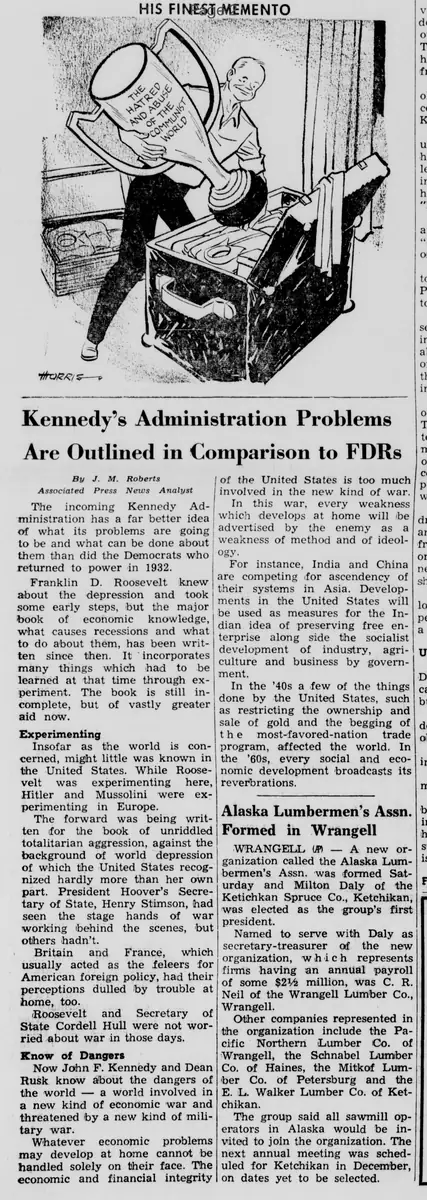
Merged-components note: The image is an illustration accompanying the news analysis story; merged due to sequential reading order and spatial proximity.
Clipping
OCR Quality
Full Text
By J. M. Roberts Associated Press News Analyst
The incoming Kennedy Administration has a far better idea of what its problems are going to be and what can be done about them than did the Democrats who returned to power in 1932.
Franklin D. Roosevelt knew about the depression and took some early steps, but the major book of economic knowledge, what causes recessions and what to do about them, has been written since then. It incorporates many things which had to be learned at that time through experiment.
The book is still incomplete, but of vastly greater aid now.
Experimenting
Insofar as the world is concerned, mighty little was known in the United States. While Roosevelt was experimenting here, Hitler and Mussolini were experimenting in Europe.
The forward was being written for the book of unriddled totalitarian aggression, against the background of world depression of which the United States recognized hardly more than her own part.
President Hoover's Secretary of State, Henry Stimson, had seen the stage hands of war working behind the scenes, but others hadn't.
Britain and France, which usually acted as the feelers for American foreign policy, had their perceptions dulled by trouble at home, too.
Roosevelt and Secretary of State Cordell Hull were not worried about war in those days.
Know of Dangers
Now John F. Kennedy and Dean Rusk know about the dangers of the world - a world involved in a new kind of economic war and threatened by a new kind of military war.
Whatever economic problems may develop at home cannot be handled solely on their face. The economic and financial integrity of the United States is too much involved in the new kind of war.
In this war, every weakness which develops at home will be advertised by the enemy as a weakness of method and of ideology.
For instance, India and China are competing for ascendency of their systems in Asia. Developments in the United States will be used as measures for the Indian idea of preserving free enterprise along side the socialist development of industry, agriculture and business by government.
In the '40s a few of the things done by the United States, such as restricting the ownership and sale of gold and the begging of the most-favored-nation trade program, affected the world. In the '60s, every social and economic development broadcasts its reverberations.
What sub-type of article is it?
What themes does it cover?
What keywords are associated?
What entities or persons were involved?
Where did it happen?
Story Details
Key Persons
Location
United States
Event Date
1961 Compared To 1932
Story Details
The article analyzes how Kennedy's administration possesses superior economic insights from post-depression experiments compared to FDR's era, yet confronts escalated global perils including totalitarian aggression, economic warfare, and ideological rivalries in Asia.