Thank you for visiting SNEWPapers!
Sign up free
Editorial
July 15, 1809
The Delaware Gazette
Wilmington, New Castle County, Delaware
What is this article about?
Editorial advocates for a balanced national mindset of cautious optimism and defensive preparedness amid uncertain peace with Britain, praising Congress for maintaining military measures while implementing pacific arrangements, and urging impartial goodwill toward Britain and France.
Clipping
OCR Quality
98%
Excellent
Full Text
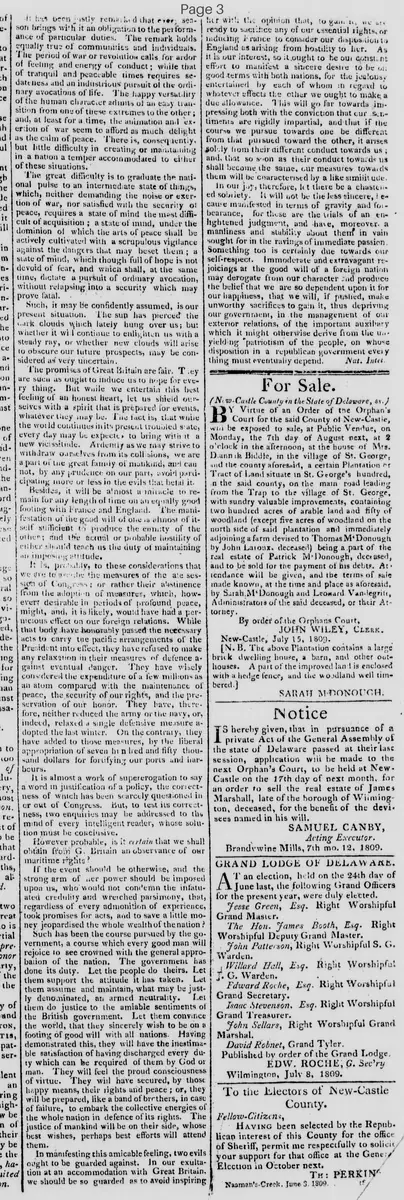
It has been justly remarked that every season brings with it an obligation to the performance of particular duties. The remark holds equally true of communities and individuals. The period of war or revolution calls for ardor of feeling and energy of conduct; while that of tranquil and peaceable times requires sedateness and an industrious pursuit of the ordinary avocations of life. The happy versatility of the human character admits of an easy transition from one of these extremes to the other; and, at least for a time, the animation and exertion of war seem to afford as much delight as the calm of peace. There is, consequently, but little difficulty in creating or maintaining in a nation a temper accommodated to either of these situations.
The great difficulty is to graduate the national pulse to an intermediate state of things, which, neither demanding the noise or exertion of war, nor satisfied with the security of peace, requires a state of mind the most difficult of acquisition; a state of mind, under the dominion of which the arts of peace shall be actively cultivated with a scrupulous vigilance against the dangers that may beset them; a state of mind, which though full of hope is not devoid of fear, and which shall, at the same time, dictate a pursuit of ordinary avocation, without relapsing into a security which may prove fatal.
Such, it may be confidently assumed, is our present situation. The sun has pierced the dark clouds which lately hung over us; but whether it will continue to enlighten us with a steady ray, or whether new clouds will arise to obscure our future prospects, may be considered as very uncertain.
The promises of Great Britain are fair. They are such as ought to induce us to hope for everything. But while we entertain this best feeling of an honest heart, let us shield ourselves with a spirit that is prepared for events, whatever they may be. The fact is, that while the world continues in its present troubled state, every day may be expected to bring with it a new vicissitude. Ardent as we may strive to withdraw ourselves from its collisions, we are a part of the great family of mankind, and can not, by any prudence on our part, avoid participating more or less in the evils that befall it. Besides, it will be almost a miracle to remain for any length of time on an equally good footing with France and England. The manifestation of the good will of one is almost of itself sufficient to produce the enmity of the other: and the actual or probable hostility of either should teach us the duty of maintaining an imposing attitude.
It is, principally, to these considerations that we are to attribute the measures of the late session of Congress; or rather their abstinence from the adoption of measures, which, however desirable in periods of profound peace, might, and, it is likely, would have had a pernicious effect on our foreign relations. While that body have honorably passed the necessary acts to carry the pacific arrangements of the President into effect, they have refused to make any relaxation in their measures of defence against eventual danger. They have wisely considered the expenditure of a few millions as an atom compared with the maintenance of peace, the security of our rights, and the preservation of our honor. They have, therefore, neither reduced the army or the navy, or, indeed, relaxed a single defensive measure adopted the last winter. On the contrary, they have added to those measures, by the liberal appropriation of seven hundred and fifty thousand dollars for fortifying our ports and harbours.
It is almost a work of supererogation to say a word in justification of a policy, the correctness of which has been scarcely questioned in or out of Congress. But, to test its correctness, two enquiries may be addressed to the mind of every intelligent reader, whose solution must be conclusive.
However probable, is it certain that we shall obtain from G. Britain an observance of our maritime rights?
If the event should be otherwise, and the strong arm of her power should be imposed upon us, who would not condemn the infatuated credulity and wretched parsimony, that, regardless of every admonition of experience, took promises for acts, and to save a little money jeopardised the whole wealth of the nation?
Such has been the course pursued by the government, a course which every good man will rejoice to see crowned with the general approbation of the nation. The government has done its duty. Let the people do theirs. Let them support the attitude it has taken. Let them assume and maintain, what may be justly denominated, an armed neutrality. Let them do justice to the amiable sentiments of the British government. Let them convince the world, that they sincerely wish to be on a footing of good will with all nations. Having demonstrated this, they will have the inestimable satisfaction of having discharged every duty which can be required of them by God or man. They will feel the proud consciousness of virtue. They will have secured, by those happy means, their rights and peace; or, they will be prepared, like a band of brothers, in case of failure, to embark the collective energies of the whole nation in defence of its rights. The justice of mankind will be on their side, whose best wishes, perhaps best efforts will attend them.
In manifesting this amicable feeling, two evils ought to be guarded against. In our exultation at an accommodation with Great Britain, we should be so guarded as to avoid inspiring her with the opinion that, to gain it, we are ready to sacrifice any of our essential rights, or inducing France to consider our disposition to England as arising from hostility to her. As it is our interest, so it ought to be our constant effort to manifest a sincere desire to be on good terms with both nations, for the jealousy entertained by each of them in regard to whatever effects the other we ought to make a due allowance. This will go far towards impressing both with the conviction that our sentiments are rigidly impartial, and that if the course we pursue towards one be different from that pursued toward the other, it arises solely from their different conduct towards us; and, that so soon as their conduct towards us shall become the same, our measures towards them will be characterised by a like similitude.
In our joy, therefore, let there be a chastened sobriety. It will not be the less sincere, because manifested in terms of gravity and forbearance, for these are the trials of an enlightened judgment, and have, moreover, a manliness and stability about them in vain sought for in the ravings of immediate passion.
Something too is certainly due towards our self-respect. Immoderate and extravagant rejoicings at the good will of a foreign nation may derogate from our character and produce the belief that we are so dependent upon it for our happiness, that we will, if pushed, make unworthy sacrifices to gain it, thus depriving our government, in the management of our exterior relations, of the important auxiliary which it might otherwise derive from the unyielding "patriotism of the people, on whose disposition in a republican government everything must eventually depend.
Nat. Intel.
The great difficulty is to graduate the national pulse to an intermediate state of things, which, neither demanding the noise or exertion of war, nor satisfied with the security of peace, requires a state of mind the most difficult of acquisition; a state of mind, under the dominion of which the arts of peace shall be actively cultivated with a scrupulous vigilance against the dangers that may beset them; a state of mind, which though full of hope is not devoid of fear, and which shall, at the same time, dictate a pursuit of ordinary avocation, without relapsing into a security which may prove fatal.
Such, it may be confidently assumed, is our present situation. The sun has pierced the dark clouds which lately hung over us; but whether it will continue to enlighten us with a steady ray, or whether new clouds will arise to obscure our future prospects, may be considered as very uncertain.
The promises of Great Britain are fair. They are such as ought to induce us to hope for everything. But while we entertain this best feeling of an honest heart, let us shield ourselves with a spirit that is prepared for events, whatever they may be. The fact is, that while the world continues in its present troubled state, every day may be expected to bring with it a new vicissitude. Ardent as we may strive to withdraw ourselves from its collisions, we are a part of the great family of mankind, and can not, by any prudence on our part, avoid participating more or less in the evils that befall it. Besides, it will be almost a miracle to remain for any length of time on an equally good footing with France and England. The manifestation of the good will of one is almost of itself sufficient to produce the enmity of the other: and the actual or probable hostility of either should teach us the duty of maintaining an imposing attitude.
It is, principally, to these considerations that we are to attribute the measures of the late session of Congress; or rather their abstinence from the adoption of measures, which, however desirable in periods of profound peace, might, and, it is likely, would have had a pernicious effect on our foreign relations. While that body have honorably passed the necessary acts to carry the pacific arrangements of the President into effect, they have refused to make any relaxation in their measures of defence against eventual danger. They have wisely considered the expenditure of a few millions as an atom compared with the maintenance of peace, the security of our rights, and the preservation of our honor. They have, therefore, neither reduced the army or the navy, or, indeed, relaxed a single defensive measure adopted the last winter. On the contrary, they have added to those measures, by the liberal appropriation of seven hundred and fifty thousand dollars for fortifying our ports and harbours.
It is almost a work of supererogation to say a word in justification of a policy, the correctness of which has been scarcely questioned in or out of Congress. But, to test its correctness, two enquiries may be addressed to the mind of every intelligent reader, whose solution must be conclusive.
However probable, is it certain that we shall obtain from G. Britain an observance of our maritime rights?
If the event should be otherwise, and the strong arm of her power should be imposed upon us, who would not condemn the infatuated credulity and wretched parsimony, that, regardless of every admonition of experience, took promises for acts, and to save a little money jeopardised the whole wealth of the nation?
Such has been the course pursued by the government, a course which every good man will rejoice to see crowned with the general approbation of the nation. The government has done its duty. Let the people do theirs. Let them support the attitude it has taken. Let them assume and maintain, what may be justly denominated, an armed neutrality. Let them do justice to the amiable sentiments of the British government. Let them convince the world, that they sincerely wish to be on a footing of good will with all nations. Having demonstrated this, they will have the inestimable satisfaction of having discharged every duty which can be required of them by God or man. They will feel the proud consciousness of virtue. They will have secured, by those happy means, their rights and peace; or, they will be prepared, like a band of brothers, in case of failure, to embark the collective energies of the whole nation in defence of its rights. The justice of mankind will be on their side, whose best wishes, perhaps best efforts will attend them.
In manifesting this amicable feeling, two evils ought to be guarded against. In our exultation at an accommodation with Great Britain, we should be so guarded as to avoid inspiring her with the opinion that, to gain it, we are ready to sacrifice any of our essential rights, or inducing France to consider our disposition to England as arising from hostility to her. As it is our interest, so it ought to be our constant effort to manifest a sincere desire to be on good terms with both nations, for the jealousy entertained by each of them in regard to whatever effects the other we ought to make a due allowance. This will go far towards impressing both with the conviction that our sentiments are rigidly impartial, and that if the course we pursue towards one be different from that pursued toward the other, it arises solely from their different conduct towards us; and, that so soon as their conduct towards us shall become the same, our measures towards them will be characterised by a like similitude.
In our joy, therefore, let there be a chastened sobriety. It will not be the less sincere, because manifested in terms of gravity and forbearance, for these are the trials of an enlightened judgment, and have, moreover, a manliness and stability about them in vain sought for in the ravings of immediate passion.
Something too is certainly due towards our self-respect. Immoderate and extravagant rejoicings at the good will of a foreign nation may derogate from our character and produce the belief that we are so dependent upon it for our happiness, that we will, if pushed, make unworthy sacrifices to gain it, thus depriving our government, in the management of our exterior relations, of the important auxiliary which it might otherwise derive from the unyielding "patriotism of the people, on whose disposition in a republican government everything must eventually depend.
Nat. Intel.
What sub-type of article is it?
Foreign Affairs
Military Affairs
War Or Peace
What keywords are associated?
Armed Neutrality
Foreign Relations
Britain France
Congress Measures
National Defense
Maritime Rights
Pacific Arrangements
What entities or persons were involved?
Great Britain
France
Congress
President
Editorial Details
Primary Topic
Maintaining Armed Neutrality Amid Uncertain Peace With Britain
Stance / Tone
Cautious Optimism Supporting Defensive Preparedness And Impartial Foreign Policy
Key Figures
Great Britain
France
Congress
President
Key Arguments
National Mindset Must Balance Peace Cultivation With Vigilance Against Dangers
Britain's Promises Warrant Hope But Require Preparedness For Vicissitudes
Maintaining Good Relations With Both Britain And France Is Challenging Due To Their Jealousy
Congress Wisely Preserved Defensive Measures Including Army, Navy, And Fortifications
Policy Of Armed Neutrality Honors Britain's Goodwill While Protecting Rights
Avoid Excesses In Rejoicing To Preserve Self Respect And Impartiality