Thank you for visiting SNEWPapers!
Sign up free
Story
June 5, 1959
Clinch Valley News
Tazewell, Jeffersonville, Tazewell County, Virginia
What is this article about?
Dr. Edward C. Roeber explains vocational guidance for students, stressing lifelong career planning over accidental paths. Uses examples of Bob White's related auto jobs and Roger Smith's varied medical career. Describes school programs with counseling, tests, and resources to aid decisions.
Clipping
OCR Quality
97%
Excellent
Full Text
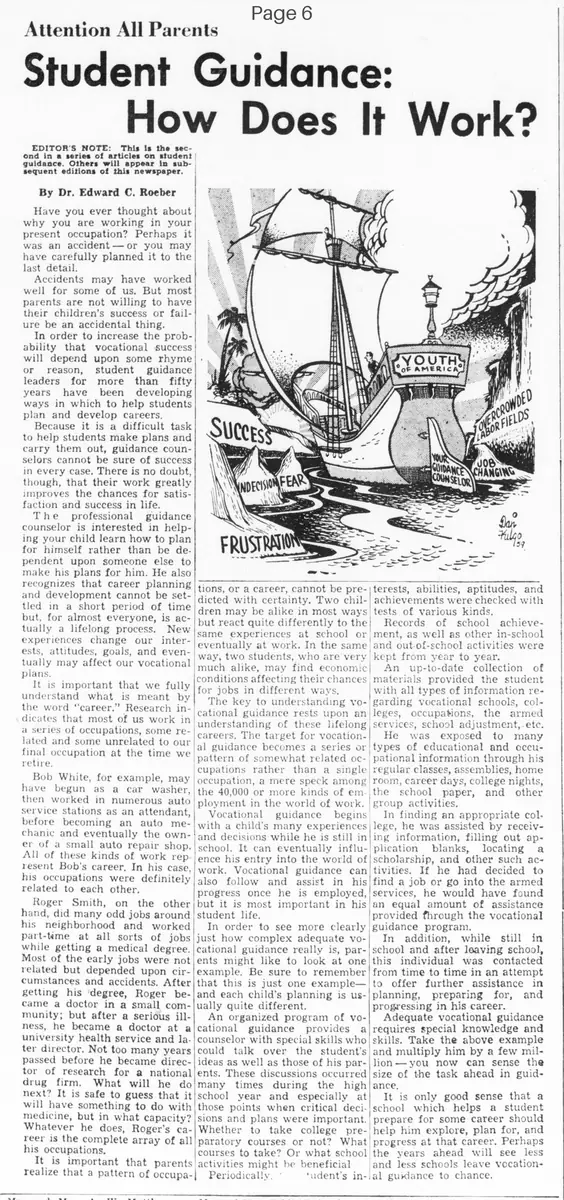
Attention All Parents
Student Guidance:
How Does It Work?
EDITOR'S NOTE: This is the second in a series of articles on student guidance. Others will appear in subsequent editions of this newspaper.
By Dr. Edward C. Roeber
Have you ever thought about why you are working in your present occupation? Perhaps it was an accident—or you may have carefully planned it to the last detail.
Accidents may have worked well for some of us. But most parents are not willing to have their children's success or failure be an accidental thing.
In order to increase the probability that vocational success will depend upon some rhyme or reason, student guidance leaders for more than fifty years have been developing ways in which to help students plan and develop careers.
Because it is a difficult task to help students make plans and carry them out, guidance counselors cannot be sure of success in every case. There is no doubt, though, that their work greatly improves the chances for satisfaction and success in life.
The professional guidance counselor is interested in helping your child learn how to plan for himself rather than be dependent upon someone else to make his plans for him. He also recognizes that career planning and development cannot be settled in a short period of time but, for almost everyone, is actually a lifelong process. New experiences change our interests, attitudes, goals, and eventually may affect our vocational plans.
It is important that we fully understand what is meant by the word career. Research indicates that most of us work in a series of occupations, some related and some unrelated to our final occupation at the time we retire.
Bob White, for example, may have begun as a car washer, then worked in numerous auto service stations as an attendant, before becoming an auto mechanic and eventually the owner of a small auto repair shop. All of these kinds of work represent Bob's career. In his case, his occupations were definitely related to each other.
Roger Smith, on the other hand, did many odd jobs around his neighborhood and worked part-time at all sorts of jobs while getting a medical degree. Most of the early jobs were not related but depended upon circumstances and accidents. After getting his degree, Roger became a doctor in a small community; but after a serious illness, he became a doctor at a university health service and later director. Not too many years passed before he became director of research for a national drug firm. What will he do next? It is safe to guess that it will have something to do with medicine, but in what capacity? Whatever he does, Roger's career is the complete array of all his occupations.
Occupations, or a career, cannot be predicted with certainty. Two children may be alike in most ways but react quite differently to the same experiences at school or eventually at work. In the same way, two students, who are very much alike, may find economic conditions affecting their chances for jobs in different ways.
The key to understanding vocational guidance rests upon an understanding of these lifelong careers. The target for vocational guidance becomes a series or pattern of somewhat related occupations rather than a single occupation, a mere speck among the 40,000 or more kinds of employment in the world of work.
Vocational guidance begins with a child's many experiences and decisions while he is still in school. It can eventually influence his entry into the world of work. Vocational guidance can also follow and assist in his progress once he is employed, but it is most important in his student life.
In order to see more clearly just how complex adequate vocational guidance really is, parents might like to look at one example. Be sure to remember that this is just one example—and each child's planning is usually quite different.
An organized program of vocational guidance provides a counselor with special skills who could talk over the student's ideas as well as those of his parents. These discussions occurred many times during the high school year and especially at those points when critical decisions and plans were important. Whether to take college preparatory courses or not? What courses to take? Or what school
It is important that parents realize that a pattern of occupations, or a career, cannot be predicted with certainty.
Interests, abilities, aptitudes, and achievements were checked with tests of various kinds. Records of school achievement, as well as other in-school and out-of-school activities were kept from year to year.
An up-to-date collection of materials provided the student with all types of information regarding vocational schools, colleges, occupations, the armed services, school adjustment, etc. He was exposed to many types of educational and occupational information through his regular classes, assemblies, home room, career days, college nights, the school paper, and other group activities.
In finding an appropriate college, he was assisted by receiving information, filling out application blanks, locating a scholarship, and other such activities. If he had decided to find a job or go into the armed services, he would have found an equal amount of assistance provided through the vocational guidance program.
In addition, while still in school and after leaving school, this individual was contacted from time to time in an attempt to offer further assistance in planning, preparing for, and progressing in his career.
Adequate vocational guidance requires special knowledge and skills. Take the above example and multiply him by a few million—you now can sense the size of the task ahead in guidance.
It is only good sense that a school which helps a student prepare for some career should help him explore, plan for, and progress at that career. Perhaps the years ahead will see less and less schools leave vocational guidance to chance.
Student Guidance:
How Does It Work?
EDITOR'S NOTE: This is the second in a series of articles on student guidance. Others will appear in subsequent editions of this newspaper.
By Dr. Edward C. Roeber
Have you ever thought about why you are working in your present occupation? Perhaps it was an accident—or you may have carefully planned it to the last detail.
Accidents may have worked well for some of us. But most parents are not willing to have their children's success or failure be an accidental thing.
In order to increase the probability that vocational success will depend upon some rhyme or reason, student guidance leaders for more than fifty years have been developing ways in which to help students plan and develop careers.
Because it is a difficult task to help students make plans and carry them out, guidance counselors cannot be sure of success in every case. There is no doubt, though, that their work greatly improves the chances for satisfaction and success in life.
The professional guidance counselor is interested in helping your child learn how to plan for himself rather than be dependent upon someone else to make his plans for him. He also recognizes that career planning and development cannot be settled in a short period of time but, for almost everyone, is actually a lifelong process. New experiences change our interests, attitudes, goals, and eventually may affect our vocational plans.
It is important that we fully understand what is meant by the word career. Research indicates that most of us work in a series of occupations, some related and some unrelated to our final occupation at the time we retire.
Bob White, for example, may have begun as a car washer, then worked in numerous auto service stations as an attendant, before becoming an auto mechanic and eventually the owner of a small auto repair shop. All of these kinds of work represent Bob's career. In his case, his occupations were definitely related to each other.
Roger Smith, on the other hand, did many odd jobs around his neighborhood and worked part-time at all sorts of jobs while getting a medical degree. Most of the early jobs were not related but depended upon circumstances and accidents. After getting his degree, Roger became a doctor in a small community; but after a serious illness, he became a doctor at a university health service and later director. Not too many years passed before he became director of research for a national drug firm. What will he do next? It is safe to guess that it will have something to do with medicine, but in what capacity? Whatever he does, Roger's career is the complete array of all his occupations.
Occupations, or a career, cannot be predicted with certainty. Two children may be alike in most ways but react quite differently to the same experiences at school or eventually at work. In the same way, two students, who are very much alike, may find economic conditions affecting their chances for jobs in different ways.
The key to understanding vocational guidance rests upon an understanding of these lifelong careers. The target for vocational guidance becomes a series or pattern of somewhat related occupations rather than a single occupation, a mere speck among the 40,000 or more kinds of employment in the world of work.
Vocational guidance begins with a child's many experiences and decisions while he is still in school. It can eventually influence his entry into the world of work. Vocational guidance can also follow and assist in his progress once he is employed, but it is most important in his student life.
In order to see more clearly just how complex adequate vocational guidance really is, parents might like to look at one example. Be sure to remember that this is just one example—and each child's planning is usually quite different.
An organized program of vocational guidance provides a counselor with special skills who could talk over the student's ideas as well as those of his parents. These discussions occurred many times during the high school year and especially at those points when critical decisions and plans were important. Whether to take college preparatory courses or not? What courses to take? Or what school
It is important that parents realize that a pattern of occupations, or a career, cannot be predicted with certainty.
Interests, abilities, aptitudes, and achievements were checked with tests of various kinds. Records of school achievement, as well as other in-school and out-of-school activities were kept from year to year.
An up-to-date collection of materials provided the student with all types of information regarding vocational schools, colleges, occupations, the armed services, school adjustment, etc. He was exposed to many types of educational and occupational information through his regular classes, assemblies, home room, career days, college nights, the school paper, and other group activities.
In finding an appropriate college, he was assisted by receiving information, filling out application blanks, locating a scholarship, and other such activities. If he had decided to find a job or go into the armed services, he would have found an equal amount of assistance provided through the vocational guidance program.
In addition, while still in school and after leaving school, this individual was contacted from time to time in an attempt to offer further assistance in planning, preparing for, and progressing in his career.
Adequate vocational guidance requires special knowledge and skills. Take the above example and multiply him by a few million—you now can sense the size of the task ahead in guidance.
It is only good sense that a school which helps a student prepare for some career should help him explore, plan for, and progress at that career. Perhaps the years ahead will see less and less schools leave vocational guidance to chance.
What sub-type of article is it?
Educational Article
Career Guidance
What keywords are associated?
Vocational Guidance
Career Planning
Student Counseling
Lifelong Career
Occupational Sequence
Guidance Program
What entities or persons were involved?
Dr. Edward C. Roeber
Bob White
Roger Smith
Story Details
Key Persons
Dr. Edward C. Roeber
Bob White
Roger Smith
Story Details
The article describes vocational guidance as a lifelong process of planning careers through school counseling, tests, discussions, and resources, using examples of sequential occupations in auto repair and medicine to illustrate related and unrelated job paths.