Thank you for visiting SNEWPapers!
Sign up free
The Virginia Gazette
Williamsburg, Virginia
What is this article about?
British parliamentary debates criticize government policies on American colonies, highlighting failed Boston punishment, colonial unity, naval preparations, and American Congress responses; includes speeches by Burke and Johnstone, anecdotes, and motions in Houses of Commons and Peers amid rising tensions.
Clipping
OCR Quality
Full Text
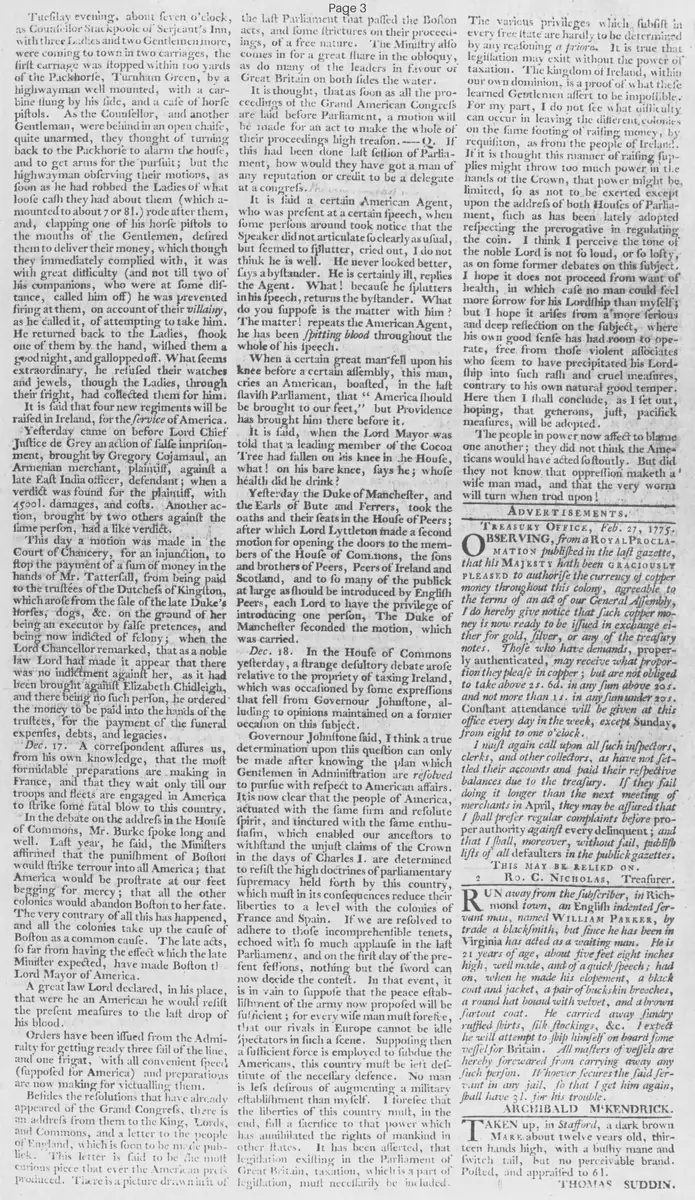
A great law Lord declared, in his place, that were he an American he would resist the present measures to the last drop of his blood.
Orders have been issued from the Admiralty for getting ready three ships of the line, and one frigate, with all convenient speed (supposed for America) and preparations are now making for victualling them.
Besides the resolutions that have already appeared of the Grand Congress, there is an address from them to the King, Lords, and Commons, and a letter to the people of England, which is soon to be made publick. This letter is said to be the most curious piece that ever the American press produced. There is a picture drawn in it of the last Parliament that passed the Boston acts, and some strictures on their proceedings, of a free nature. The Ministry also comes in for a great share in the obloquy, as do many of the leaders in favour of Great Britain on both sides the water.
It is thought, that as soon as all the proceedings of the Grand American Congress are laid before Parliament, a motion will be made for an act to make the whole of their proceedings high treason. ----Q. If this had been done last session of Parliament, how would they have got a man of any reputation or credit to be a delegate at a congress?
It is said a certain American Agent, who was present at a certain speech, when some persons around took notice that the Speaker did not articulate so clearly as usual, but seemed to splutter, cried out, I do not think he is well. He never looked better, says a bystander. He is certainly ill, replies the Agent. What! because he splutters in his speech, returns the bystander. What do you suppose is the matter with him? The matter! repeats the American Agent, he has been Spitting blood throughout the whole of his speech.
When a certain great man fell upon his knee before a certain assembly, this man, cries an American, boasted, in the last slavish Parliament, that America should be brought to our feet, but Providence has brought him there before it.
It is said, when the Lord Mayor was told that a leading member of the Cocoa Tree had fallen on his knee in the House, what! on his bare knee, says he; whose health did he drink?
Yesterday the Duke of Manchester, and the Earls of Bute and Ferrers, took the oaths and their seats in the House of Peers: after which Lord Lyttleton made a second motion for opening the doors to the members of the House of Commons, the sons and brothers of Peers, Peers of Ireland and Scotland, and to so many of the publick at large as should be introduced by English Peers, each Lord to have the privilege of introducing one person. The Duke of Manchester seconded the motion, which was carried.
Dec. 18. In the House of Commons yesterday, a strange desultory debate arose relative to the propriety of taxing Ireland, which was occasioned by some expressions that fell from Governor Johnstone, alluding to opinions maintained on a former occasion on this subject.
Governor Johnstone said, I think a true determination upon this question can only be made after knowing the plan which Gentlemen in Administration are resolved to pursue with respect to American affairs. It is now clear that the people of America, actuated with the same firm and resolute spirit, and tinctured with the same enthusiasm, which enabled our ancestors to withstand the unjust claims of the Crown in the days of Charles I. are determined to resist the high doctrines of parliamentary supremacy held forth by this country, which must in its consequences reduce their liberties to a level with the colonies of France and Spain. If we are resolved to adhere to those incomprehensible tenets, echoed with so much applause in the last Parliament, and on the first day of the present sessions, nothing but the sword can now decide the contest. In that event, it is in vain to suppose that the peace establishment of the army now proposed will be sufficient; for every wise man must foresee, that our rivals in Europe cannot be idle spectators in such a scene. Supposing then a sufficient force is employed to subdue the Americans, this country must be left destitute of the necessary defence. No man is less desirous of augmenting a military establishment than myself. I foresee that the liberties of this country must, in the end, fall a sacrifice to that power which has annihilated the rights of mankind in other States. It has been asserted, that legislation existing in the Parliament of Great Britain, taxation, which is a part of legislation, must necessarily be included.
The various privileges which subsist in every free state are hardly to be determined by any reasoning a priori. It is true that legislation may exist without the power of taxation. The kingdom of Ireland, within our own dominion, is a proof of what these learned Gentlemen assert to be impossible. For my part, I do not see what difficulty can occur in leaving the different colonies on the same footing of raising money, by requisition, as from the people of Ireland! If it is thought this manner of raising supplies might throw too much power in the hands of the Crown, that power might be limited, so as not to be exerted except upon the address of both Houses of Parliament, such as has been lately adopted respecting the prerogative in regulating the coin. I think I perceive the tone of the noble Lord is not so loud, or so lofty, as on some former debates on this subject. I hope it does not proceed from want of health, in which case no man could feel more sorrow for his Lordship than myself: but I hope it arises from a more serious and deep reflection on the subject, where his own good sense has had room to operate, free from those violent associates who seem to have precipitated his Lordship into such rash and cruel measures, contrary to his own natural good temper. Here then I shall conclude, as I set out, hoping, that generous, just, pacifick measures, will be adopted.
The people in power now affect to blame one another; they did not think the Americans would have acted so stoutly. But did they not know, that oppression maketh a wise man mad, and that the very worm will turn when trod upon!
What sub-type of article is it?
What themes does it cover?
What keywords are associated?
What entities or persons were involved?
Where did it happen?
Story Details
Key Persons
Location
House Of Commons, House Of Peers, London
Event Date
Dec. 18
Story Details
Debates in British Parliament on American resistance to punitive measures, with speeches by Burke highlighting colonial unity and Johnstone warning of conflict and advocating for Irish-style requisitions; naval preparations for America; American Congress address and letter criticizing British actions; anecdotes mocking British leaders; motion to open House of Peers to more members.