Thank you for visiting SNEWPapers!
Sign up free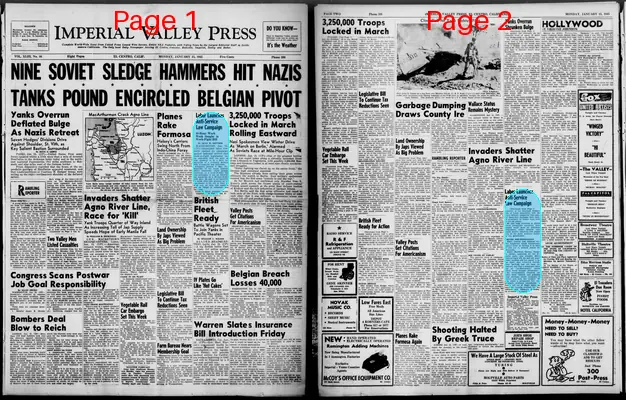
Imperial Valley Press
El Centro, Imperial County, California
What is this article about?
Organized labor opens campaign against national service and work-or-fight legislation amid push for 48-hour work week in essential war industries. House Military Affairs Committee hears from AFL rep Lewis G. Hines and Socialist Albert Hamilton opposing Chairman Andrew J. May's bill forcing men into essential jobs or army induction.
Merged-components note: Merge continuation of 'Labor Launches Anti-Service Law Campaign' from page 1 to page 2 based on explicit '(Continued from Page 1)'.
Clippings
1 of 2
OCR Quality
Full Text
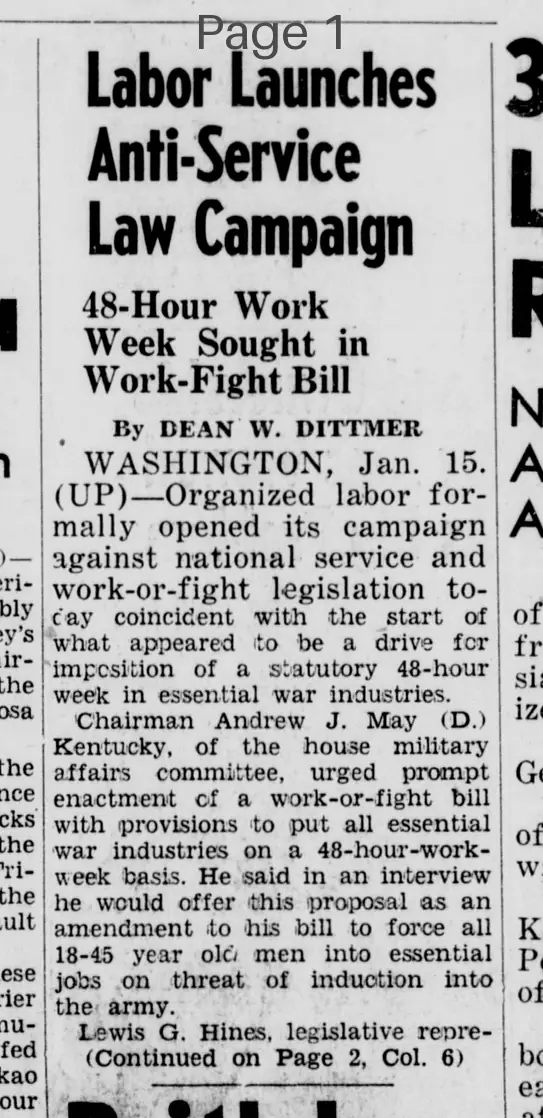
48-Hour Work Week Sought in Work-Fight Bill
By DEAN W. DITTMER
WASHINGTON, Jan. 15. (UP)—Organized labor formally opened its campaign against national service and work-or-fight legislation today coincident with the start of what appeared to be a drive for imposition of a statutory 48-hour week in essential war industries.
Chairman Andrew J. May (D.) Kentucky, of the house military affairs committee, urged prompt enactment of a work-or-fight bill with provisions to put all essential war industries on a 48-hour-work-week basis. He said in an interview he would offer this proposal as an amendment to his bill to force all 18-45 year old men into essential jobs on threat of induction into the army.
Lewis G. Hines, legislative representative of the American Federation of Labor meanwhile, told the house military committee that present manpower shortages were caused principally by frozen wage level in certain plants.
He said wage increases in plants where production speed-ups were needed would have no sufficient inflationary effect because they would involve relatively few plants and, in the main, products bought by the government.
CALLED DISCRIMINATION
Hines insisted that national service legislation would discriminate against labor by forcing it to work at low pay to provide profits for employers.
Albert Hamilton, Vienna, Virginia, farmer, appearing for the Socialist party, also attacked May's work-or-fight bill. He said the manpower problem did not justify a labor draft, that voluntary recruitment methods had not been exhausted, and that a manpower draft was an "un-Democratic" device which would hamper production.
He recommended breaking the Little Steel formula and granting wage increases where necessary to recruit and hold war workers. He also urged a permanent fair employment practices commission to insure full use of Negro labor, an expanded housing program for war workers, and "adequate planning" by procurement agencies.
What sub-type of article is it?
What keywords are associated?
What entities or persons were involved?
Where did it happen?
Domestic News Details
Primary Location
Washington
Event Date
Jan. 15
Key Persons
Event Details
Organized labor opened campaign against national service and work-or-fight legislation. Chairman Andrew J. May urged 48-hour work week in war industries via amendment to bill forcing 18-45 year old men into essential jobs or army. Lewis G. Hines of AFL attributed shortages to frozen wages, suggested increases. Albert Hamilton for Socialist party opposed bill, recommended wage adjustments, fair employment, housing, planning.