Thank you for visiting SNEWPapers!
Sign up free
Editorial
November 20, 1931
Clinch Valley News
Tazewell, Jeffersonville, Tazewell County, Virginia
What is this article about?
Editorial counters Governor Pollard's objection to state funding for public schools, arguing that greater state control and funding would relieve local burdens, abolish tuition, and eliminate teacher salary supplements, despite concerns over centralization of power.
Clipping
OCR Quality
98%
Excellent
Full Text
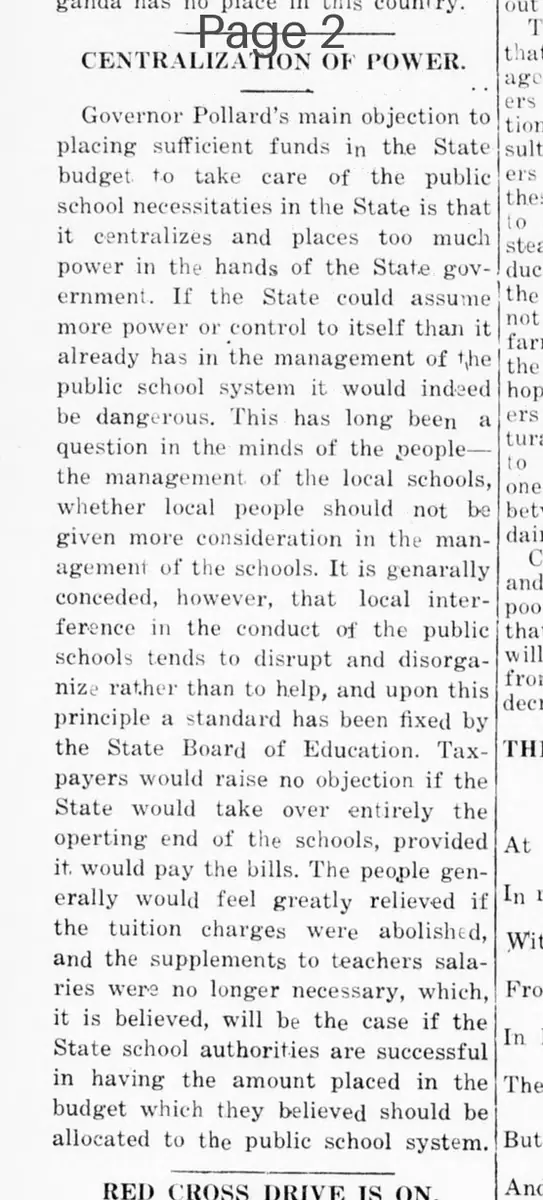
CENTRALIZATION OF POWER.
Governor Pollard's main objection to placing sufficient funds in the State budget to take care of the public school necessities in the State is that it centralizes and places too much power in the hands of the State government. If the State could assume more power or control to itself than it already has in the management of the public school system it would indeed be dangerous. This has long been a question in the minds of the people—the management of the local schools, whether local people should not be given more consideration in the management of the schools. It is generally conceded, however, that local interference in the conduct of the public schools tends to disrupt and disorganize rather than to help, and upon this principle a standard has been fixed by the State Board of Education. Taxpayers would raise no objection if the State would take over entirely the operating end of the schools, provided it would pay the bills. The people generally would feel greatly relieved if the tuition charges were abolished, and the supplements to teachers salaries were no longer necessary, which, it is believed, will be the case if the State school authorities are successful in having the amount placed in the budget which they believe should be allocated to the public school system.
Governor Pollard's main objection to placing sufficient funds in the State budget to take care of the public school necessities in the State is that it centralizes and places too much power in the hands of the State government. If the State could assume more power or control to itself than it already has in the management of the public school system it would indeed be dangerous. This has long been a question in the minds of the people—the management of the local schools, whether local people should not be given more consideration in the management of the schools. It is generally conceded, however, that local interference in the conduct of the public schools tends to disrupt and disorganize rather than to help, and upon this principle a standard has been fixed by the State Board of Education. Taxpayers would raise no objection if the State would take over entirely the operating end of the schools, provided it would pay the bills. The people generally would feel greatly relieved if the tuition charges were abolished, and the supplements to teachers salaries were no longer necessary, which, it is believed, will be the case if the State school authorities are successful in having the amount placed in the budget which they believe should be allocated to the public school system.
What sub-type of article is it?
Education
What keywords are associated?
School Funding
State Control
Local Management
Education Budget
Teacher Salaries
Tuition Abolition
What entities or persons were involved?
Governor Pollard
State Board Of Education
State Government
Editorial Details
Primary Topic
Centralization Of Power In State School Funding And Management
Stance / Tone
Supportive Of Increased State Control If Fully Funded
Key Figures
Governor Pollard
State Board Of Education
State Government
Key Arguments
State Funding Centralizes Power But Is Not Dangerous Given Current Controls
Local Interference Disrupts Schools
State Standards By Board Of Education Are Beneficial
Taxpayers Support State Takeover If It Pays Costs
Full State Funding Would Abolish Tuition And Salary Supplements