Thank you for visiting SNEWPapers!
Sign up free
The Virginia Gazette
Richmond, Williamsburg, Richmond County, Virginia
What is this article about?
In the House of Lords on December 23, a protest was entered by several peers against the bill prohibiting trade with American colonies, arguing it promotes separation, encourages naval plunder, exceeds injustices, and risks corruption and tyranny.
Merged-components note: This is a continuation of the House of Lords protest across pages, with text connecting directly at the page break; relabeled from editorial to foreign_news as it reports on British parliamentary proceedings regarding America.
Clippings
1 of 2
OCR Quality
Full Text
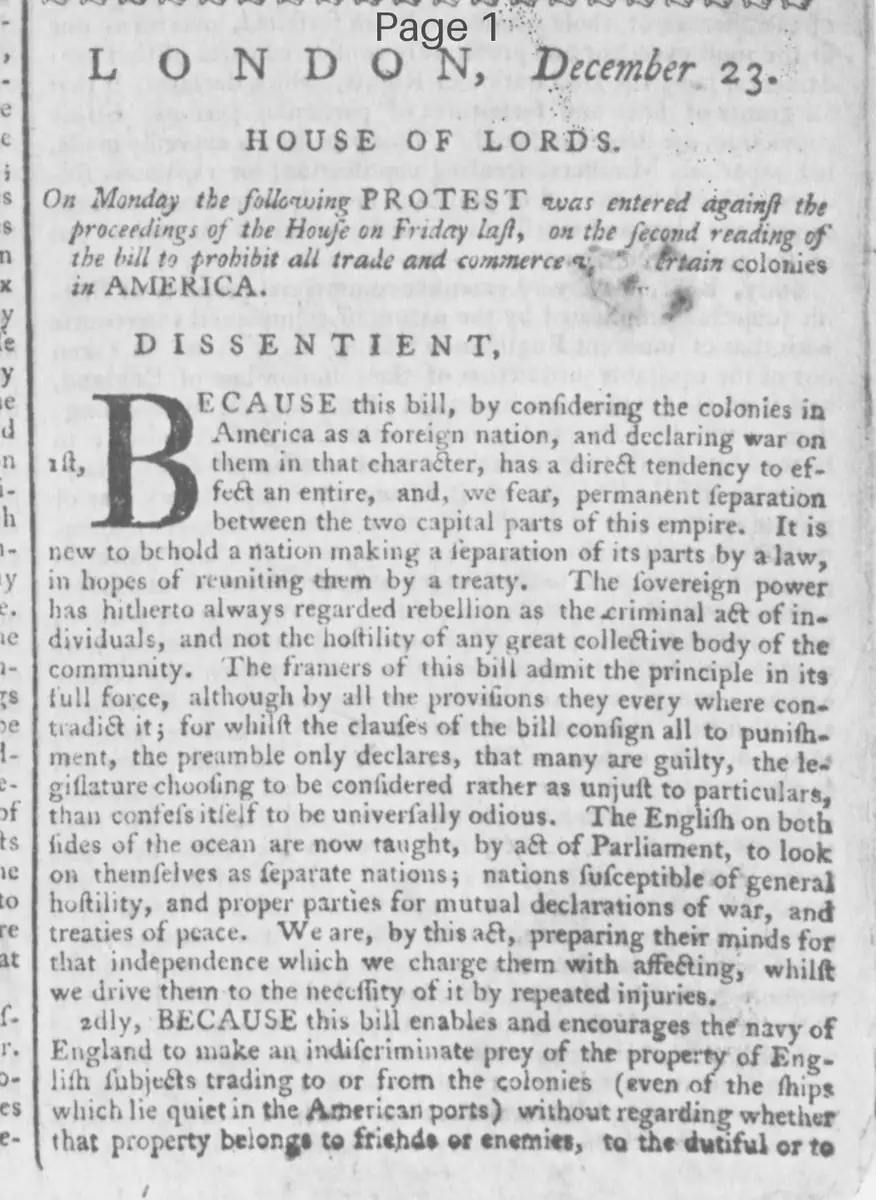
December 23.
HOUSE OF LORDS.
On Monday the following PROTEST was entered against the proceedings of the House on Friday last, on the second reading of the bill to prohibit all trade and commerce with certain colonies in AMERICA.
DISSENTIENT,
1st, BECAUSE this bill, by considering the colonies in America as a foreign nation, and declaring war on them in that character, has a direct tendency to effect an entire, and, we fear, permanent separation between the two capital parts of this empire. It is new to behold a nation making a separation of its parts by a law, in hopes of reuniting them by a treaty. The sovereign power has hitherto always regarded rebellion as the criminal act of individuals, and not the hostility of any great collective body of the community. The framers of this bill admit the principle in its full force, although by all the provisions they every where contradict it; for whilst the clauses of the bill consign all to punishment, the preamble only declares, that many are guilty, the legislature choosing to be considered rather as unjust to particulars, than confess itself to be universally odious. The English on both sides of the ocean are now taught, by act of Parliament, to look on themselves as separate nations; nations susceptible of general hostility, and proper parties for mutual declarations of war, and treaties of peace. We are, by this act, preparing their minds for that independence which we charge them with affecting, whilst we drive them to the necessity of it by repeated injuries.
2dly, BECAUSE this bill enables and encourages the navy of England to make an indiscriminate prey of the property of English subjects trading to or from the colonies (even of the ships which lie quiet in the American ports) without regarding whether that property belongs to friends or enemies, to the dutiful or to the disobedient. This plan of promiscuous rapine (unworthy of the wisdom and decorum of Government) must complete what yet remains to be completed of the union in North America against the authority of Parliament. Parliament, in this bill, seems much more inclined to distress, than able or willing to protect. In North America the refractory and submissive may be blended together. In the West Indies all are innocent; but all are doomed to a much more severe, and much more certain punishment, than falls upon the most guilty in North America. The whole accommodation, if not the immediate subsistence, of the West India islands, depends on a commercial connexion with the continent, from which; by this bill, they are expressly restrained. One of the chief, and much the most plausible of the complaints, made last year against the North American colonies, was a resolution on their part to withhold supply from the sugar plantations. But this year we have made ourselves to adopt and sanctify that very conduct which we had painted to the world in such odious colours. It must appear as if this bill was purposely made against the West Indies; and lest the people of the United Colonies might return to sentiments of fraternal affection, or from motives of self-interest, or from impatience of so hard a restraint, should disobey or elude the orders of the Congress, and afford relief to our innocent planters in the West Indies, it seems as if an Act of the British Parliament came in aid of that authority, and provided that no supply whatsoever shall be carried to the West Indies, contrary to the resolution of the Congress.
3dly, BECAUSE this bill greatly exceeds in violence the pattern of injustice which it seems to follow. In some respects the prohibition of the Congress materially differed from the prohibition of this bill. Theirs was not immediate. Time was given to the West Indies for supply, both from America and other places. No confiscations were made. We, on the other hand, have permitted the trade from America as long as it was necessary to save ourselves from famine, and to enable the colonies to pay their debts. This supply they have made plentifully, and many of these debts they have discharged most honourably. In return for this, to us useful and honourable behaviour, Ministry, abusing the bounty of Providence, on the first restoration of domestic plenty, has fabricated a bill for seizing American vessels, now trading under the faith of an act of Parliament, no ship of theirs being suffered to return to its own country, either from hence, or from the West Indies.
4thly, BECAUSE the bill, not satisfied with making predatory war upon the trade of the colonies, thinks it necessary to stimulate particular avarice and rapacity to an activity in such service, by rendering captures of North American vessels and goods the property of the captors. This regulation is now, for the first time, by any regular authority in this kingdom, to be adopted in a civil contention. We consider this method of holding out the spoil of their fellow citizens, for the reward of alacrity in civil wars, as a source of the most dangerous corruption that can be conceived; in the first instance to our navy, and in its consequence to our army. A number of bold, enterprising men, trained to the profession of arms, with fortunes to make, and promotion to be obtained, are naturally lovers of war. When they have once tasted of emoluments from domestic spoil, they will no longer look on the commerce of England as an object of protection, but of plunder. They will see the prosperous state of peaceful domestic industry, not with pleasure, but with envy. They will be taught to wish for those lucrative civil commotions, which they will always have the means of provoking. Our soldiers in the land service will see no reason for their being distinguished from the marine; and they will call for the plunder of English trading towns, when they see that the seamen have been indulged in the plunder of English trading ships. It never can be safe for a state to hold out an interest in disturbing it, to those who have the sword in their hand. The greatest republic of which history gives us any knowledge was subverted by this licence of domestic plunder. We are perfectly assured that the navy of England wants no such unnatural and impious encouragement towards the performance of any duty which their known public spirit, and yet uncorrupted honour, may make it fit for them to perform. And it is no less on theirs, than on the public account, a matter of the most serious affliction to us, that a service always looked upon (and hitherto most justly) not only without fear or jealousy, but with the most partial affection in every part of this empire, should be unnecessarily exposed to the lasting odium which must attend those who are enriched from the spoils of citizens, amongst whom they may be obliged to spend their lives, and form their connexions. Civil wars (when they must be made) should be made in such a manner as not to render the return to peace and cordiality impracticable. If the spoil ordered by this act had been left in the Crown, the Crown might use it as an encouragement for a return to obedience, and as a means of future peace. It is now only a provocation, through despair and resentment, to perpetual hostility. We cannot possibly discern how any necessary operation of war is strengthened by this disgrace of legislature. But if the arms now used should succeed, so as to enforce a temporary and reluctant obedience, we see but too well that this bill will leave such a sting in the minds of the colonists, as to render our government there hated and suspected, and therefore for ever precarious.
5thly, BECAUSE this bill, by anticipating all legal judgment of the offences of those whose goods are forfeited, overturns one of the most excellent and profoundly considered parts of that fundamental law, the Declaration of Rights, which declares, "that all grants of fines and forfeitures of particular persons, before conviction, are illegal and void." This provision is expressly made, lest rapacious Ministers, scenting confiscation, or rapacious soldiers, allured by the lust of plunder, should be induced to forge or provoke plots and rebellions, in order to enrich themselves out of the public disorders.
6thly, BECAUSE very extensive commercial property of British subjects (implicated by the nature of commercial intercourse with that of innocent Englishmen residing here) is to be taken out of the equitable jurisdiction of the common law of England, and from that inestimable birthright of the subjects of this kingdom, a trial by jury, and carried to the Court of Admiralty to be tried by a single judge, on the rules of an arbitrary foreign law.
7thly, BECAUSE the whole scheme of this predatory war of private lucre is put under the arbitrary direction of certain commissioners, to us unknown, even by name; who have power to give such countenance to the ravages authorised by this bill as their arbitrary will shall suggest; to pardon, or except from pardon, any number or description of persons, and with such exceptions as they shall see fit, without any other rule than their own private opinion, fancy, caprice, favour, or resentment; and, without any other rule, to open or keep shut any colony, province, county, town, district, or place. We are of opinion that the power left to the commissioners is perfectly unjustifiable and unconstitutional. It has, besides, a tendency to create the most shameful and mischievous monopolies. The power given to the Admiralty, and to the West India Governors, to licence ships, is of the same nature. If such monopolies and jobs should not arise from such powers, it is no fault of this bill, which, as if it had these purposes in view, has taken especial care to provide as strong a temptation as human nature, set above law and restraint, and furnished with every facility to corruption, can possibly be exposed to.
8thly, BECAUSE we know nothing of the business of these Commissioners, further than the above arbitrary discretion with regard to pardons. Rumour gives out that they are to have a power to treat with the Americans for a redress of their grievances. Of this, however, neither the speech from the throne, nor the bill, have given the least intimation. Although, if the commissioners treat on this subject at all, acts and powers of Parliament being the matter of complaint, the commission ought to derive some previous authority from Parliament, in order to give weight and efficacy to their negotiations, and to preserve some appearance of dignity in ourselves. It is hardly proper that Parliament should appear in no other light than as the instrument of penal restrictions, attainder, penalties, and confiscations; as the maker of menacing addresses, and the rejector of dutiful petitions. It is hardly decent to show ourselves fierce and inflexible here, but to be satisfied with permitting unknown persons whom Ministers shall choose in future to appoint, to dispose in America of powers and acts of Parliament at their pleasure: Leaving us first the odium of rejecting reasonable requests, and afterwards the disgrace of ratifying shameful concessions.
9thly, BECAUSE we reject with indignation, that clause of this bill, which by a refinement in tyranny, and in a sentence worse than death, obliges the unhappy men who shall be made captives in this predatory war, to bear arms against their families, kindred, friends, and country; and after being plundered themselves, to become accomplices in plundering their brethren. If there exists a doubt whether to justify the infliction of capital punishment or desertion, it should be necessary to prove that a seaman was a pressed man or a volunteer. The object of this clause is to deprive the American seaman of the plea of his being a pressed man, as it declares that he is to be considered to all intents and purposes, as having entered voluntarily into the service. By this clause, not only common seamen, but masters of vessels are, without regard to age or circumstances, or condition, to be ignominiously turned before the mast, and subjected to the austere discipline of the boatswain. Persons, in that subordinate station, not being animated with the liberal and ingenuous spirit which distinguishes officers in the navy, and taught to consider these forced volunteers as rebels, will be but too apt to aggravate miseries of captivity by insult and outrage. These prisoners, among the comrades they are obliged to live and serve with, may very probably be often forced to behold the spoils of their honest industry, and the natural support of their sober families, squandered in riot and profligate debauchery before their faces. This we look upon as the last degree of wretchedness and indignity, to which human nature can be subjected. This cruelty, unknown to the most savage nations, is to be practised by Englishmen on Englishmen. It has been said in Parliament, that the pay the prisoners are to receive is to be considered as a full compensation for the principles they are obliged to violate. We do not envy any one that sentiment. An attempt is also made to justify it by the supposed right of pressing. We cannot conceive that the burdens of subjection ought ever to be imposed, where the protection belonging to it is denied, or that a man can ever be despoiled of his goods as a foreign enemy, and at the same time obliged to serve the state as a citizen. This compulsion we have never heard to be practised on any prisoners in war, or rebellion— nor do we know any example of it, except among pirates—the outlaws and enemies of human society.
10thly, BECAUSE a bill unprecedented in its nature, and so important in its consequences, is brought in at a time of the year, when by experience it is known, that most of the independent members of both Houses are called away by their domestic affairs, and when few but those in the immediate pay of the Court, and attending on their employments, are in town. This we conceive to be done in order to impress the public with a delusive idea, that those measures are agreeable to greater numbers in both Houses, than in reality they are. The only part of this bill which we approve, is the repeal of the unjust and imprudent acts which have produced all the evil effects which we had foreseen, and none of the good which was pretended as the ground for making them; acts, as unfit for, as incapable of execution. But to our inexpressible grief, and to the disgrace of the public Councils of this kingdom, Ministers, untaught by misfortunes, and unchecked by disappointments, at the very instant they are obliged to demolish the old fabric of their oppression, as useless and mischievous, are building up another on nearly the same model, and with the same materials, adding only something more of that injustice and violence, which have always proved mischievous, in proportion as they have been augmented.
RICHMOND.
ROCKINGHAM.
PONSONBY.
CHEDWORTH.
FITZWILLIAM
ABINGTON.
ABERGAVENNY.
MANCHESTER.
What sub-type of article is it?
What keywords are associated?
What entities or persons were involved?
Where did it happen?
Foreign News Details
Primary Location
Colonies In America
Event Date
December 23
Key Persons
Outcome
protest entered against the bill on the second reading
Event Details
A detailed protest with ten points of dissent was entered in the House of Lords against the bill prohibiting trade and commerce with American colonies, criticizing it for promoting separation, enabling naval plunder, exceeding injustices, stimulating corruption, violating rights, arbitrary powers, and cruel treatment of captives.