Thank you for visiting SNEWPapers!
Sign up free
Story
October 31, 1875
The New Orleans Bulletin
New Orleans, Orleans County, Louisiana
What is this article about?
Business partners A and B, facing limited profits, see B increase stock, hire more salesmen, and advertise aggressively while A is away, leading to booming sales and proving that strategic spending reduces liabilities and boosts revenue.
Clipping
OCR Quality
95%
Excellent
Full Text
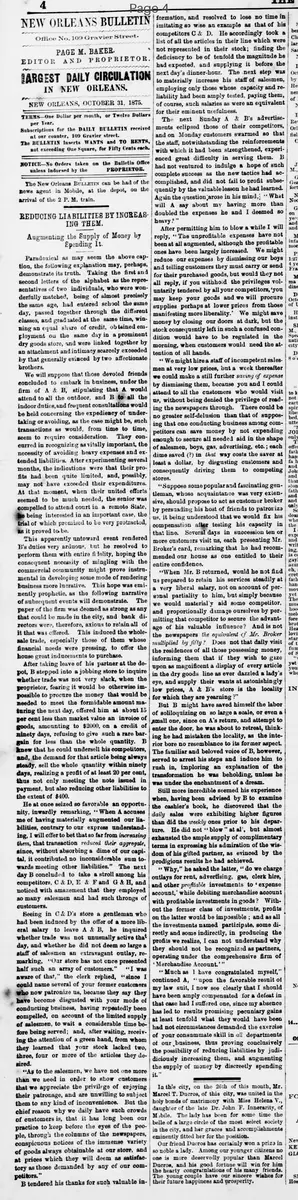
REDUCING LIABILITIES BY INCREASING THEM
Augmenting the Supply of Money by Spending It.
Paradoxical as may seem the above caption, the following explanation may, perhaps, demonstrate its truth. Taking the first and second letters of the alphabet as the representatives of two individuals, who were wonderfully matched, being of almost precisely the same age, had entered school the same day, passed together through the different classes, and graduated at the same time, winning an equal share of credit, obtained employment on the same day in a prominent dry goods store, and were linked together by an attachment and intimacy scarcely exceeded by that generally evinced by two affectionate brothers.
We will suppose that those devoted friends concluded to embark in business, under the firm of A & B, stipulating that A would attend to all the outdoor, and B to all the indoor duties, and frequent consultations would be held concerning the expediency of undertaking or avoiding, as the case might be, such transactions as would, from time to time, seem to require consideration. They concurred in recognizing as vitally important, the necessity of avoiding heavy expenses and extended liabilities. After experimenting several months, the indications were that their profits had been quite limited, and, possibly, may not have exceeded their expenditures.
At that moment, when their united efforts seemed to be much needed, the senior was compelled to attend court in a remote State, he being interested in an important case, the trial of which promised to be very protracted, as it proved to be.
This apparently untoward event rendered B's duties very arduous, but he resolved to perform them with entire fidelity, hoping the consequent necessity of mingling with the commercial community might prove instrumental in developing some mode of rendering business more lucrative. This hope was eminently prophetic, as the following narrative of subsequent events will demonstrate. The paper of the firm was deemed as strong as any that could be made in the city, and bank directors were, therefore, anxious to retain all of it that was offered. This induced the wholesale trade, especially those of them whose financial needs were pressing, to offer the house great inducements to purchase.
After taking leave of his partner at the depot, B stepped into a jobbing store to inquire whether trade was not very slack, when the proprietor, fearing it would be otherwise impossible to procure the money that would be needed to meet the formidable amount maturing the next day, offered him at about 15 per cent less than market value an invoice of goods, amounting to $2000, on a credit of ninety days, refusing to give such a rare bargain for less than the whole quantity. B knew that he could undersell his competitors, and, the demand for that article being always steady, sell the whole quantity within ninety days, realizing a profit of at least 20 per cent, thus not only meeting the note issued in payment, but also reducing other liabilities to the extent of $400.
He at once seized so favorable an opportunity, inwardly remarking, "When A accuses me of having materially augmented our liabilities, contrary to our express understanding, I will offer to bet that so far from increasing them, that transaction reduced their aggregate, since, without absorbing a dime of our capital, it contributed no inconsiderable sum towards meeting other liabilities." The next day B concluded to take a stroll among his competitors, C & D, E & F, and G & H, and noticed with amazement that they employed so many salesmen and had such throngs of customers.
Seeing in C & D's store a gentleman who had been induced by the offer of a more liberal salary to leave A & B, he inquired whether trade was not unusually active that day, and whether he did not deem so large a staff of salesmen an extravagant outlay, remarking, "Our store has not once presented half such an array of customers."
"I was aware of that," the clerk replied, "since I could name several of your former customers who now patronize us, because they say they have become disgusted with your mode of conducting business, having repeatedly been compelled, on account of the limited supply of salesmen, to wait a considerable time before being served; and, after waiting, receiving the attention of a green hand, from whom they learned that your stock lacked two, three, four or more of the articles they desired."
"As to the salesmen, we have not one more than we need in order to show customers that we appreciate the privilege of enjoying their patronage, and are unwilling to subject them to any kind of inconvenience. But the chief reason why we daily have such crowds of customers is, that it has long been our practice to keep before the eyes of the people, through the columns of the newspapers, conspicuous notices of the immense variety of goods always obtainable at our store, and at prices which they will deem as satisfactory as those demanded by any of our competitors."
B tendered his thanks for such valuable information, and resolved to lose no time in imitating so wise an example as that of his competitors C & D. He accordingly took a list of all the articles in their line which were not represented in their stock; finding the deficiency to be of tenfold the magnitude he had expected, and supplying it before the next day's dinner-hour. The next step was to materially increase his staff of salesmen, employing only those whose capacity and reliability had been amply tested, paying them, of course, such salaries as were an equivalent for their eminent usefulness.
The next Sunday A & B's advertisements eclipsed those of their competitors, and on Monday customers swarmed so that the staff, notwithstanding the reinforcements with which it had been strengthened, experienced great difficulty in serving them. B had not ventured to indulge a hope of such complete success as the new tactics had accomplished, and did not fail to profit subsequently by the valuable lesson he had learned.
Again the question arose in his mind; "What will A say about my having more than doubled the expenses he and I deemed so heavy?"
After permitting him to blow a while I will reply, "The unprofitable expenses have not been at all augmented, although the profitable ones have been largely increased. We might reduce our expenses by dismissing our boys and telling customers they must carry or send for their purchased goods, but would they not all reply, if you withhold the privileges voluntarily tendered by all your competitors, 'you may keep your goods and we will procure supplies perhaps at lower prices from those manifesting more liberality.' We might save money by closing our doors at dark, but the stock consequently left in such a confused condition would have to be regulated in the morning, when customers would need the attention of all hands.
"We might hire a staff of incompetent salesmen at very low prices, but a week thereafter we could make a still further saving of expense by dismissing them, because you and I could attend to all the customers who would visit us, without being denied the privilege of reading the newspapers through. There could be no greater self-delusion than that of supposing that one conducting business among competitors can save money by not expending enough to secure all needed aid in the shape of salesmen, boys, gas, advertising, etc.; each dime saved (?) in that way costs the saver at least a dollar, by disgusting customers and consequently driving them to competing stores.
"Suppose some popular and fascinating gentleman, whose acquaintance was very extensive, should propose to act as customer broker by persuading his host of friends to patronize us, it being understood that we would fix his compensation after testing his capacity in that line. Several days in succession ten or more customers visit us, each presenting Mr. Broker's card, remarking that he had recommended our house as one entitled to their entire confidence.
"When Mr. B returned, would he not find us prepared to retain his services steadily at a very liberal salary, not on account of personal partiality to him, but simply because we would materially aid some competitor, and proportionally damage ourselves by permitting that competitor to secure the advantage of his valuable influence? And is not the newspapers the equivalent of Mr. Broker multiplied by fifty? Does not that daily visit the residences of all those possessing money, informing them that if they wish to gaze upon as magnificent a display of every article in the dry goods line as ever dazzled a lady's eye, and supply their wants at astonishingly low prices, A & B's store is the locality for which they are yearning?"
But B might have saved himself the labor of soliloquizing on so large a scale, or even a small one, since on A's return, and attempt to enter the door, he was about to retreat, thinking he had mistaken the locality, as the interior bore no resemblance to its former aspect. The familiar and beloved voice of B, however, served to arrest his steps and induce him to rush in, imploring an explanation of the transformation he was beholding, unless he was under the enchantment of a dream.
Still more incredible seemed his experience when, having been advised by B to examine the cashier's book, he discovered that the daily sales were exhibiting higher figures than did the weekly ones prior to his departure. He did not "blow" at all, but almost exhausted the ample supply of complimentary terms in expressing his admiration of the wisdom of his gifted partner, as evinced by the prodigious results he had achieved.
"Why," he asked the latter, "do we charge outlays for rent, advertising, gas, clerk hire, and other profitable investments to 'expense account,' while debiting merchandise account with profitable investments in goods? Without the former class of investments, profits on the latter would be impossible; and as all the investments named participate, some directly and some indirectly, in producing the profits we realize, I cannot understand why they should not be recognized as partners, operating under the comprehensive firm of 'Merchandise Account.'
"Much as I have congratulated myself," continued A, "upon the favorable result of my law suit, I now see clearly that I should have been amply compensated for a defeat in that case had I suffered one, since my absence has led to results promising pecuniary gains at least tenfold what they would have been had not circumstances demanded the exercise of your consummate skill in all departments of our business, thus proving conclusively the possibility of reducing liabilities by judiciously increasing them, and augmenting the supply of money by discreetly spending it."
Augmenting the Supply of Money by Spending It.
Paradoxical as may seem the above caption, the following explanation may, perhaps, demonstrate its truth. Taking the first and second letters of the alphabet as the representatives of two individuals, who were wonderfully matched, being of almost precisely the same age, had entered school the same day, passed together through the different classes, and graduated at the same time, winning an equal share of credit, obtained employment on the same day in a prominent dry goods store, and were linked together by an attachment and intimacy scarcely exceeded by that generally evinced by two affectionate brothers.
We will suppose that those devoted friends concluded to embark in business, under the firm of A & B, stipulating that A would attend to all the outdoor, and B to all the indoor duties, and frequent consultations would be held concerning the expediency of undertaking or avoiding, as the case might be, such transactions as would, from time to time, seem to require consideration. They concurred in recognizing as vitally important, the necessity of avoiding heavy expenses and extended liabilities. After experimenting several months, the indications were that their profits had been quite limited, and, possibly, may not have exceeded their expenditures.
At that moment, when their united efforts seemed to be much needed, the senior was compelled to attend court in a remote State, he being interested in an important case, the trial of which promised to be very protracted, as it proved to be.
This apparently untoward event rendered B's duties very arduous, but he resolved to perform them with entire fidelity, hoping the consequent necessity of mingling with the commercial community might prove instrumental in developing some mode of rendering business more lucrative. This hope was eminently prophetic, as the following narrative of subsequent events will demonstrate. The paper of the firm was deemed as strong as any that could be made in the city, and bank directors were, therefore, anxious to retain all of it that was offered. This induced the wholesale trade, especially those of them whose financial needs were pressing, to offer the house great inducements to purchase.
After taking leave of his partner at the depot, B stepped into a jobbing store to inquire whether trade was not very slack, when the proprietor, fearing it would be otherwise impossible to procure the money that would be needed to meet the formidable amount maturing the next day, offered him at about 15 per cent less than market value an invoice of goods, amounting to $2000, on a credit of ninety days, refusing to give such a rare bargain for less than the whole quantity. B knew that he could undersell his competitors, and, the demand for that article being always steady, sell the whole quantity within ninety days, realizing a profit of at least 20 per cent, thus not only meeting the note issued in payment, but also reducing other liabilities to the extent of $400.
He at once seized so favorable an opportunity, inwardly remarking, "When A accuses me of having materially augmented our liabilities, contrary to our express understanding, I will offer to bet that so far from increasing them, that transaction reduced their aggregate, since, without absorbing a dime of our capital, it contributed no inconsiderable sum towards meeting other liabilities." The next day B concluded to take a stroll among his competitors, C & D, E & F, and G & H, and noticed with amazement that they employed so many salesmen and had such throngs of customers.
Seeing in C & D's store a gentleman who had been induced by the offer of a more liberal salary to leave A & B, he inquired whether trade was not unusually active that day, and whether he did not deem so large a staff of salesmen an extravagant outlay, remarking, "Our store has not once presented half such an array of customers."
"I was aware of that," the clerk replied, "since I could name several of your former customers who now patronize us, because they say they have become disgusted with your mode of conducting business, having repeatedly been compelled, on account of the limited supply of salesmen, to wait a considerable time before being served; and, after waiting, receiving the attention of a green hand, from whom they learned that your stock lacked two, three, four or more of the articles they desired."
"As to the salesmen, we have not one more than we need in order to show customers that we appreciate the privilege of enjoying their patronage, and are unwilling to subject them to any kind of inconvenience. But the chief reason why we daily have such crowds of customers is, that it has long been our practice to keep before the eyes of the people, through the columns of the newspapers, conspicuous notices of the immense variety of goods always obtainable at our store, and at prices which they will deem as satisfactory as those demanded by any of our competitors."
B tendered his thanks for such valuable information, and resolved to lose no time in imitating so wise an example as that of his competitors C & D. He accordingly took a list of all the articles in their line which were not represented in their stock; finding the deficiency to be of tenfold the magnitude he had expected, and supplying it before the next day's dinner-hour. The next step was to materially increase his staff of salesmen, employing only those whose capacity and reliability had been amply tested, paying them, of course, such salaries as were an equivalent for their eminent usefulness.
The next Sunday A & B's advertisements eclipsed those of their competitors, and on Monday customers swarmed so that the staff, notwithstanding the reinforcements with which it had been strengthened, experienced great difficulty in serving them. B had not ventured to indulge a hope of such complete success as the new tactics had accomplished, and did not fail to profit subsequently by the valuable lesson he had learned.
Again the question arose in his mind; "What will A say about my having more than doubled the expenses he and I deemed so heavy?"
After permitting him to blow a while I will reply, "The unprofitable expenses have not been at all augmented, although the profitable ones have been largely increased. We might reduce our expenses by dismissing our boys and telling customers they must carry or send for their purchased goods, but would they not all reply, if you withhold the privileges voluntarily tendered by all your competitors, 'you may keep your goods and we will procure supplies perhaps at lower prices from those manifesting more liberality.' We might save money by closing our doors at dark, but the stock consequently left in such a confused condition would have to be regulated in the morning, when customers would need the attention of all hands.
"We might hire a staff of incompetent salesmen at very low prices, but a week thereafter we could make a still further saving of expense by dismissing them, because you and I could attend to all the customers who would visit us, without being denied the privilege of reading the newspapers through. There could be no greater self-delusion than that of supposing that one conducting business among competitors can save money by not expending enough to secure all needed aid in the shape of salesmen, boys, gas, advertising, etc.; each dime saved (?) in that way costs the saver at least a dollar, by disgusting customers and consequently driving them to competing stores.
"Suppose some popular and fascinating gentleman, whose acquaintance was very extensive, should propose to act as customer broker by persuading his host of friends to patronize us, it being understood that we would fix his compensation after testing his capacity in that line. Several days in succession ten or more customers visit us, each presenting Mr. Broker's card, remarking that he had recommended our house as one entitled to their entire confidence.
"When Mr. B returned, would he not find us prepared to retain his services steadily at a very liberal salary, not on account of personal partiality to him, but simply because we would materially aid some competitor, and proportionally damage ourselves by permitting that competitor to secure the advantage of his valuable influence? And is not the newspapers the equivalent of Mr. Broker multiplied by fifty? Does not that daily visit the residences of all those possessing money, informing them that if they wish to gaze upon as magnificent a display of every article in the dry goods line as ever dazzled a lady's eye, and supply their wants at astonishingly low prices, A & B's store is the locality for which they are yearning?"
But B might have saved himself the labor of soliloquizing on so large a scale, or even a small one, since on A's return, and attempt to enter the door, he was about to retreat, thinking he had mistaken the locality, as the interior bore no resemblance to its former aspect. The familiar and beloved voice of B, however, served to arrest his steps and induce him to rush in, imploring an explanation of the transformation he was beholding, unless he was under the enchantment of a dream.
Still more incredible seemed his experience when, having been advised by B to examine the cashier's book, he discovered that the daily sales were exhibiting higher figures than did the weekly ones prior to his departure. He did not "blow" at all, but almost exhausted the ample supply of complimentary terms in expressing his admiration of the wisdom of his gifted partner, as evinced by the prodigious results he had achieved.
"Why," he asked the latter, "do we charge outlays for rent, advertising, gas, clerk hire, and other profitable investments to 'expense account,' while debiting merchandise account with profitable investments in goods? Without the former class of investments, profits on the latter would be impossible; and as all the investments named participate, some directly and some indirectly, in producing the profits we realize, I cannot understand why they should not be recognized as partners, operating under the comprehensive firm of 'Merchandise Account.'
"Much as I have congratulated myself," continued A, "upon the favorable result of my law suit, I now see clearly that I should have been amply compensated for a defeat in that case had I suffered one, since my absence has led to results promising pecuniary gains at least tenfold what they would have been had not circumstances demanded the exercise of your consummate skill in all departments of our business, thus proving conclusively the possibility of reducing liabilities by judiciously increasing them, and augmenting the supply of money by discreetly spending it."
What sub-type of article is it?
Biography
Personal Triumph
What themes does it cover?
Triumph
Moral Virtue
What keywords are associated?
Business Partnership
Increasing Expenses
Advertising
Salesmen
Dry Goods Store
Profit Increase
Strategic Spending
What entities or persons were involved?
A
B
Where did it happen?
A City Dry Goods Store
Story Details
Key Persons
A
B
Location
A City Dry Goods Store
Story Details
Partners A and B start a dry goods business with caution on expenses. While A is away, B buys discounted goods on credit, stocks more variety, hires experienced salesmen, and advertises heavily, attracting crowds and boosting sales far beyond previous levels, demonstrating that profitable investments reduce overall liabilities.