Thank you for visiting SNEWPapers!
Sign up free
Editorial
July 31, 1812
The Rhode Island American, And General Advertiser
Providence, Providence County, Rhode Island
What is this article about?
Editorial compiles extracts from Sen. Bayard's speech opposing the timing of the 1812 war declaration due to U.S. unpreparedness and property risks, and a Halifax address portraying the war as French-influenced betrayal by American government against Britain.
Merged-components note: This is a continuation of the editorial across pages, as the text flows directly from the end of the first component to the start of the second.
Clippings
1 of 2
OCR Quality
95%
Excellent
Full Text
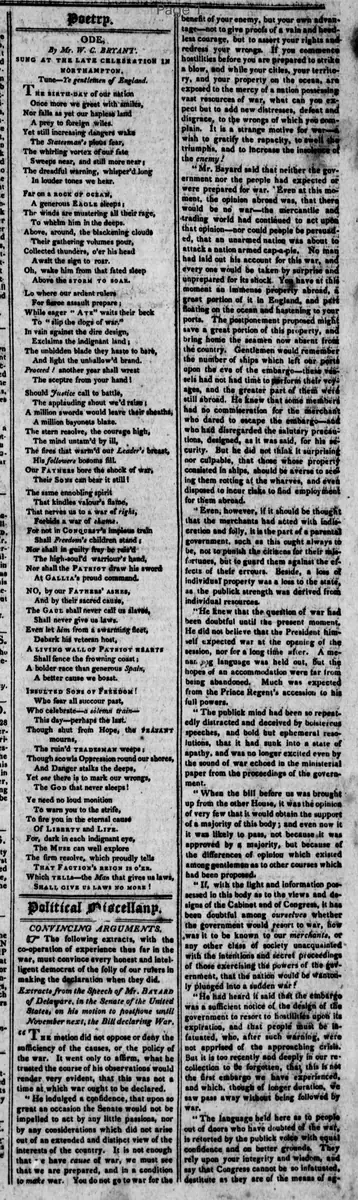
Political miscellany.
CONVINCING ARGUMENTS.
The following extracts, with the
co-operation of experience thus far in the
war, must convince every honest and intelligent
democrat of the folly of our rulers in
making the declaration when they did.
Extract from the Speech of Mr. Bayard
of Delaware, in the Senate of the United
States, on his motion to postpone until
November next; the Bill declaring War.
"The motion did not oppose or deny the
sufficiency of the causes, or the policy of
the war. It went only to affirm, what he
trusted the course of his observations would
render very evident, that this was not a
time at which war ought to be declared.
"He indulged a confidence, that upon so
great an occasion the Senate would not be
impelled to act by any little passions, nor
by any considerations which did not arise
out of an extended and distinct view of the
interests of the country. It is not enough
that we have cause of war, we must see
that we are prepared, and in a condition
to make war. You do not go to war for the
benefit of your enemy, but your own advantage.-not to give proofs of a vain and heed-
less courage. but to assert your rights and
redress your wrongs. If you commence
hostilities before you are prepared to strike
a blow, and while your cities, your territory,
and your property on the ocean, are
exposed to the mercy of a nation possessing
vast resources of war, what can you expect
but to add new distresses, defeat and
disgrace, to the wrongs of which you complain. It is a strange motive for war.
To wish to gratify the rapacity, to swell the
triumphs, and to increase the insolence of
the enemy!
"Mr. Bayard said that neither the government nor the people had expected or
were prepared for war. Even at this moment, the opinion abroad was, that there
would be no war --the mercantile and
trading world had continued to act upon
that opinion--nor could people be persuaded,
that an unarmed nation was about to
attack a nation armed cap-a-pie. No man
had laid out his account for this war, and
every one would be taken by surprise and
unprepared for its shock. You have at this
moment an immense property abroad,
great portion of it in England, and part
floating on the ocean and hastening to your
ports. The postponement proposed might
save a great portion of this property, and
bring home the seamen now absent from
the country. Gentlemen would remember
the number of ships which left our port
upon the eve of the embargo--these vessels
had not had time to perform their voyages, and the greater part of them were
still abroad. He knew that some members
had no commiseration for the merchant
who dared to escape the embargo and
who had disregarded the salutary precautions, designed, as it was said, for his security.
But he did not think it surprising
nor culpable, that those whose property
consisted in ships, should be averse to seeing them rotting at the wharves, and even
disposed to incur risks to find employment
for them abroad.
"Even; however, if it should be thought
that the merchants had acted with indis-
cretion and folly, it is the part of a parental
government, such as this ought always to
be, not to punish the citizens for their mis-
fortunes, but to guard them against the effects of their errors. Beside, a loss of
individual property was a loss to the state,
as the public strength was derived from
individual resources.
"He knew that the question of war had
been doubtful until the present moment.
He did not believe that the President himself expected war at the opening of the
session, nor for a long time after. A menacing language was held out, But the
hopes of an accommodation were far from
being abandoned. Much was expected
from the Prince Regent's accession to his
full powers.
The public mind had been so repeatedly distracted and deceived by boisterous
speeches, and bold but ephemeral resolutions, that it had sunk into a state of
apathy. and was no longer excited even by
the sound of war echoed in the ministerial
paper from the proceedings of the government.
"When the bill before us was brought
up from the other House, it was the opinion
of very few that it would obtain the support
of a majority of this body; and even now it
is likely to pass, not because it was
approved by a majority, but because of
the differences of opinion which existed
among gentlemen as to other courses which
had been proposed.
"If, with the light and information possessed in this body as to the views and designs of the Cabinet and of Congress, it has
been doubtful among ourselves whether
the government would resort to war, how
was it to be known to our merchants, or
any other class of society unacquainted
with the intentions and secret proceedings
of those exercising the powers of the government, that the nation would be wantonly plunged into a sudden war ?
"He had heard it said that the embargo
was a sufficient notice of the design of the
government to resort to hostilities upon its
expiration, and that people must be in-
not apprised of the approaching crisis.
But it is too recently and deeply in our recollection to be forgotten, that this is not
the first embargo we have experienced,
and which, though of longer duration, we
saw pass away without being followed by
war.
"The language held here as to people
out of doors who have doubted of the war,
is retorted by the public voice with equal
confidence and on better grounds. They
rely upon your integrity and wisdom, and
say that Congress cannot be so infatuated,
destitute as they are of the means of war.
aggression or defence, to draw upon themselves a war with one of the most powerful and formidable nations on the globe. If a with Britain be thought unavoidable, she leaves to us the time of commencing it, surely we ought to select that time, when the first shock shall be least disastrous and can best be resisted. Why should we hurry into a war from which nothing but calamity can be expected? There is no danger that the redress of our wrongs or the assertion of our rights will be barred by the limitation of time. No time has existed for years past when we had less cause to complain of the conduct of Great-Britain. If the war be suspended until November, the government and the people will both be better prepared to sustain it. He was not a friend to the restrictive system, but with a choice only of evils, he should prefer the embargo to war. Postpone the war and we will submit to the embargo until November. This will furnish time for the return of your ships and seamen; and if at the same time you will abandon the non-importation act, you will replenish your treasury with at least twelve millions of dollars, and restore to your citizens sixty millions now abroad and in danger of being lost. It appeared to him that the course which had been pursued was the most preposterous imaginable. For eighteen months past we have been sending our property out of the country, and not suffering it to return; and while contemplating a war with Great-Britain, we saw our effects to an immense amount accumulating in that kingdom, liable any moment to fall a prey to the government, and to be employed in support of the war against us.
"He asked why rush with this precipitancy into war? Are you provided with means to annoy the enemy or to defend yourselves? Have you an army or navy which can make any impression? Are your exposed towns fortified and garrisoned? Was any nation ever less prepared for war? It would require the whole military force you possess to constitute an adequate defence of New-Orleans, New-York and Newport. It is very well known that the General who will command at New Orleans, has declared to the government, that he will not be answerable for the security of the place with a less force than ten thousand men, which is equal to all the effective troops yet raised. It would be natural to suppose that no government would declare war till it was prepared to attack an enemy. In peace we require no defence, and shall we declare war in order only to defend ourselves? But what blow, are you prepared to strike? Were you able in the summer to recruit your army of twenty-five thousand men, could it be employed in any service in the course of this year? A soldier is not made in a day. The authority of a foreign officer now in this country of the highest military reputation, he had heard frequently cited, that it required at least fourteen months to form a soldier of a recruit. This remark applied to France, where the officers have generally received a military education, and where there are so many models to imitate and so many instructors to teach. But here the officer is to form as well as the soldier. The officer has to learn his lesson first before he can prescribe the task to the soldier. You may possibly have a herd of men, but you can have no army to lead into service this season. And if this herd be led against disciplined troops you can expect nothing but defeat and disgrace. But you have not got, nor can you get the men during the present year. These are not the days of Cadmus. It will require great patience and industry, and a considerable length of time, to collect twenty-five thousand men. Have you the least prospect, if you declare war, of attacking Canada this season? It is impossible that you can do it with effect. You will be sufficiently occupied in defending your frontiers against the savages."
As Americans may have a curiosity to know what is said in English papers of the war, we have copied the following:
Extract from an Address to the People of Nova Scotia, on the war with America, published in the Halifax papers.
"Fellow Subjects! The threatened day is at length arrived, when the insidious bane of French influence, to the full extent of its mischief, is destined to pervade the long peaceful and happy shores of America. The government of that ill-fated land has declared itself at War with England and her Dependencies, against the interest and affections of both countries.
"Thus is added another nation to the enemies of our parent state; a nation that may well be termed the hostium cariabilis of the list, the offspring of Britain herself, the child of her glorious constitution, and the inheritor of her envied freedom. It is this, my fellow-subjects, that gives severity to the measure, and cruelty to the blow. One would have imagined that a few sparks of filial affection, yet remaining in the hearts of Americans, might have warmed them in the cause of their mother country, and averted this premeditated attack of our common enemy, for such is France to America, as well as to England; and such, alas! will America find her, though acting under the specious garb of an ally, and speaking with the plausible professions of a friend. But it is the Government, and not the People of America, that have declared this unnatural war. The flame, however, is roused, and what direction it may take, and to what extent it may rise, can only be known to that Almighty Director of Events, whose great designs are out of the reach of all human wisdom."
"When the battle begins, whether on land or on ship-board, consider yourselves as engaged with Frenchmen and not Americans."
"Soon will your garrisons be reinforced by a fresh supply of those gallant soldiers, who have been long fighting the battles of their country in the campaigns of Europe, and will be proud to defend the territories of their King, and the property and freedom of their fellow-subjects, wherever situated and however remote."
"Even now are you well able to withstand the foe. You have a fleet upon your coast that could capture the whole navy of America; you have an effective garrison of well disciplined troops, commanded by officers of high merit and distinction; you have a militia of many thousand men ready for active service, and willing to put themselves in motion at a moment's call; and, at the head of your province, uniting the civil and military command, you have an experienced General."
CONVINCING ARGUMENTS.
The following extracts, with the
co-operation of experience thus far in the
war, must convince every honest and intelligent
democrat of the folly of our rulers in
making the declaration when they did.
Extract from the Speech of Mr. Bayard
of Delaware, in the Senate of the United
States, on his motion to postpone until
November next; the Bill declaring War.
"The motion did not oppose or deny the
sufficiency of the causes, or the policy of
the war. It went only to affirm, what he
trusted the course of his observations would
render very evident, that this was not a
time at which war ought to be declared.
"He indulged a confidence, that upon so
great an occasion the Senate would not be
impelled to act by any little passions, nor
by any considerations which did not arise
out of an extended and distinct view of the
interests of the country. It is not enough
that we have cause of war, we must see
that we are prepared, and in a condition
to make war. You do not go to war for the
benefit of your enemy, but your own advantage.-not to give proofs of a vain and heed-
less courage. but to assert your rights and
redress your wrongs. If you commence
hostilities before you are prepared to strike
a blow, and while your cities, your territory,
and your property on the ocean, are
exposed to the mercy of a nation possessing
vast resources of war, what can you expect
but to add new distresses, defeat and
disgrace, to the wrongs of which you complain. It is a strange motive for war.
To wish to gratify the rapacity, to swell the
triumphs, and to increase the insolence of
the enemy!
"Mr. Bayard said that neither the government nor the people had expected or
were prepared for war. Even at this moment, the opinion abroad was, that there
would be no war --the mercantile and
trading world had continued to act upon
that opinion--nor could people be persuaded,
that an unarmed nation was about to
attack a nation armed cap-a-pie. No man
had laid out his account for this war, and
every one would be taken by surprise and
unprepared for its shock. You have at this
moment an immense property abroad,
great portion of it in England, and part
floating on the ocean and hastening to your
ports. The postponement proposed might
save a great portion of this property, and
bring home the seamen now absent from
the country. Gentlemen would remember
the number of ships which left our port
upon the eve of the embargo--these vessels
had not had time to perform their voyages, and the greater part of them were
still abroad. He knew that some members
had no commiseration for the merchant
who dared to escape the embargo and
who had disregarded the salutary precautions, designed, as it was said, for his security.
But he did not think it surprising
nor culpable, that those whose property
consisted in ships, should be averse to seeing them rotting at the wharves, and even
disposed to incur risks to find employment
for them abroad.
"Even; however, if it should be thought
that the merchants had acted with indis-
cretion and folly, it is the part of a parental
government, such as this ought always to
be, not to punish the citizens for their mis-
fortunes, but to guard them against the effects of their errors. Beside, a loss of
individual property was a loss to the state,
as the public strength was derived from
individual resources.
"He knew that the question of war had
been doubtful until the present moment.
He did not believe that the President himself expected war at the opening of the
session, nor for a long time after. A menacing language was held out, But the
hopes of an accommodation were far from
being abandoned. Much was expected
from the Prince Regent's accession to his
full powers.
The public mind had been so repeatedly distracted and deceived by boisterous
speeches, and bold but ephemeral resolutions, that it had sunk into a state of
apathy. and was no longer excited even by
the sound of war echoed in the ministerial
paper from the proceedings of the government.
"When the bill before us was brought
up from the other House, it was the opinion
of very few that it would obtain the support
of a majority of this body; and even now it
is likely to pass, not because it was
approved by a majority, but because of
the differences of opinion which existed
among gentlemen as to other courses which
had been proposed.
"If, with the light and information possessed in this body as to the views and designs of the Cabinet and of Congress, it has
been doubtful among ourselves whether
the government would resort to war, how
was it to be known to our merchants, or
any other class of society unacquainted
with the intentions and secret proceedings
of those exercising the powers of the government, that the nation would be wantonly plunged into a sudden war ?
"He had heard it said that the embargo
was a sufficient notice of the design of the
government to resort to hostilities upon its
expiration, and that people must be in-
not apprised of the approaching crisis.
But it is too recently and deeply in our recollection to be forgotten, that this is not
the first embargo we have experienced,
and which, though of longer duration, we
saw pass away without being followed by
war.
"The language held here as to people
out of doors who have doubted of the war,
is retorted by the public voice with equal
confidence and on better grounds. They
rely upon your integrity and wisdom, and
say that Congress cannot be so infatuated,
destitute as they are of the means of war.
aggression or defence, to draw upon themselves a war with one of the most powerful and formidable nations on the globe. If a with Britain be thought unavoidable, she leaves to us the time of commencing it, surely we ought to select that time, when the first shock shall be least disastrous and can best be resisted. Why should we hurry into a war from which nothing but calamity can be expected? There is no danger that the redress of our wrongs or the assertion of our rights will be barred by the limitation of time. No time has existed for years past when we had less cause to complain of the conduct of Great-Britain. If the war be suspended until November, the government and the people will both be better prepared to sustain it. He was not a friend to the restrictive system, but with a choice only of evils, he should prefer the embargo to war. Postpone the war and we will submit to the embargo until November. This will furnish time for the return of your ships and seamen; and if at the same time you will abandon the non-importation act, you will replenish your treasury with at least twelve millions of dollars, and restore to your citizens sixty millions now abroad and in danger of being lost. It appeared to him that the course which had been pursued was the most preposterous imaginable. For eighteen months past we have been sending our property out of the country, and not suffering it to return; and while contemplating a war with Great-Britain, we saw our effects to an immense amount accumulating in that kingdom, liable any moment to fall a prey to the government, and to be employed in support of the war against us.
"He asked why rush with this precipitancy into war? Are you provided with means to annoy the enemy or to defend yourselves? Have you an army or navy which can make any impression? Are your exposed towns fortified and garrisoned? Was any nation ever less prepared for war? It would require the whole military force you possess to constitute an adequate defence of New-Orleans, New-York and Newport. It is very well known that the General who will command at New Orleans, has declared to the government, that he will not be answerable for the security of the place with a less force than ten thousand men, which is equal to all the effective troops yet raised. It would be natural to suppose that no government would declare war till it was prepared to attack an enemy. In peace we require no defence, and shall we declare war in order only to defend ourselves? But what blow, are you prepared to strike? Were you able in the summer to recruit your army of twenty-five thousand men, could it be employed in any service in the course of this year? A soldier is not made in a day. The authority of a foreign officer now in this country of the highest military reputation, he had heard frequently cited, that it required at least fourteen months to form a soldier of a recruit. This remark applied to France, where the officers have generally received a military education, and where there are so many models to imitate and so many instructors to teach. But here the officer is to form as well as the soldier. The officer has to learn his lesson first before he can prescribe the task to the soldier. You may possibly have a herd of men, but you can have no army to lead into service this season. And if this herd be led against disciplined troops you can expect nothing but defeat and disgrace. But you have not got, nor can you get the men during the present year. These are not the days of Cadmus. It will require great patience and industry, and a considerable length of time, to collect twenty-five thousand men. Have you the least prospect, if you declare war, of attacking Canada this season? It is impossible that you can do it with effect. You will be sufficiently occupied in defending your frontiers against the savages."
As Americans may have a curiosity to know what is said in English papers of the war, we have copied the following:
Extract from an Address to the People of Nova Scotia, on the war with America, published in the Halifax papers.
"Fellow Subjects! The threatened day is at length arrived, when the insidious bane of French influence, to the full extent of its mischief, is destined to pervade the long peaceful and happy shores of America. The government of that ill-fated land has declared itself at War with England and her Dependencies, against the interest and affections of both countries.
"Thus is added another nation to the enemies of our parent state; a nation that may well be termed the hostium cariabilis of the list, the offspring of Britain herself, the child of her glorious constitution, and the inheritor of her envied freedom. It is this, my fellow-subjects, that gives severity to the measure, and cruelty to the blow. One would have imagined that a few sparks of filial affection, yet remaining in the hearts of Americans, might have warmed them in the cause of their mother country, and averted this premeditated attack of our common enemy, for such is France to America, as well as to England; and such, alas! will America find her, though acting under the specious garb of an ally, and speaking with the plausible professions of a friend. But it is the Government, and not the People of America, that have declared this unnatural war. The flame, however, is roused, and what direction it may take, and to what extent it may rise, can only be known to that Almighty Director of Events, whose great designs are out of the reach of all human wisdom."
"When the battle begins, whether on land or on ship-board, consider yourselves as engaged with Frenchmen and not Americans."
"Soon will your garrisons be reinforced by a fresh supply of those gallant soldiers, who have been long fighting the battles of their country in the campaigns of Europe, and will be proud to defend the territories of their King, and the property and freedom of their fellow-subjects, wherever situated and however remote."
"Even now are you well able to withstand the foe. You have a fleet upon your coast that could capture the whole navy of America; you have an effective garrison of well disciplined troops, commanded by officers of high merit and distinction; you have a militia of many thousand men ready for active service, and willing to put themselves in motion at a moment's call; and, at the head of your province, uniting the civil and military command, you have an experienced General."
What sub-type of article is it?
War Or Peace
Military Affairs
Partisan Politics
What keywords are associated?
War Declaration
Bayard Speech
War Preparation
Embargo Effects
British Perspective
Nova Scotia Address
French Influence
What entities or persons were involved?
Mr. Bayard Of Delaware
Senate Of The United States
President
Great Britain
Prince Regent
Congress
Merchants
People Of Nova Scotia
Editorial Details
Primary Topic
Folly Of Premature Declaration Of War With Britain
Stance / Tone
Critical Of Hasty War Declaration And Lack Of Preparation
Key Figures
Mr. Bayard Of Delaware
Senate Of The United States
President
Great Britain
Prince Regent
Congress
Merchants
People Of Nova Scotia
Key Arguments
Nation Is Unprepared For War, Lacking Army, Navy, And Fortifications
Declaration Will Expose Property And Cities To Enemy Without Ability To Strike Back
Postponement To November Would Allow Return Of Ships And Seamen, Saving Property
Embargo And Non Importation Have Sent Wealth Abroad, Now At Risk
Public And Merchants Did Not Expect War, Leading To Surprise And Losses
War Driven By French Influence, Unnatural For America Against Britain
Americans Should View Conflict As Against Frenchmen, Not Fellow Subjects