Thank you for visiting SNEWPapers!
Sign up free
Story
October 6, 1915
The Press
Stafford Springs, Tolland County, Connecticut
What is this article about?
Description of incendiary bombs, which use thermit to generate intense heat and start fires, differing from explosive bombs. W. A. Tilden details their conical structure, components like resinous padding, phosphorus, celluloid, and petrol.
Clipping
OCR Quality
98%
Excellent
Full Text
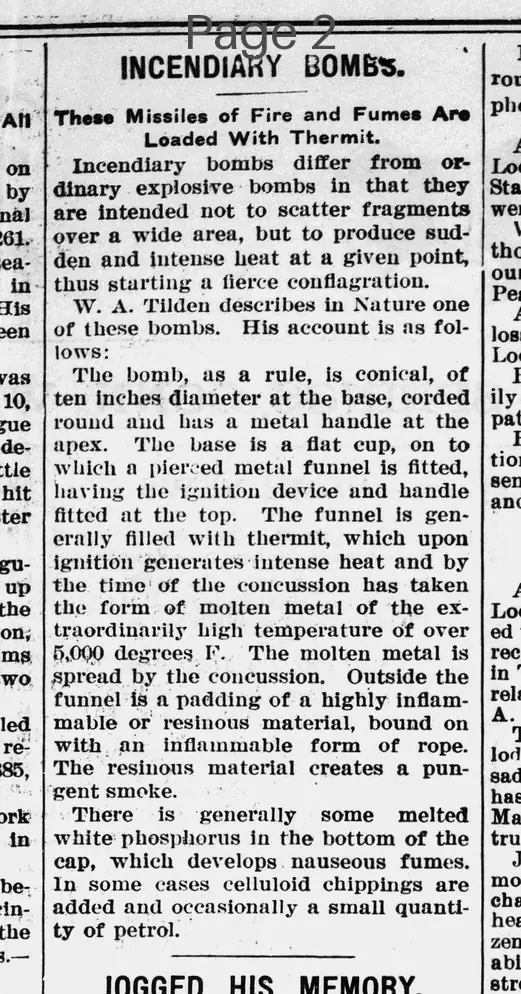
INCENDIARY BOMBS.
These Missiles of Fire and Fumes Are Loaded With Thermit.
Incendiary bombs differ from ordinary explosive bombs in that they are intended not to scatter fragments over a wide area, but to produce sudden and intense heat at a given point, thus starting a fierce conflagration.
W. A. Tilden describes in Nature one of these bombs. His account is as follows:
The bomb, as a rule, is conical, of ten inches diameter at the base, corded round and has a metal handle at the apex. The base is a flat cup, on to which a pierced metal funnel is fitted, having the ignition device and handle fitted at the top. The funnel is generally filled with thermit, which upon ignition generates intense heat and by the time of the concussion has taken the form of molten metal of the extraordinarily high temperature of over 5,000 degrees F. The molten metal is spread by the concussion. Outside the funnel is a padding of a highly inflammable or resinous material, bound on with an inflammable form of rope.
The resinous material creates a pungent smoke.
There is generally some melted white phosphorus in the bottom of the cap, which develops nauseous fumes.
In some cases celluloid chippings are added and occasionally a small quantity of petrol.
These Missiles of Fire and Fumes Are Loaded With Thermit.
Incendiary bombs differ from ordinary explosive bombs in that they are intended not to scatter fragments over a wide area, but to produce sudden and intense heat at a given point, thus starting a fierce conflagration.
W. A. Tilden describes in Nature one of these bombs. His account is as follows:
The bomb, as a rule, is conical, of ten inches diameter at the base, corded round and has a metal handle at the apex. The base is a flat cup, on to which a pierced metal funnel is fitted, having the ignition device and handle fitted at the top. The funnel is generally filled with thermit, which upon ignition generates intense heat and by the time of the concussion has taken the form of molten metal of the extraordinarily high temperature of over 5,000 degrees F. The molten metal is spread by the concussion. Outside the funnel is a padding of a highly inflammable or resinous material, bound on with an inflammable form of rope.
The resinous material creates a pungent smoke.
There is generally some melted white phosphorus in the bottom of the cap, which develops nauseous fumes.
In some cases celluloid chippings are added and occasionally a small quantity of petrol.
What sub-type of article is it?
Curiosity
What themes does it cover?
Catastrophe
What keywords are associated?
Incendiary Bombs
Thermit
Molten Metal
White Phosphorus
Resinous Material
What entities or persons were involved?
W. A. Tilden
Story Details
Key Persons
W. A. Tilden
Story Details
Incendiary bombs are conical devices filled with thermit that produces molten metal at over 5,000 degrees F upon ignition, spreading heat to start fires. They include resinous padding for smoke, white phosphorus for fumes, and sometimes celluloid or petrol.