Thank you for visiting SNEWPapers!
Sign up free
The Lancaster Ledger
Lancaster, Lancaster County, South Carolina
What is this article about?
In a speech to the House of Representatives on February 24, 1852, Hon. J. L. Orr of South Carolina advocates for a bill granting public lands to support construction of the Missouri Railroad from Hannibal to St. Joseph. He defends its constitutionality, Democratic alignment, and benefits including increased land sales, mail and military transport savings, and economic growth in the West.
Clipping
OCR Quality
Full Text
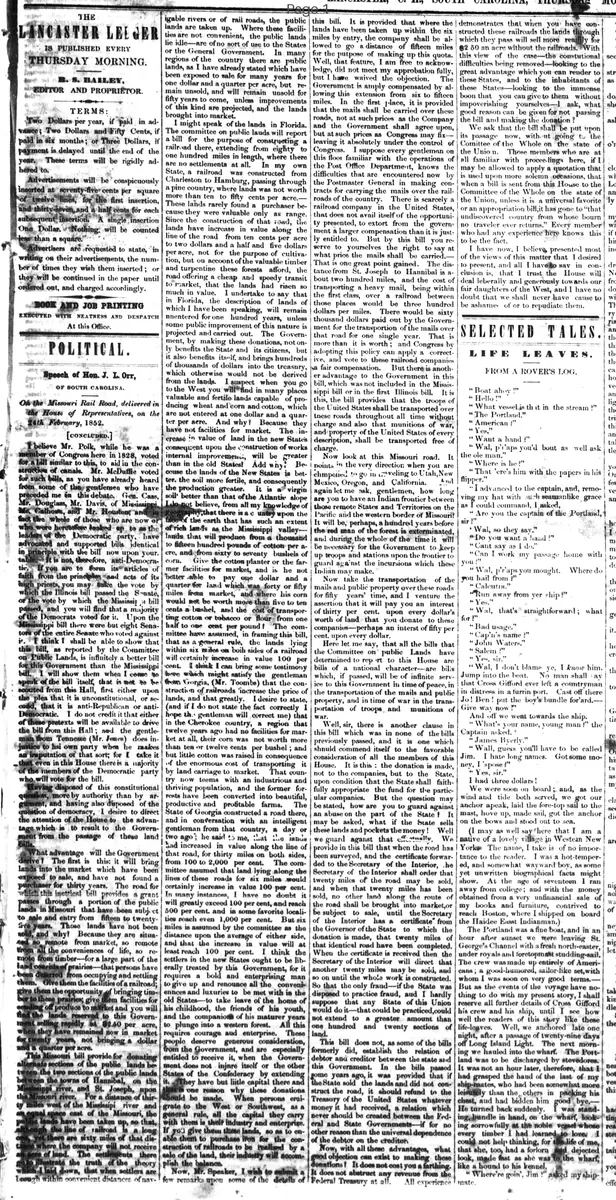
Speech of Hon. J. L. Orr, of South Carolina.
On the Missouri Rail Road, delivered in the House of Representatives, on the 24th February, 1852.
[CONCLUDED.]
I believe Mr. Polk, while he was a member of Congress here in 1828, voted for a bill similar to this, to aid in the construction of canals. Mr. McDuffie voted for such bills, as you have already heard from some of the gentlemen who have preceded me in this debate. Gen. Cass, Mr. Douglas, Mr. Davis, of Mississippi, Mr. Calhoun, and Mr. Houston, and I think the whole of those who are now or who were heretofore looked up to as the leaders of the Democratic party, have advocated and supported bills identical in principle with the bill now upon your table. It is not, therefore, anti-Democratic, if you are to form its articles of faith from the principles and acts of its high priests, you may take the vote by which the Illinois bill passed the Senate or the vote by which the Mississippi bill passed, and you will find that a majority of the Democrats voted for it. Upon the Mississippi bill there were but eight Senators of the entire Senate who voted against it. I think I shall be able to show that this bill, as reported by the Committee on Public Lands, is infinitely a better bill for this Government than the Mississippi bill. I will show them when I come to speak of the bill itself, that it is not to be scouted from this Hall, either upon the plea that it is unconstitutional, or second, that it is anti-Republican or anti-Democratic. I do not credit it that either of these pretexts will be available to drive the bill from this Hall; and the gentleman from Tennessee (Mr. Jones) does injustice to his own party when he makes an imputation of that sort; for I take it that even in this House there is a majority of the members of the Democratic party who will vote for the bill.
Having disposed of this constitutional question, more by authority than by argument, and having also disposed of the question of democracy, I desire to direct the attention of the House to the advantage which is to result to the Government from the passage of these land bills.
What advantage will the Government derive? The first is this: it will bring lands into the market which have been exposed to sale, and have not found a purchaser for thirty years. The road for which this limited bill provides a grant passes through a portion of the public lands in Missouri that have been subject to sale and entry from fifteen to twenty-five years. Those lands have not been sold, and why? Because they are situated so remote from market, so remote from all the conveniences of life, so remote from timber—for a large part of the land consists of prairies—that persons have been deterred from occupying and settling them. Give them the facilities of a railroad; give them the opportunity of bringing timber to these prairies; give them facilities for sending off produce to market and you will find the lands reserved to this Government selling rapidly at $2.50 per acre, when they have remained now in market for twenty years, not bringing a dollar and a quarter per acre.
This Missouri bill provides for donating alternate sections of the public lands between the two sections of the public lands between the towns of Hannibal, on the Mississippi river, and St. Joseph, upon the Missouri river. For a distance of thirty miles west of the Mississippi river and an equal space east of the Missouri, the public lands have been taken up, so that, although the line of railroad is a long one, yet there are sixty miles of that distance where the company will not receive a single acre of land. The settlements there go to illustrate the truth of the theory which I laid down, that when settlers are brought within convenient distances of navigable rivers or of rail roads, the public lands are taken up. Where these facilities are not convenient, the public lands lie idle—are of no sort of use to the States or the General Government. In many regions of the country there are public lands, as I have already stated which have been exposed to sale for many years for one dollar and a quarter per acre, but remain unsold, and will remain unsold for fifty years to come, unless improvements of this kind are projected, and the lands brought into market.
I might speak of the lands in Florida. The committee on public lands will report a bill for the purpose of constructing a railroad there, extending from eighty to one hundred miles in length, where there are no settlements at all. In my own State, a railroad was constructed from Charleston to Hamburg, passing through a pine country, where lands were not worth more than ten to fifty cents per acre. These lands rarely found a purchaser because they were valuable only as range. Since the construction of that road, the lands have increased in value along the line of the road from ten cents per acre to two dollars and a half and five dollars per acre, not for the purpose of cultivation, but on account of the valuable timber and turpentine these forests afford, the road offering a cheap and speedy transit to market, that the lands had risen so much in value. I undertake to say that in Florida, the description of lands of which I have been speaking, will remain unentered for one hundred years, unless some public improvement of this nature is projected and carried out. The Government, by making these donations, not only benefits the State and its citizens, but it also benefits itself, and brings hundreds of thousands of dollars into the treasury, which otherwise would not be derived from the lands. I suspect when you go to the West you will find in many places valuable and fertile lands capable of producing wheat and corn and cotton, which are not entered at one dollar and a quarter per acre. And why! Because they have not facilities for market. The increase in value of land in the new States consequent upon the construction of works of internal improvements, will be greater than in the old States! And why? Because the lands of the New States are better, the soil more fertile, and consequently the production greater. It is a virgin soil better than that of the Atlantic slope. I do not believe, from all my knowledge of physics, that there is a country upon the face of the earth that has such an extent of rich lands as the Mississippi valley—lands that will produce from a thousand to fifteen hundred pounds of cotton per acre, and from sixty to seventy bushels of corn.
Give the cotton planter or the farmer facilities for market, and is he not better able to pay one dollar and a quarter for land which was forty or fifty miles from market, and where his corn would not be worth more than five to ten cents a bushel, and the cost of transporting cotton or tobacco or flour from one half to one cent per pound! The committee have assumed, in framing this bill, that as a general rule, the lands lying within six miles on both sides of a railroad will certainly increase in value 100 per cent. I think I can bring some testimony here which might satisfy the gentleman from Georgia, (Mr. Toombs) that the construction of railroads increase the price of lands, and that greatly. I desire to state, (and if I do not state the fact correctly I hope the gentleman will correct me) that in the Cherokee country, a region that twelve years ago had no facilities for market at all, their corn was not worth more than ten or twelve cents per bushel; and but little cotton was raised in consequence of the enormous cost of transporting it by land carriage to market. That country now teems with an industrious and thriving population, and the former forests have been converted into beautiful, productive and profitable farms. The State of Georgia constructed a road there, and in conversation with an intelligent gentleman from that country, a day or two ago; he said to me, that the lands had increased in value along the line of that road, for thirty miles on both sides, from 100 to 2,000 per cent. The committee assumed that land lying along the lines of these roads for six miles would certainly increase in value 100 per cent. In many instances, I have no doubt it will greatly exceed 100 per cent, and reach 500 per cent. and in some favorite localities reach even 1,000 per cent. But six miles is assumed by the committee as the distance upon the average of either side, and that the increase in value will at least reach 100 per cent. I think the settlers in the new States ought to be liberally treated by this Government, for it requires a bold and enterprising man to give up and renounce all the conveniences and luxuries to be met with in the old States to take leave of the home of his childhood, the friends of his youth, and the companions of his maturer years to plunge into a western forest. All this requires courage and enterprise. These people deserve generous consideration, from the Government, and are especially entitled to receive it, when the Government does not injure itself or the other States of the Confederacy by extending it. They have but little capital there and that is one reason why these donations should be made. When persons emigrate to the West or Southwest, as a general rule, all the capital they carry with them is their industry and enterprise. If you give them these lands, so as to enable them to purchase iron for the construction of railroads to be realized by a sale of the land, their industry will accomplish the balance.
Now, Mr. Speaker, a few remarks upon some of the details of this bill. It is provided that where the lands have been taken up within the six miles by entry, the company shall be allowed to go a distance of fifteen miles for the purpose of making up this quota. Well, that feature, I am free to acknowledge, did not meet my approbation fully, but I have waived the objection. The Government is amply compensated by allowing this extension from six to fifteen miles. In the first place, it is provided that the mails shall be carried over these roads, not at such prices as the Company and the Government shall agree upon, but at such prices as Congress may fix—leaving it absolutely under the control of Congress. I suppose every gentleman on this floor familiar with the operations of the Post Office Department, knows the difficulties that are encountered now by the Postmaster General in making contracts for carrying the mails over the railroads of the country. There is scarcely a railroad company in the United States, that does not avail itself of the opportunity presented, to extort from the government a larger compensation than it is justly entitled to. But by this bill you reserve to yourselves the right to say at what price the mails shall be carried. That is one great point gained. The distance from St. Joseph to Hannibal is about two hundred miles, and the cost of transporting a heavy mail, being within the first class, over a railroad between those places would be three hundred dollars per mile. There would be sixty thousand dollars paid out by the Government for the transportation of the mails over that road for one single year. That is more than it is worth: and Congress by adopting this policy can apply a corrective, and vote to these railroad companies a fair compensation. But there is another advantage to the Government in this bill, which was not included in the Mississippi bill or in the first Illinois bill. It is this, the bill provides that the troops of the United States shall be transported over these roads throughout all time without charge and also that munitions of war, and property of the United States of every description, shall be transported free of charge.
Now look at this Missouri road. It points in the very direction when you are compelled to go in traveling to Utah, New Mexico, Oregon, and California. And again let me ask, gentlemen, how long are you to have an Indian frontier between those remote States and Territories on the Pacific and the western border of Missouri? It will be, perhaps, a hundred years before the red man of the forest is exterminated, and during the whole of that time it will be necessary for the Government to keep up troops and stations upon the frontier to guard against the incursions which these Indians may make.
Now take the transportation of the mails and public property over these roads for fifty years' time, and I venture the assertion that it will pay you an interest of thirty per cent. upon every dollar's worth of land that you donate to these companies—perhaps an interest of fifty per cent. upon every dollar.
Here let me say, that all the bills that the Committee on Public Lands have determined to report to this House are bills of a national character—are bills which, if passed, will be of infinite service to this Government in time of peace, in the transportation of the mails and public property, and in time of war in the transportation of troops and munitions of war.
Well, sir, there is another clause in this bill which was in none of the bills previously passed, and it is one which should commend itself to the favorable consideration of all the members of this House. It is this: the donation is made, not to the companies, but to the State, upon condition that the State shall faithfully appropriate the fund for the particular companies. But the question may be stated, how are you to guard against an abuse on the part of the State! It may be asked, what if the State sells these lands and pockets the money! Well we guard against that effectually. We provide in this bill that when the road has been surveyed, and the certificate forwarded to the Secretary of the Interior, the Secretary of the Interior shall order that twenty miles of the road may be sold, and when that twenty miles has been sold, no other land along the route of the road shall be brought into market, or be subject to sale, until the Secretary of the Interior has a certificate from the Governor of the State to which the donation is made, that twenty miles of that identical road have been completed. When the certificate is received then the Secretary of the Interior will direct that another twenty miles may be sold, and so on until the whole work is constructed. So that the only fraud if the State was disposed to practice fraud, and I hardly suppose that any State of this Union would do it—that could be practiced, could not extend to a greater amount than one hundred and twenty sections of land.
This bill does not, as some of the bills formerly did, establish the relation of debtor and creditor between the State and this Government. In the bills passed some years ago, it was provided that if the State sold the lands and did not construct the road, it should refund to the Treasury of the United States whatever money it had received, a relation which never should be created between the Federal and State Governments—if for no other reason than the universal dependence of the debtor on the creditor.
Now, with all these advantages, what good objection can exist to making these donations? It does not cost you a farthing. It does not abstract any revenue from the Federal Treasury at all. All experience demonstrates that when you have constructed these railroads the lands through which they pass will sell more readily for $2.50 an acre without the railroads. With this view of the case—the constitutional difficulties being removed—looking to the great advantage which you can render to these States, and to the inhabitants of these States—looking to the immense boon that you can give to them without impoverishing yourselves—I ask, what good reason can be given for not passing the bill and making the donation?
We ask that the bill shall be put upon its passage now, without going to the Committee of the Whole on the state of the Union. Those members who are at all familiar with proceedings here, if I may be allowed to apply a quotation that is used upon more solemn occasions, that when a bill is sent from this House to the Committee of the Whole on the state of the Union, unless it is a universal favorite or an appropriation bill, it has gone to 'that undiscovered country from whose bourn no traveler ever returns.' Every member who had any experience here knows this to be the fact.
I have now, I believe, presented most of the views of this matter that I desired to present, and all I have to say in conclusion is, that I trust the House will deal liberally and generously towards our fair daughters of the West, and I have no doubt that we shall never have cause to be ashamed of or to repudiate them.
What sub-type of article is it?
What keywords are associated?
What entities or persons were involved?
Where did it happen?
Domestic News Details
Primary Location
House Of Representatives, Washington
Event Date
24th February, 1852
Key Persons
Event Details
Hon. J. L. Orr delivers a concluding speech advocating for the Missouri Railroad land grant bill, defending its constitutionality by citing Democratic leaders' past support for similar measures, highlighting economic benefits like increased land values and sales, advantages for mail and military transport, and safeguards against state misuse of funds.