Thank you for visiting SNEWPapers!
Sign up free
Literary
July 16, 1916
Tombstone Epitaph
Tombstone, Cochise County, Arizona
What is this article about?
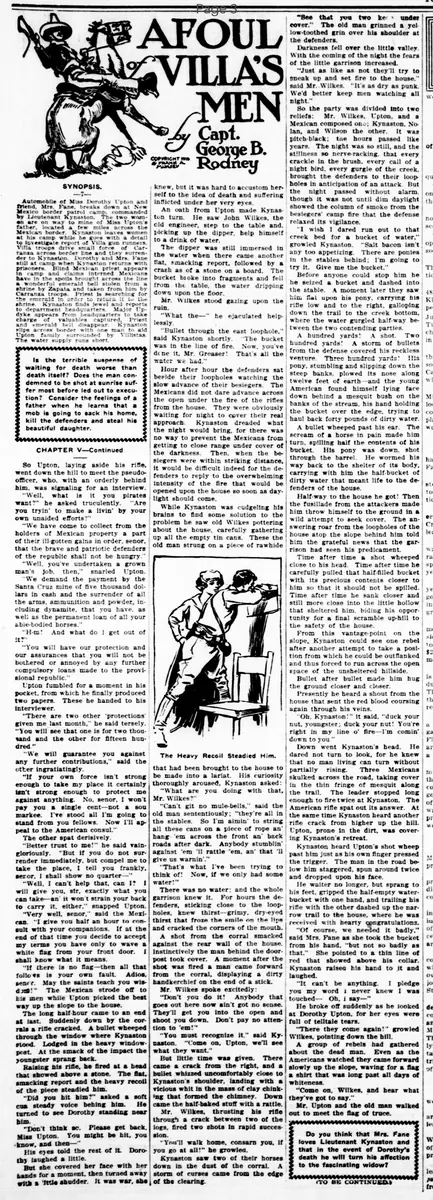
Synopsis of an adventure tale set during the Mexican Revolution: American women encounter border patrol Lt. Kynaston amid Villa gunrunners and a stolen emerald bell. Chapter V depicts a siege at Upton's mine, with extortion demands, water shortage, gunfire, and Kynaston's heroic water fetch under fire.
Clipping
OCR Quality
95%
Excellent
Full Text
SYNOPSIS.
Automobile of Miss Dorothy Upton and friend, Mrs. Fane, breaks down at New Mexico border patrol camp, commanded by Lieutenant Kynaston. The two women are on way to mine of Miss Upton's father, located a few miles across the Mexican border. Kynaston leaves women at his camp while he goes with a detail to investigate report of Villa gun runners. Villa troops drive small force of Carranza across border line and they surrender to Kynaston. Dorothy and Mrs. Fane still at camp when Kynaston returns with prisoners. Blind Mexican priest appears in camp and claims interned Mexicans have in the spoils brought across the line a wonderful emerald bell stolen from a shrine by Zapata and taken from him by Carranza troops. Priest is searching for the emerald in order to return it to the shrine. Kynaston finds jewel and reports to department headquarters. Major Updyke appears from headquarters to take charge of valuables captured. Priest and emerald bell disappear. Kynaston slips across border with one man to aid Upton family surrounded by Villistas.
The water supply runs short.
Is the terrible suspense of waiting for death worse than death itself? Does the man condemned to be shot at sunrise suffer most before led out to execution? Consider the feelings of a father when he learns that a mob is going to sack his home, kill the defenders and steal his beautiful daughter.
CHAPTER V—Continued
So Upton, laying aside his rifle, went down the hill to meet the pseudo-officer, who, with an orderly behind him, was signaling for an interview.
"Well, what is it you pirates want?" he asked truculently. "Are you tryin' to make a livin' by your own unaided efforts?"
"We have come to collect from the holders of Mexican property a part of their ill-gotten gains in order, senor, that the brave and patriotic defenders of the republic shall not be hungry."
"Well, you've undertaken a grown man's job, then," snarled Upton.
"We demand the payment by the Santa Cruz mine of five thousand dollars in cash and the surrender of all the arms, ammunition and powder, including dynamite, that you have, as well as the permanent loan of all your able-bodied horses."
"H-m. And what do I get out of it?"
"You will have our protection and our assurances that you will not be bothered or annoyed by any further compulsory loans made to the provisional republic."
Upton fumbled for a moment in his pocket, from which he finally produced two papers. These he handed to his interviewer.
"There are two other 'protections' given me last month," he said tersely. "You will see that one is for two thousand and the other for fifteen hundred."
"We will guarantee you against any further contributions," said the other ingratiatingly.
"If your own force isn't strong enough to take my place it certainly isn't strong enough to protect me against anything. No, senor, I won't pay you a single cent—not a sou marquee. I've stood all I'm going to stand from you fellows. Now I'll appeal to the American consul."
The other spat derisively.
"Better trust to me!" he said vaingloriously. "But if you do not surrender immediately, but compel me to take the place, I tell you frankly, senor, I shall show no quarter—"
"Well, I can't help that, can I? I will give you, sir, exactly what you can take—an' it won't strain your back to carry it, either," snapped Upton.
"Very well, senor," said the Mexican. "I give you half an hour to consult with your companions. If at the end of that time you decide to accept my terms you have only to wave a white flag from your front door. I shall know what it means.
"If there is no flag—then all that follows is your own fault. Adios, senor. May the saints teach you wisdom!"
The Mexican strode off to his men while Upton picked the best way up the slope to the house.
The long half-hour came to an end at last. Suddenly down by the corrals a rifle cracked. A bullet wheeped through the window where Kynaston stood. Lodged in the heavy window-post. At the smack of the impact the youngster sprang back.
Raising his rifle, he fired at a head that showed above a stone. The flat, smacking report and the heavy recoil of the piece steadied him.
"Did you hit him?" asked a soft, steady voice behind him. He turned to see Dorothy standing near him.
"Don't think so. Please get back, Miss Upton. You might be hit, you know, and then—"
His eyes told the rest of it. Dorothy laughed a little.
But she covered her face with her hands for a moment, then turned away with a little shudder. It was war, she knew, but it was hard to accustom herself to the idea of death and suffering inflicted under her very eyes.
An oath from Upton made Kynaston turn. He saw John Wilkes, the old engineer, step to the table and, picking up the dipper, help himself to a drink of water.
The dipper was still immersed in the water when there came another flat, smacking report, followed by a crash as of a stone on a board. The bucket broke into fragments and fell from the table, the water dripping down upon the floor.
Mr. Wilkes stood gazing upon the ruin.
"What the—" he ejaculated helplessly.
"Bullet through the east loophole," said Kynaston shortly. "The bucket was in the line of fire. Now you've done it, Mr. Greaser! That's all the water we had."
Hour after hour the defenders sat beside their loopholes watching the slow advance of their besiegers. The Mexicans did not dare advance across the open under the fire of the rifles from the house. They were obviously waiting for night to cover their real approach. Kynaston dreaded what the night would bring, for there was no way to prevent the Mexicans from getting to close range under cover of the darkness.
Then, when the besiegers were within striking distance, it would be difficult indeed for the defenders to reply to the overwhelming intensity of the fire that would be opened upon the house so soon as daylight should come.
While Kynaston was cudgeling his brains to find some solution to the problem he saw old Wilkes pottering about the house, carefully gathering up all the empty tin cans. These the old man strung on a piece of rawhide that had been brought to the house to be made into a lariat. His curiosity thoroughly aroused, Kynaston asked:
"What are you doing with that, Mr. Wilkes?"
"Can't git no mule-bells," said the old man sententiously; "they're all in the stables. So I'm aimin' to string all these cans on a piece of rope an' hang 'em across the front an' back roads after dark. Anybody stumblin' against 'em 'll rattle 'em, an' that 'll give us warnin'."
"That's what I've been trying to think of! Now, if we only had some water!"
There was no water; and the whole garrison knew it. For hours the defenders, sticking close to the loopholes, knew thirst—grimy, dry-eyed thirst that froze the smile on the lips and cracked the corners of the mouth.
A shot from the corral smacked against the rear wall of the house. Instinctively the man behind the door-post took cover. A moment after the shot was fired a man came forward from the corral, displaying a dirty handkerchief on the end of a stick.
Mr. Wilkes spoke excitedly:
"Don't you do it! Anybody that goes out here now ain't got no sense. They'll get you into the open and shoot you down. Don't pay no attention to 'em!"
"You must recognize it," said Kynaston. "Come on, Upton, we'll see what they want."
But little time was given. There came a crack from the right, and a bullet whizzed uncomfortably close to Kynaston's shoulder, landing with a vicious whit in the mass of clay chinking that formed the chimney. Down came the half-baked stuff with a rattle.
Mr. Wilkes, thrusting his rifle through a crack between two of the logs, fired two shots in rapid succession.
"You'll walk home, consarn you, if you go at all!" he growled.
Kynaston saw two of their horses down in the dust of the corral. A storm of curses came from the edge of the clearing.
"See that you two keep under cover."
The old man grinned a yellow-toothed grin over his shoulder at the defenders.
Darkness fell over the little valley. With the coming of the night the fears of the little garrison increased.
"Just as like as not they'll try to sneak up and set fire to the house," said Mr. Wilkes. "It's as dry as punk. We'd better keep men watching all night."
So the party was divided into two reliefs: Mr. Wilkes, Upton, and a Mexican composed one; Kynaston, Nolan, and Wilson the other. It was pitch-black; the hours passed like years. The night was so still, and the stillness so nerve-racking, that every crackle in the brush, every call of a night bird, every gurgle of the creek brought the defenders to their loop holes in anticipation of an attack. But the night passed without alarm, though it was not until dim daylight showed the column of smoke from the besiegers' camp fire that the defense relaxed its vigilance.
"I wish I dared run out to that creek bed for a bucket of water," growled Kynaston. "Salt bacon isn't any too appetizing. There are ponies in the stables behind; I'm going to try it. Give me the bucket."
Before anyone could stop him he seized a bucket and dashed into the stable. A moment later they saw him flat upon his pony, carrying his rifle low and to the right, galloping down the trail to the creek bottom, where the water gurgled half-way between the two contending parties.
A hundred yards! A shot. Two hundred yards! A storm of bullets from the defense covered his reckless venture. Three hundred yards: His pony, stumbling and slipping down the steep banks, plowed its nose along twelve feet of earth—and the young American found himself lying face down behind a mesquit bush on the banks of the stream, his hand holding the bucket over the edge, trying to haul back forty pounds of dirty water.
A bullet wheeped past his ear. The scream of a horse in pain made him turn, spilling half the contents of his bucket. His pony was down, shot through the barrel. He wormed his way back to the shelter of its body, carrying with him the half-bucket of dirty water that meant life to the defenders of the house.
Half-way to the house he got! Then the fusillade from the attackers made him throw himself to the ground in a wild attempt to seek cover. The answering roar from the loopholes of the house atop the slope behind him told him the grateful news that the garrison had seen his predicament.
Time after time a shot wheeped close to his head. Time after time he carefully pulled that half-filled bucket with its precious contents closer to him so that it should not be spilled. Time after time he sank closer and still more close into the little hollow that sheltered him, biding his opportunity for a final scramble up-hill to the safety of the house.
From this vantage-point on the slope, Kynaston could see one rebel after another attempt to take a position from which he could be outflanked and thus forced to run across the open space of the unsheltered hillside.
Bullet after bullet made him hug the ground closer and closer. Presently he heard a shout from the house that sent the red blood coursing again through his veins.
"Oh, Kynaston!" it said, "duck your nut, youngster: duck your nut! You're right in my line o' fire—I'm comin' down to you!"
Down went Kynaston's head. He dared not turn to look, for he knew that no man living can turn without partially rising.
Three Mexicans skulked across the road, taking cover in the thin fringe of mesquit along the trail. The leader stopped long enough to fire twice at Kynaston. The American rifle spat out its answer. At the same time Kynaston heard another rifle crack from higher up the hill.
Upton, prone in the dirt, was covering Kynaston's retreat.
Kynaston heard Upton's shot wheep past him just as his own finger pressed the trigger. The man in the road below him staggered, spun around twice and dropped upon his face.
He waited no longer, but sprang to his feet, gripped the half-empty water-bucket with one hand, and trailing his rifle with the other dashed up the narrow trail to the house, where he was received with hearty congratulations.
"Of course, we needed it badly," said Mrs. Fane as she took the bucket from his hand, "but not so badly as that." She pointed to a thin line of red that showed above his collar.
Kynaston raised his hand to it and laughed.
"It can't be anything. I pledge you my word I never knew I was touched— Oh, I say—"
He broke off suddenly as he looked at Dorothy Upton, for her eyes were full of telltale tears.
"There they come again!" growled Wilkes, pointing down the hill.
A group of rebels had gathered about the dead man. Even as the Americans watched they came forward slowly up the slope, waving for a flag—a shirt that was long past all days of whiteness.
"Come on, Wilkes, and hear what they've got to say."
Mr. Upton and the old man walked out to meet the flag of truce.
Do you think that Mrs. Fane loves Lieutenant Kynaston and that in the event of Dorothy's death he will turn his affection to the fascinating widow?
(TO BE CONTINUED)
Automobile of Miss Dorothy Upton and friend, Mrs. Fane, breaks down at New Mexico border patrol camp, commanded by Lieutenant Kynaston. The two women are on way to mine of Miss Upton's father, located a few miles across the Mexican border. Kynaston leaves women at his camp while he goes with a detail to investigate report of Villa gun runners. Villa troops drive small force of Carranza across border line and they surrender to Kynaston. Dorothy and Mrs. Fane still at camp when Kynaston returns with prisoners. Blind Mexican priest appears in camp and claims interned Mexicans have in the spoils brought across the line a wonderful emerald bell stolen from a shrine by Zapata and taken from him by Carranza troops. Priest is searching for the emerald in order to return it to the shrine. Kynaston finds jewel and reports to department headquarters. Major Updyke appears from headquarters to take charge of valuables captured. Priest and emerald bell disappear. Kynaston slips across border with one man to aid Upton family surrounded by Villistas.
The water supply runs short.
Is the terrible suspense of waiting for death worse than death itself? Does the man condemned to be shot at sunrise suffer most before led out to execution? Consider the feelings of a father when he learns that a mob is going to sack his home, kill the defenders and steal his beautiful daughter.
CHAPTER V—Continued
So Upton, laying aside his rifle, went down the hill to meet the pseudo-officer, who, with an orderly behind him, was signaling for an interview.
"Well, what is it you pirates want?" he asked truculently. "Are you tryin' to make a livin' by your own unaided efforts?"
"We have come to collect from the holders of Mexican property a part of their ill-gotten gains in order, senor, that the brave and patriotic defenders of the republic shall not be hungry."
"Well, you've undertaken a grown man's job, then," snarled Upton.
"We demand the payment by the Santa Cruz mine of five thousand dollars in cash and the surrender of all the arms, ammunition and powder, including dynamite, that you have, as well as the permanent loan of all your able-bodied horses."
"H-m. And what do I get out of it?"
"You will have our protection and our assurances that you will not be bothered or annoyed by any further compulsory loans made to the provisional republic."
Upton fumbled for a moment in his pocket, from which he finally produced two papers. These he handed to his interviewer.
"There are two other 'protections' given me last month," he said tersely. "You will see that one is for two thousand and the other for fifteen hundred."
"We will guarantee you against any further contributions," said the other ingratiatingly.
"If your own force isn't strong enough to take my place it certainly isn't strong enough to protect me against anything. No, senor, I won't pay you a single cent—not a sou marquee. I've stood all I'm going to stand from you fellows. Now I'll appeal to the American consul."
The other spat derisively.
"Better trust to me!" he said vaingloriously. "But if you do not surrender immediately, but compel me to take the place, I tell you frankly, senor, I shall show no quarter—"
"Well, I can't help that, can I? I will give you, sir, exactly what you can take—an' it won't strain your back to carry it, either," snapped Upton.
"Very well, senor," said the Mexican. "I give you half an hour to consult with your companions. If at the end of that time you decide to accept my terms you have only to wave a white flag from your front door. I shall know what it means.
"If there is no flag—then all that follows is your own fault. Adios, senor. May the saints teach you wisdom!"
The Mexican strode off to his men while Upton picked the best way up the slope to the house.
The long half-hour came to an end at last. Suddenly down by the corrals a rifle cracked. A bullet wheeped through the window where Kynaston stood. Lodged in the heavy window-post. At the smack of the impact the youngster sprang back.
Raising his rifle, he fired at a head that showed above a stone. The flat, smacking report and the heavy recoil of the piece steadied him.
"Did you hit him?" asked a soft, steady voice behind him. He turned to see Dorothy standing near him.
"Don't think so. Please get back, Miss Upton. You might be hit, you know, and then—"
His eyes told the rest of it. Dorothy laughed a little.
But she covered her face with her hands for a moment, then turned away with a little shudder. It was war, she knew, but it was hard to accustom herself to the idea of death and suffering inflicted under her very eyes.
An oath from Upton made Kynaston turn. He saw John Wilkes, the old engineer, step to the table and, picking up the dipper, help himself to a drink of water.
The dipper was still immersed in the water when there came another flat, smacking report, followed by a crash as of a stone on a board. The bucket broke into fragments and fell from the table, the water dripping down upon the floor.
Mr. Wilkes stood gazing upon the ruin.
"What the—" he ejaculated helplessly.
"Bullet through the east loophole," said Kynaston shortly. "The bucket was in the line of fire. Now you've done it, Mr. Greaser! That's all the water we had."
Hour after hour the defenders sat beside their loopholes watching the slow advance of their besiegers. The Mexicans did not dare advance across the open under the fire of the rifles from the house. They were obviously waiting for night to cover their real approach. Kynaston dreaded what the night would bring, for there was no way to prevent the Mexicans from getting to close range under cover of the darkness.
Then, when the besiegers were within striking distance, it would be difficult indeed for the defenders to reply to the overwhelming intensity of the fire that would be opened upon the house so soon as daylight should come.
While Kynaston was cudgeling his brains to find some solution to the problem he saw old Wilkes pottering about the house, carefully gathering up all the empty tin cans. These the old man strung on a piece of rawhide that had been brought to the house to be made into a lariat. His curiosity thoroughly aroused, Kynaston asked:
"What are you doing with that, Mr. Wilkes?"
"Can't git no mule-bells," said the old man sententiously; "they're all in the stables. So I'm aimin' to string all these cans on a piece of rope an' hang 'em across the front an' back roads after dark. Anybody stumblin' against 'em 'll rattle 'em, an' that 'll give us warnin'."
"That's what I've been trying to think of! Now, if we only had some water!"
There was no water; and the whole garrison knew it. For hours the defenders, sticking close to the loopholes, knew thirst—grimy, dry-eyed thirst that froze the smile on the lips and cracked the corners of the mouth.
A shot from the corral smacked against the rear wall of the house. Instinctively the man behind the door-post took cover. A moment after the shot was fired a man came forward from the corral, displaying a dirty handkerchief on the end of a stick.
Mr. Wilkes spoke excitedly:
"Don't you do it! Anybody that goes out here now ain't got no sense. They'll get you into the open and shoot you down. Don't pay no attention to 'em!"
"You must recognize it," said Kynaston. "Come on, Upton, we'll see what they want."
But little time was given. There came a crack from the right, and a bullet whizzed uncomfortably close to Kynaston's shoulder, landing with a vicious whit in the mass of clay chinking that formed the chimney. Down came the half-baked stuff with a rattle.
Mr. Wilkes, thrusting his rifle through a crack between two of the logs, fired two shots in rapid succession.
"You'll walk home, consarn you, if you go at all!" he growled.
Kynaston saw two of their horses down in the dust of the corral. A storm of curses came from the edge of the clearing.
"See that you two keep under cover."
The old man grinned a yellow-toothed grin over his shoulder at the defenders.
Darkness fell over the little valley. With the coming of the night the fears of the little garrison increased.
"Just as like as not they'll try to sneak up and set fire to the house," said Mr. Wilkes. "It's as dry as punk. We'd better keep men watching all night."
So the party was divided into two reliefs: Mr. Wilkes, Upton, and a Mexican composed one; Kynaston, Nolan, and Wilson the other. It was pitch-black; the hours passed like years. The night was so still, and the stillness so nerve-racking, that every crackle in the brush, every call of a night bird, every gurgle of the creek brought the defenders to their loop holes in anticipation of an attack. But the night passed without alarm, though it was not until dim daylight showed the column of smoke from the besiegers' camp fire that the defense relaxed its vigilance.
"I wish I dared run out to that creek bed for a bucket of water," growled Kynaston. "Salt bacon isn't any too appetizing. There are ponies in the stables behind; I'm going to try it. Give me the bucket."
Before anyone could stop him he seized a bucket and dashed into the stable. A moment later they saw him flat upon his pony, carrying his rifle low and to the right, galloping down the trail to the creek bottom, where the water gurgled half-way between the two contending parties.
A hundred yards! A shot. Two hundred yards! A storm of bullets from the defense covered his reckless venture. Three hundred yards: His pony, stumbling and slipping down the steep banks, plowed its nose along twelve feet of earth—and the young American found himself lying face down behind a mesquit bush on the banks of the stream, his hand holding the bucket over the edge, trying to haul back forty pounds of dirty water.
A bullet wheeped past his ear. The scream of a horse in pain made him turn, spilling half the contents of his bucket. His pony was down, shot through the barrel. He wormed his way back to the shelter of its body, carrying with him the half-bucket of dirty water that meant life to the defenders of the house.
Half-way to the house he got! Then the fusillade from the attackers made him throw himself to the ground in a wild attempt to seek cover. The answering roar from the loopholes of the house atop the slope behind him told him the grateful news that the garrison had seen his predicament.
Time after time a shot wheeped close to his head. Time after time he carefully pulled that half-filled bucket with its precious contents closer to him so that it should not be spilled. Time after time he sank closer and still more close into the little hollow that sheltered him, biding his opportunity for a final scramble up-hill to the safety of the house.
From this vantage-point on the slope, Kynaston could see one rebel after another attempt to take a position from which he could be outflanked and thus forced to run across the open space of the unsheltered hillside.
Bullet after bullet made him hug the ground closer and closer. Presently he heard a shout from the house that sent the red blood coursing again through his veins.
"Oh, Kynaston!" it said, "duck your nut, youngster: duck your nut! You're right in my line o' fire—I'm comin' down to you!"
Down went Kynaston's head. He dared not turn to look, for he knew that no man living can turn without partially rising.
Three Mexicans skulked across the road, taking cover in the thin fringe of mesquit along the trail. The leader stopped long enough to fire twice at Kynaston. The American rifle spat out its answer. At the same time Kynaston heard another rifle crack from higher up the hill.
Upton, prone in the dirt, was covering Kynaston's retreat.
Kynaston heard Upton's shot wheep past him just as his own finger pressed the trigger. The man in the road below him staggered, spun around twice and dropped upon his face.
He waited no longer, but sprang to his feet, gripped the half-empty water-bucket with one hand, and trailing his rifle with the other dashed up the narrow trail to the house, where he was received with hearty congratulations.
"Of course, we needed it badly," said Mrs. Fane as she took the bucket from his hand, "but not so badly as that." She pointed to a thin line of red that showed above his collar.
Kynaston raised his hand to it and laughed.
"It can't be anything. I pledge you my word I never knew I was touched— Oh, I say—"
He broke off suddenly as he looked at Dorothy Upton, for her eyes were full of telltale tears.
"There they come again!" growled Wilkes, pointing down the hill.
A group of rebels had gathered about the dead man. Even as the Americans watched they came forward slowly up the slope, waving for a flag—a shirt that was long past all days of whiteness.
"Come on, Wilkes, and hear what they've got to say."
Mr. Upton and the old man walked out to meet the flag of truce.
Do you think that Mrs. Fane loves Lieutenant Kynaston and that in the event of Dorothy's death he will turn his affection to the fascinating widow?
(TO BE CONTINUED)
What sub-type of article is it?
Prose Fiction
What themes does it cover?
War Peace
Political
Taxation Oppression
What keywords are associated?
Mexican Revolution
Border Siege
Water Shortage
Extortion Demand
Gunfight
Heroic Rescue
Villa Troops
Emerald Bell
Literary Details
Title
Chapter V—Continued
Form / Style
Serialized Adventure Narrative
Key Lines
"Well, What Is It You Pirates Want?" He Asked Truculently. "Are You Tryin' To Make A Livin' By Your Own Unaided Efforts?"
"We Demand The Payment By The Santa Cruz Mine Of Five Thousand Dollars In Cash And The Surrender Of All The Arms, Ammunition And Powder, Including Dynamite, That You Have, As Well As The Permanent Loan Of All Your Able Bodied Horses."
"Now You've Done It, Mr. Greaser! That's All The Water We Had."
"Can't Git No Mule Bells," Said The Old Man Sententiously; "They're All In The Stables. So I'm Aimin' To String All These Cans On A Piece Of Rope An' Hang 'Em Across The Front An' Back Roads After Dark."
Do You Think That Mrs. Fane Loves Lieutenant Kynaston And That In The Event Of Dorothy's Death He Will Turn His Affection To The Fascinating Widow?