Thank you for visiting SNEWPapers!
Sign up free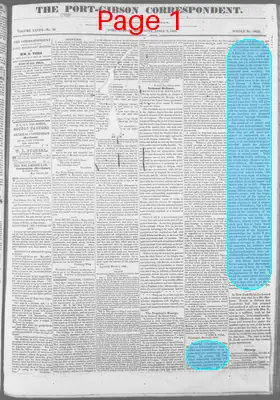
Story
April 8, 1846
The Port Gibson Correspondent
Port Gibson, Claiborne County, Mississippi
What is this article about?
Exploration of Moorish character contrasts: individual honesty and bravery versus national perfidy and cowardice; unique norms on women's modesty, spousal inquiries, honor, and physical punishment without disgrace, compared to Western views.
Clipping
OCR Quality
97%
Excellent
Full Text
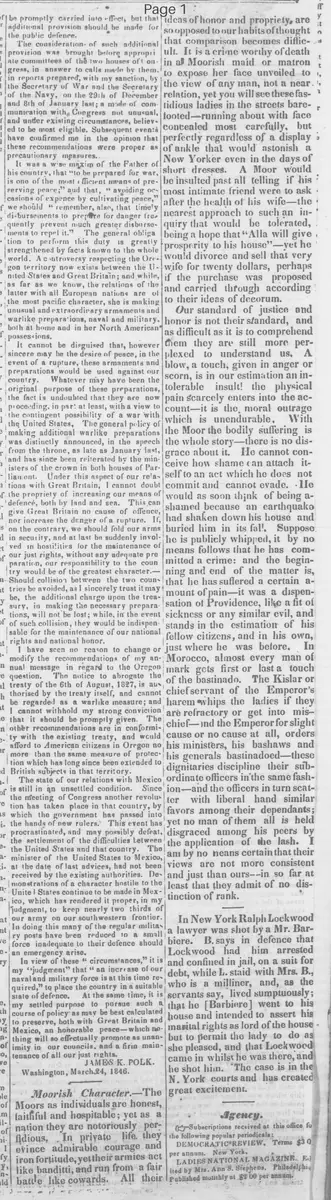
Moorish Character. The Moors as individuals are honest, faithful and hospitable; yet as a nation they are notoriously perfidious. In private life, they evince admirable courage and iron fortitude, yet their armies act like banditti, and run from a fair battle like cowards. All their ideas of honor and propriety, are so opposed to our habits of thought that comparison becomes difficult. It is a crime worthy of death in all Moorish maid or matron to expose her face unveiled to the view of any man, not a near relation, yet you will see these fastidious ladies in the streets bare-footed—running about with face concealed most carefully, but perfectly regardless of a display of ankle that would astonish a New Yorker even in the days of short dresses. A Moor would be insulted past all telling if his most intimate friend were to ask after the health of his wife—the nearest approach to such an inquiry that would be tolerated, being a hope that "Alla will give prosperity to his house"—yet he would divorce and sell that very wife for twenty dollars, perhaps if the purchase was proposed and carried through according to their ideas of decorum.
Our standard of justice and honor is not their standard, and as difficult as it is to comprehend them they are still more perplexed to understand us. A blow, a touch, given in anger or scorn, is in our estimation an intolerable insult! the physical pain scarcely enters into the account—it is the moral outrage which is unendurable. With the Moor the bodily suffering is the whole story—there is no disgrace about it. He cannot conceive how shame can attach itself to an act which he does not commit and cannot evade. He would as soon think of being ashamed because an earthquake had shaken down his house and buried him in its fall. Suppose he is publicly whipped, it by no means follows that he has committed a crime: and the beginning and end of the matter is, that he has suffered a certain amount of pain—it was a dispensation of Providence, like a fit of sickness or any similar evil, and stands in the estimation of his fellow citizens, and in his own, just where he was before. In Morocco, almost every man of mark gets first or last a touch of the bastinado. The Kislar or chief servant of the Emperor's harem whips the ladies if they are refractory or get into mischief—and the Emperor for slight cause or no cause at all, orders his ministers, his bashaws and his generals bastinadoed—these dignitaries discipline their subordinate officers in the same fashion—and the officers in turn scatter with liberal hand similar favors among their dependants; yet no man of them all is held disgraced among his peers by the application of the lash. I am by no means certain that their views are not more consistent and just than ours—in so far at least that they admit of no distinction of rank.
Our standard of justice and honor is not their standard, and as difficult as it is to comprehend them they are still more perplexed to understand us. A blow, a touch, given in anger or scorn, is in our estimation an intolerable insult! the physical pain scarcely enters into the account—it is the moral outrage which is unendurable. With the Moor the bodily suffering is the whole story—there is no disgrace about it. He cannot conceive how shame can attach itself to an act which he does not commit and cannot evade. He would as soon think of being ashamed because an earthquake had shaken down his house and buried him in its fall. Suppose he is publicly whipped, it by no means follows that he has committed a crime: and the beginning and end of the matter is, that he has suffered a certain amount of pain—it was a dispensation of Providence, like a fit of sickness or any similar evil, and stands in the estimation of his fellow citizens, and in his own, just where he was before. In Morocco, almost every man of mark gets first or last a touch of the bastinado. The Kislar or chief servant of the Emperor's harem whips the ladies if they are refractory or get into mischief—and the Emperor for slight cause or no cause at all, orders his ministers, his bashaws and his generals bastinadoed—these dignitaries discipline their subordinate officers in the same fashion—and the officers in turn scatter with liberal hand similar favors among their dependants; yet no man of them all is held disgraced among his peers by the application of the lash. I am by no means certain that their views are not more consistent and just than ours—in so far at least that they admit of no distinction of rank.
What sub-type of article is it?
Curiosity
What themes does it cover?
Social Manners
Justice
What keywords are associated?
Moorish Character
Cultural Contrasts
Honor Norms
Women Modesty
Bastinado Punishment
Where did it happen?
Morocco
Story Details
Location
Morocco
Story Details
Contrasting Moorish individual virtues with national flaws; cultural norms on women's veiling and exposure, spousal privacy, honor through physical rather than moral lens, and acceptance of bastinado without disgrace, differing from Western standards.