Thank you for visiting SNEWPapers!
Sign up free
Editorial
August 18, 1790
Gazette Of The United States
New York, New York County, New York
What is this article about?
Philosophical editorial critiquing human self-deceit in balancing virtues and vices, and the instability of institutions, governments, and religious sects founded on narrow, local principles rather than universal ones, fostering unsocial passions.
Clipping
OCR Quality
95%
Excellent
Full Text
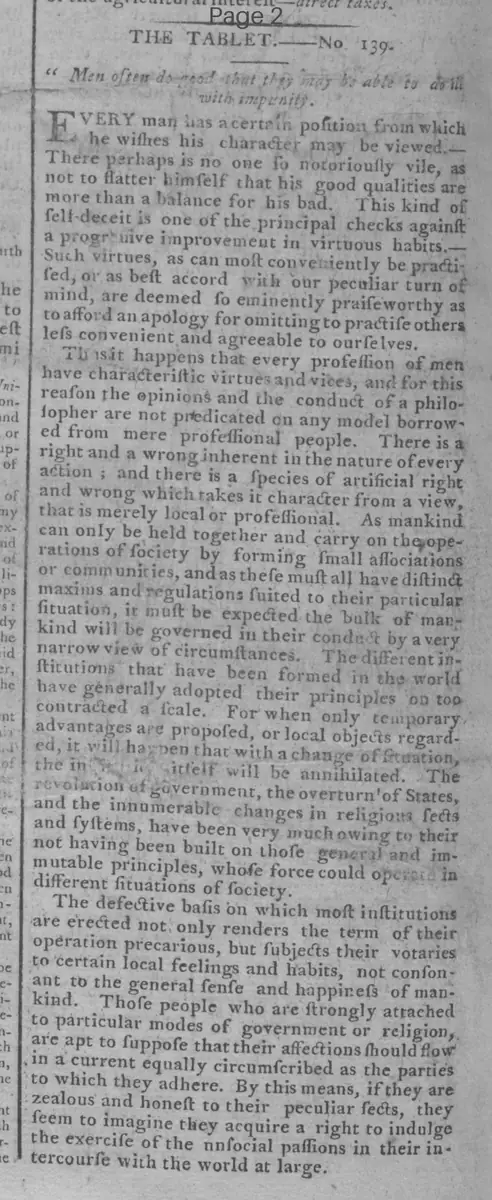
THE TABLET. No 139—
"Men often do most that they may be able to do it
with impunity."
EVERY man has a certain position from which
he wishes his character may be viewed.—
There perhaps is no one so notoriously vile, as
not to flatter himself that his good qualities are
more than a balance for his bad. This kind of
self-deceit is one of the principal checks against
a progressive improvement in virtuous habits.—
Such virtues, as can most conveniently be practiced,
or as best accord with our peculiar turn of
mind, are deemed so eminently praiseworthy as
to afford an apology for omitting to practice others
less convenient and agreeable to ourselves.
Thus it happens that every profession of men
have characteristic virtues and vices, and for this
reason the opinions and the conduct of a philosopher
are not predicated on any model borrowed from mere
professional people. There is a right and a wrong
inherent in the nature of every action; and there is
a species of artificial right and wrong which takes
its character from a view, that is merely local or
professional. As mankind can only be held together
and carry on the operations of society by forming
small associations or communities, and as these must
all have distinct maxims and regulations suited to
their particular situation, it must be expected the
bulk of mankind will be governed in their conduct
by a very narrow view of circumstances. The different institutions
that have been formed in the world have generally
adopted their principles on too contracted a scale.
For when only temporary advantages are proposed,
or local objects regarded, it will happen that with
a change of situation, the institution itself will be
annihilated. The revolution of government, the
overturn of States, and the innumerable changes
in religious sects and systems, have been very much
owing to their not having been built on those general
and immutable principles, whose force could operate
in different situations of society.
The defective basis on which most institutions
are erected not only renders the term of their
operation precarious, but subjects their votaries
to certain local feelings and habits, not consonant
to the general good and happiness of mankind.
Those people who are strongly attached to particular
modes of government or religion, are apt to suppose
that their affections should flow in a current equally
circumscribed as the parties to which they adhere.
By this means, if they are zealous and honest to
their peculiar sects, they seem to imagine they acquire
a right to indulge the exercise of the unsocial passions
in their intercourse with the world at large.
"Men often do most that they may be able to do it
with impunity."
EVERY man has a certain position from which
he wishes his character may be viewed.—
There perhaps is no one so notoriously vile, as
not to flatter himself that his good qualities are
more than a balance for his bad. This kind of
self-deceit is one of the principal checks against
a progressive improvement in virtuous habits.—
Such virtues, as can most conveniently be practiced,
or as best accord with our peculiar turn of
mind, are deemed so eminently praiseworthy as
to afford an apology for omitting to practice others
less convenient and agreeable to ourselves.
Thus it happens that every profession of men
have characteristic virtues and vices, and for this
reason the opinions and the conduct of a philosopher
are not predicated on any model borrowed from mere
professional people. There is a right and a wrong
inherent in the nature of every action; and there is
a species of artificial right and wrong which takes
its character from a view, that is merely local or
professional. As mankind can only be held together
and carry on the operations of society by forming
small associations or communities, and as these must
all have distinct maxims and regulations suited to
their particular situation, it must be expected the
bulk of mankind will be governed in their conduct
by a very narrow view of circumstances. The different institutions
that have been formed in the world have generally
adopted their principles on too contracted a scale.
For when only temporary advantages are proposed,
or local objects regarded, it will happen that with
a change of situation, the institution itself will be
annihilated. The revolution of government, the
overturn of States, and the innumerable changes
in religious sects and systems, have been very much
owing to their not having been built on those general
and immutable principles, whose force could operate
in different situations of society.
The defective basis on which most institutions
are erected not only renders the term of their
operation precarious, but subjects their votaries
to certain local feelings and habits, not consonant
to the general good and happiness of mankind.
Those people who are strongly attached to particular
modes of government or religion, are apt to suppose
that their affections should flow in a current equally
circumscribed as the parties to which they adhere.
By this means, if they are zealous and honest to
their peculiar sects, they seem to imagine they acquire
a right to indulge the exercise of the unsocial passions
in their intercourse with the world at large.
What sub-type of article is it?
Moral Or Religious
Social Reform
What keywords are associated?
Self Deceit
Virtues Vices
Institutions
Government Revolution
Religious Sects
Moral Improvement
Unsocial Passions
Editorial Details
Primary Topic
Self Deceit In Virtues And Flaws In Narrow Institutions
Stance / Tone
Critical Philosophical Reflection
Key Arguments
Self Deceit Balances Personal Virtues Against Vices, Hindering Moral Improvement.
Professions Develop Characteristic Virtues And Vices Based On Convenience.
True Right And Wrong Are Inherent, Not Merely Local Or Professional.
Institutions On Narrow Principles Lead To Instability And Revolutions In Governments And Sects.
Attachment To Local Modes Fosters Unsocial Passions Toward Outsiders.