Thank you for visiting SNEWPapers!
Sign up free
Story
December 29, 1925
The Milwaukee Leader
Milwaukee, Milwaukee County, Wisconsin
What is this article about?
Dr. Herbert J. Spinden, Harvard curator, solved a centuries-old Maya Venus calendar puzzle, linking it to astronomical events between 538 and 530 B.C., building on his earlier findings from 613 and 580 B.C.
Clipping
OCR Quality
98%
Excellent
Full Text
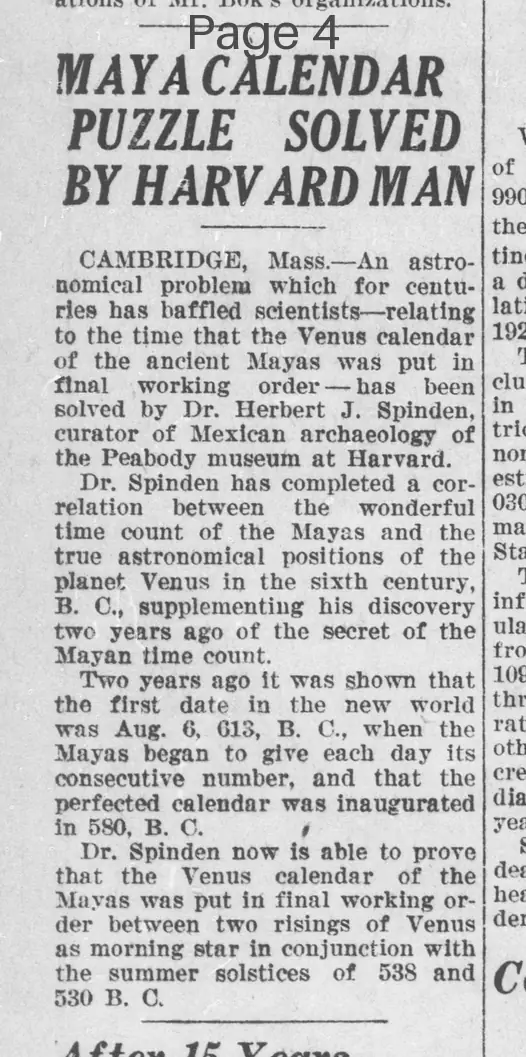
MAYA CALENDAR PUZZLE SOLVED BY HARVARD MAN
CAMBRIDGE, MASS.—An astronomical problem which for centuries has baffled scientists—relating to the time that the Venus calendar of the ancient Mayas was put in final working order—has been solved by Dr. Herbert J. Spinden, curator of Mexican archaeology of the Peabody museum at Harvard.
Dr. Spinden has completed a correlation between the wonderful time count of the Mayas and the true astronomical positions of the planet Venus in the sixth century, B. C., supplementing his discovery two years ago of the secret of the Mayan time count.
Two years ago it was shown that the first date in the new world was Aug. 6, 613, B. C., when the Mayas began to give each day its consecutive number, and that the perfected calendar was inaugurated in 580, B. C.
Dr. Spinden now is able to prove that the Venus calendar of the Mayas was put in final working order between two risings of Venus as morning star in conjunction with the summer solstices of 538 and 530 B. C.
CAMBRIDGE, MASS.—An astronomical problem which for centuries has baffled scientists—relating to the time that the Venus calendar of the ancient Mayas was put in final working order—has been solved by Dr. Herbert J. Spinden, curator of Mexican archaeology of the Peabody museum at Harvard.
Dr. Spinden has completed a correlation between the wonderful time count of the Mayas and the true astronomical positions of the planet Venus in the sixth century, B. C., supplementing his discovery two years ago of the secret of the Mayan time count.
Two years ago it was shown that the first date in the new world was Aug. 6, 613, B. C., when the Mayas began to give each day its consecutive number, and that the perfected calendar was inaugurated in 580, B. C.
Dr. Spinden now is able to prove that the Venus calendar of the Mayas was put in final working order between two risings of Venus as morning star in conjunction with the summer solstices of 538 and 530 B. C.
What sub-type of article is it?
Curiosity
Historical Event
Personal Triumph
What themes does it cover?
Triumph
What keywords are associated?
Maya Calendar
Venus Calendar
Astronomical Puzzle
Dr Spinden
Ancient Mayas
Harvard Discovery
What entities or persons were involved?
Dr. Herbert J. Spinden
Where did it happen?
Cambridge, Mass.
Story Details
Key Persons
Dr. Herbert J. Spinden
Location
Cambridge, Mass.
Event Date
Sixth Century, B. C.
Story Details
Dr. Spinden solved the astronomical problem of the Maya Venus calendar's final working order, correlating it to Venus positions between the summer solstices of 538 and 530 B. C., supplementing his prior discovery that the Mayan time count began on Aug. 6, 613 B. C., with the perfected calendar in 580 B. C.