Thank you for visiting SNEWPapers!
Sign up free
The Kentucky Gazette
Lexington, Fayette County, Kentucky
What is this article about?
Debate in the early U.S. Congress on naturalization laws, where members like Clymer, Page, Lee, Seney, Jackson, Burke, and Tucker discuss gradual admission of foreigners to citizenship rights, property ownership, and voting, balancing encouragement of immigration with preventing electoral corruption.
Clipping
OCR Quality
Full Text
Thursday, February 4
[Continued.]
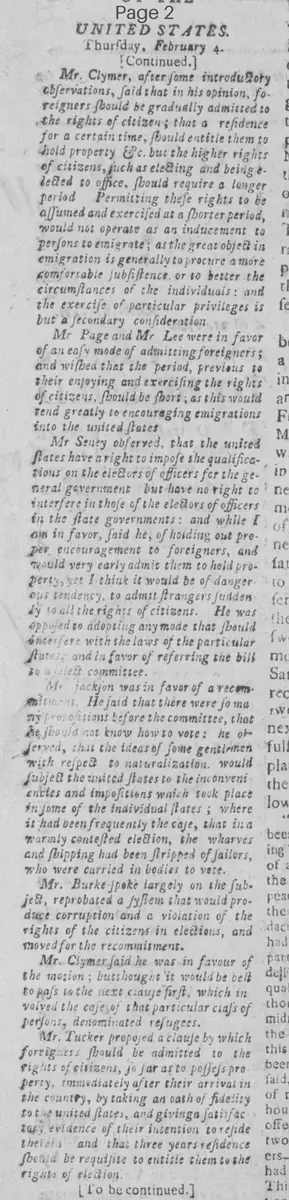
Mr. Clymer, after some introductory observations, said that in his opinion, foreigners should be gradually admitted to the rights of citizens; that a residence for a certain time, should entitle them to hold property, &c. but the higher rights of citizens, such as electing and being elected to office, should require a longer period. Permitting these rights to be assumed and exercised at a shorter period, would not operate as an inducement to persons to emigrate; as the great object in emigration is generally to procure a more comfortable subsistence, or to better the circumstances of the individuals: and the exercise of particular privileges is but a secondary consideration.
Mr. Page and Mr. Lee were in favor of an easy mode of admitting foreigners; and wished that the period, previous to their enjoying and exercising the rights of citizens, should be short; as this would tend greatly to encouraging emigrations into the united states.
Mr. Seney observed, that the united states have a right to impose the qualifications on the electors of officers for the general government but have no right to interfere in those of the electors of officers in the state governments: and while I am in favor, said he, of holding out proper encouragement to foreigners, and would very early admit them to hold property, yet I think it would be of dangerous tendency, to admit strangers suddenly by so all the rights of citizens. He was opposed to adopting any mode that should interfere with the laws of the particular state; and in favor of referring the bill to a select committee.
Mr. Jackson was in favor of a recommittal. He said that there were so many provisions before the committee, that he could not know how to vote: he observed, that the ideas of some gentlemen with respect to naturalization, would subject the united states to the inconveniences and impositions which took place in some of the individual states; where it had been frequently the case, that in a warmly contested election, the wharves and shipping had been stripped of sailors, who were carried in bodies to vote.
Mr. Burke spoke largely on the subject, reprobated a system that would produce corruption and a violation of the rights of the citizens in elections, and moved for the recommittal.
Mr. Clymer said he was in favour of the motion; but thought it would be best to pass to the next clause first, which involved the case of that particular class of persons, denominated refugees.
Mr. Tucker proposed a clause by which foreigners should be admitted to the rights of citizens, so far as to possess property, immediately after their arrival in the country, by taking an oath of fidelity to the united states, and giving satisfactory evidence of their intention to reside therein; and that three years residence should be requisite to entitle them to the rights of election.
What sub-type of article is it?
What themes does it cover?
What keywords are associated?
What entities or persons were involved?
Where did it happen?
Story Details
Key Persons
Location
United States
Event Date
Thursday, February 4
Story Details
Congressional debate on naturalization bill: Clymer advocates gradual rights; Page and Lee favor short periods to encourage immigration; Seney warns against interfering with state laws and sudden full rights; Jackson and Burke push recommittal to avoid corruption like sailor voting; Tucker proposes immediate property rights via oath, three years for election rights.