Thank you for visiting SNEWPapers!
Sign up free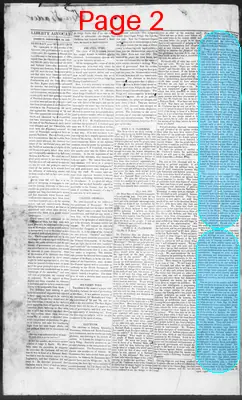
Editorial
September 19, 1837
Liberty Advocate
Liberty, Amite County, Mississippi
What is this article about?
Editorial from Washington City Reformer critiques a Philadelphia Herald piece opposing Texas annexation due to slavery expansion fears, arguing it endangers the Union by violating constitutional rights of slave-holding states and ignoring the original compact. Defends southern position against northern disunion threats.
Clipping

OCR Quality
95%
Excellent
Full Text
From the Washington City Reformer
DANGEROUS CONCLUSIONS.
Let him who has any love for his own country ponder over the following extract from a leading article in the last Philadelphia Herald and Sentinel:
TEXAS, THE UNITED STATES, MEXICO, &c.—We are glad to see the editor of the New York Evening Post take ground decidedly against annexing Texas to the United States. Whether the Texans have any wish now to come into the Union or not, we do not know; but we do know that if any attempt is made, as it has been surmised there would be soon, to annex that country to ours, and thus create some half dozen more slave States, it will raise an opposition at the North that will, if the plan be persevered in, endanger the Union. One thing the South may rest assured of, namely: that no farther territory can be added to our already too extended limits at the South without causing a rupture; and we believe that the same effect would follow a like attempt at the North. Both sections of the Union, the free and slave States, are jealous of each other, and both are striving to obtain a majority in both branches of the National Legislature. So long as no unfair means are resorted to by either to obtain the ascendancy, they may get along without any rupture, though constantly contending; but when might is used to increase power on either side, it will be resisted by might. Let those, then, who would deprecate such a state of things beware how they act, lest they bring it upon us.
COMMENTS.—These are bold and stern admonitions, to use the softest words. When the Constitution of the United States was adopted, a majority of the parties held slaves. Since that time this majority has become the minority, although twelve of the twenty-six States still retain the system of domestic servitude. Had the Constitution retained a clause abolishing slavery in the States, at the time it was framed, will any man pretend to doubt what would have been the consequences? Will any man venture to say it would have been adopted? That man cannot be found, unless as an idiot or a lunatic. The slave-holding States would have rejected it without a dissenting voice.
Now, what has since changed the rights of the parties to the compact? Upon what grounds that have the shadow of reason or right in them, do the non-slave-holding States assume to prescribe conditions, ex post facto, inconsistent with the immunities recognized and secured by the Constitution? If such conditions would originally have defeated the adoption of the Constitution, how is it now defended. with what show of justice and fair dealing can it be maintained, that these conditions should be prescribed against right, and enforced by might? We put the question earnestly and solemnly to every reasonable man in the North. What right have you now to dictate conditions to your co-parties, substantially changing the Constitution; and which, had you urged them originally, would most certainly have defeated its adoption? We ask you to put this question honestly to yourselves, and answer it as becomes men.
We are ever ready to urge considerations and adopt conclusions which jump with our feelings or our interests; and we are rarely disposed to act upon that golden rule of placing ourselves in the condition of those whose rights and interests we decide and determine. The sun is ever shining upon our rights, while mid-night darkness rests upon those of our adversaries. Suppose we were to adopt the reasoning and determination of our Northern brethren, and say to them—Domestic slavery is essential to our happiness and prosperity, to say nothing of political power—we cannot tolerate your domestic institutions as they are—you must change them—you must alter your constitutions, and admit slavery amongst you, or we will not only deny you any additional territory, but will DISSOLVE THE UNION.
Now we put it to the candor and reason of our Northern brethren to say how they would relish the argument when turned against them. "WHATSOEVER YE WOULD THAT MEN SHOULD DO UNTO YOU DO YE ALSO UNTO THEM," is a precept of the purest justice and the most sacred holiness. Are our Northern brethren prepared to heed us when we say to them that the South will dissolve the Union unless they permit slavery in their respective States? No, neither is the South disposed to regard, as of the worth of a feather, the threats of disunion unless conditions be complied with equally obnoxious to their rights and feelings. These menaces pass by them as the idle winds. They will have no influence whatever on their conduct. The Herald intimates that disunion must follow also, if the South obtain an ascendancy in the National councils. It follows, therefore, that the South must disable itself, in perpetuity, in order to preserve the Union! It must not have the influence which the North now enjoys, lest the North dissolve the Union! Are these the views and considerations to be urged upon a brave people, jealous of their rights? We tell our Northern friends and brethren that such arguments and principles never can obtain countenance in the South. They would sooner see this Union broken into a thousand fragments than admit them. They are totally inconsistent with the Constitution, with freedom, and with every idea of equal rights.
DANGEROUS CONCLUSIONS.
Let him who has any love for his own country ponder over the following extract from a leading article in the last Philadelphia Herald and Sentinel:
TEXAS, THE UNITED STATES, MEXICO, &c.—We are glad to see the editor of the New York Evening Post take ground decidedly against annexing Texas to the United States. Whether the Texans have any wish now to come into the Union or not, we do not know; but we do know that if any attempt is made, as it has been surmised there would be soon, to annex that country to ours, and thus create some half dozen more slave States, it will raise an opposition at the North that will, if the plan be persevered in, endanger the Union. One thing the South may rest assured of, namely: that no farther territory can be added to our already too extended limits at the South without causing a rupture; and we believe that the same effect would follow a like attempt at the North. Both sections of the Union, the free and slave States, are jealous of each other, and both are striving to obtain a majority in both branches of the National Legislature. So long as no unfair means are resorted to by either to obtain the ascendancy, they may get along without any rupture, though constantly contending; but when might is used to increase power on either side, it will be resisted by might. Let those, then, who would deprecate such a state of things beware how they act, lest they bring it upon us.
COMMENTS.—These are bold and stern admonitions, to use the softest words. When the Constitution of the United States was adopted, a majority of the parties held slaves. Since that time this majority has become the minority, although twelve of the twenty-six States still retain the system of domestic servitude. Had the Constitution retained a clause abolishing slavery in the States, at the time it was framed, will any man pretend to doubt what would have been the consequences? Will any man venture to say it would have been adopted? That man cannot be found, unless as an idiot or a lunatic. The slave-holding States would have rejected it without a dissenting voice.
Now, what has since changed the rights of the parties to the compact? Upon what grounds that have the shadow of reason or right in them, do the non-slave-holding States assume to prescribe conditions, ex post facto, inconsistent with the immunities recognized and secured by the Constitution? If such conditions would originally have defeated the adoption of the Constitution, how is it now defended. with what show of justice and fair dealing can it be maintained, that these conditions should be prescribed against right, and enforced by might? We put the question earnestly and solemnly to every reasonable man in the North. What right have you now to dictate conditions to your co-parties, substantially changing the Constitution; and which, had you urged them originally, would most certainly have defeated its adoption? We ask you to put this question honestly to yourselves, and answer it as becomes men.
We are ever ready to urge considerations and adopt conclusions which jump with our feelings or our interests; and we are rarely disposed to act upon that golden rule of placing ourselves in the condition of those whose rights and interests we decide and determine. The sun is ever shining upon our rights, while mid-night darkness rests upon those of our adversaries. Suppose we were to adopt the reasoning and determination of our Northern brethren, and say to them—Domestic slavery is essential to our happiness and prosperity, to say nothing of political power—we cannot tolerate your domestic institutions as they are—you must change them—you must alter your constitutions, and admit slavery amongst you, or we will not only deny you any additional territory, but will DISSOLVE THE UNION.
Now we put it to the candor and reason of our Northern brethren to say how they would relish the argument when turned against them. "WHATSOEVER YE WOULD THAT MEN SHOULD DO UNTO YOU DO YE ALSO UNTO THEM," is a precept of the purest justice and the most sacred holiness. Are our Northern brethren prepared to heed us when we say to them that the South will dissolve the Union unless they permit slavery in their respective States? No, neither is the South disposed to regard, as of the worth of a feather, the threats of disunion unless conditions be complied with equally obnoxious to their rights and feelings. These menaces pass by them as the idle winds. They will have no influence whatever on their conduct. The Herald intimates that disunion must follow also, if the South obtain an ascendancy in the National councils. It follows, therefore, that the South must disable itself, in perpetuity, in order to preserve the Union! It must not have the influence which the North now enjoys, lest the North dissolve the Union! Are these the views and considerations to be urged upon a brave people, jealous of their rights? We tell our Northern friends and brethren that such arguments and principles never can obtain countenance in the South. They would sooner see this Union broken into a thousand fragments than admit them. They are totally inconsistent with the Constitution, with freedom, and with every idea of equal rights.
What sub-type of article is it?
Constitutional
Slavery Abolition
Partisan Politics
What keywords are associated?
Texas Annexation
Slavery Expansion
Union Dissolution
Constitutional Rights
Sectional Jealousy
Northern Threats
Southern Defense
What entities or persons were involved?
Philadelphia Herald And Sentinel
New York Evening Post
Texans
United States
Mexico
North
South
Slave Holding States
Editorial Details
Primary Topic
Defense Of Southern Rights Against Northern Opposition To Texas Annexation And Slavery Expansion
Stance / Tone
Strongly Pro Southern, Anti Northern Disunion Threats, Constitutional Defense
Key Figures
Philadelphia Herald And Sentinel
New York Evening Post
Texans
United States
Mexico
North
South
Slave Holding States
Key Arguments
Annexing Texas Would Create More Slave States, Raising Northern Opposition That Endangers The Union.
Northern Threats Of Disunion Over Slavery Expansion Violate The Original Constitutional Compact.
Slave Holding States Would Have Rejected The Constitution If It Abolished Slavery.
Non Slave States Have No Right To Impose Ex Post Facto Conditions Changing The Constitution.
Southerners Apply The Golden Rule: They Would Not Demand Northern States Adopt Slavery Or Face Disunion.
Southern Threats Of Disunion In Response Would Be As Unacceptable As Northern Ones.
South Rejects Perpetual Disablement To Preserve Union; Such Arguments Are Unconstitutional And Unequal.