Thank you for visiting SNEWPapers!
Sign up free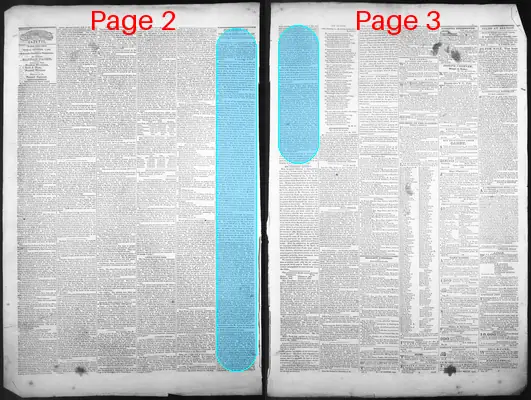
The New Hampshire Gazette
Portsmouth, Rockingham County, New Hampshire
What is this article about?
An 1837 editorial in the Portsmouth Journal responds to a pro-Bank correspondent by citing 1811-1812 Democratic opposition to renewing the Bank of the United States charter, including votes by John Langdon, Elbridge Gerry, and George Clinton. It quotes Thomas Jefferson's extensive anti-bank views from 1803-1813, emphasizing constitutional and economic dangers.
Merged-components note: Continuation across pages of editorial discussing banks, Jefferson's views, and related topics; the text flows sequentially from page 2 to page 3.
Clippings

1 of 2
OCR Quality
Full Text
TUESDAY MORNING, SEPT, 5, 1837.
The following is from the last Portsmouth Journal:
Messrs. Editors,—I was very glad to see your correspondent A. in your last Journal, bring the vote of John Langdon, of New-Hampshire, Elbridge Gerry of Massachusetts. and others, in favor of the old bank of the United States—and I was also pleased to see that Thomas Jefferson did not believe that our territory could be lawfully enlarged. People who undertake to follow the course of great men deceased, would do well to see which path they took.
A DEMOCRAT OF 1812.
This "democrat of 1812" has chosen a rather unfortunate date for his approbation of the Bank of the United States. That Bank (the old Bank) received its quietus in the Senate of the U. States, at the session of 1811, by the casting vote of George Clinton, then Vice President of the United States, and President of the Senate, and it is indeed doubtful if any one act of the democratic party at that time, was received with more universal approbation by the democrats of that day, particularly in this vicinity, than this rejection of the bill to renew its charter. We find George Clinton was toasted at a public dinner of the Democrats of this town July 4 1811 in the following words:
"The Venerable Vice President—He lifts his deciding voice in our national Senate, and the Anglo American Bank shuts its vaults of political poison."
This was one of the regular toasts; Langdon and Gerry were at this time the two most prominent democrats in New Hampshire and Massachusetts. If we mistake not they were at that time the governors of the two States, and we cannot question but they both partook in the general joy at the extinction of this "Anglo-American Bank," notwithstanding twenty years before, (1791,) they may have been instrumental in its establishment. They had by this time sufficient proofs of its injurious tendency. If this writer were in fact a democrat of 1812, he must have been almost alone, in the democratic ranks, touching his opinion of the Bank.
The writer has quoted Mr. Jefferson's opinion in regard to the constitutionality of enlarging our territory, as unfavorable to such enlargement. We have no disposition to question, that this was his opinion, and that it is a sound one. Yet one or more cases have occurred, particularly that of Louisiana, where the peace and welfare of the country demanded it ; and such cases may occur again ; but until they do, we trust we shall never be anxious to extend our territory.—
But why does not this writer quote Mr. Jefferson on the Bank question? He professes to have been a democrat of 1812, and must of course have been a Jeffersonian. He says "people who undertake to follow the course of great men deceased would do well to see what path they took;" if he were a democrat of 1812, he will, we trust, admit that Mr. Jefferson was considered, by the democrats of 1812, to be a great man in his day. Mr. Jefferson was decided against a Bank, from the beginning, and so continued to the last. Mr. Madison and Mr. Monroe were of the same opinion. As late as 1815, Mr. Madison gave his decided veto against a bill to incorporate a bank of the United States, and though he ultimately sanctioned the bill of 1816, it is believed he still retained the same opinions ; but was constrained to yield to the overwhelming sway of a majority, made of political enemies, and a portion of his friends, as was Gen. Jackson in the case of the deposite bill.
We have thought it may not be inappropriate at the present moment to publish a few extracts from Mr. Jefferson, on a National Bank. We might begin at the first establishment of the Old Bank, in 1791, had we time to refer back; but we now begin at 1803. In reply to a letter from Mr. Gallatin, then Secretary of the Treasury, who had submitted to him a letter of the President of the Bank, requesting the opinion of the Executive on some matters relative to the appointment of officers of the branches, he says:
" From a passage in the letter of the President, I observe an idea of establishing a branch bank of the United States in New Orleans. This institution is one of the most deadly hostility existing, against the principles and form of our constitution. The nation is, at this time, so strong and united in its sentiments; that it cannot be shaken at this moment. But suppose a series of untoward events should occur, sufficient to bring into doubt the competency of a republican government to meet a crisis of great danger, or to unhinge the confidence of the people in the public functionaries; an institution like this, penetrating by its branches every part of the Union, acting by command and in phalanx, may, in a critical moment, upset the government. I deem no government safe which is under the vassalage of any self-constituted authorities, or any other authority than that of the nation, or its regular functionaries. What an obstruction could not this bank of the United States, with all its branch banks, be in time of war? It might dictate to us the peace we should accept, or withdraw its aids. Ought we then to give further growth to an institution so powerful, so hostile That it is so hostile we know, 1. from a knowledge of the principles of the persons composing the body of directors in every bank, principal or branch ; and those of most of the stockholders: 2. from their opposition to the measures and principles of the government, and to the election of those friendly to them: and, 3. from the sentiments of the newspapers they support. Now, while we are strong, it is the greatest duty we owe to the safety of our constitution, to bring this powerful enemy to a perfect subordination under its authorities. The first measure would be to reduce them to an equal footing only with other banks, as to the favors of the government. But, in order to be able to meet a general combination of the banks against us, in a critical emergency, could we not make a beginning towards an independent use of our own money, towards holding our own bank in all the deposits where it is received, and letting the Treasurer give his draught or note for payment at any particular place, which, in a well conducted government, ought to have as much credit as any private draught, or bank note, or bill, and would give us the same facilities which we derive from the banks ?"
In a letter to John W. Eppes, in June,1813. when the establishment of the charter of the late Bank was proposed, he says :
" But it will be asked, are we to have no banks ? Are merchants and others to be deprived of the resource of short accommodations, found so convenient? I answer, let us have banks; but let them be such as are alone to be found in any country on earth, except Great Britain. There is not a bank of discount on the continent of Europe (at least there was not one when I was there) which offers any thing but cash for discounted bills. No one has a natural right to the trade of a money-lender, but he who has the money to lend. Let those then among us, who have a monied capital, and who prefer employing it in loans rather than otherwise,get up banks, and give cash or national bills for the notes they discount. Perhaps, to encourage them, a larger interest than is legal in the,other cases might be allowed them, on the condition of their lending for short periods only. It is from Great Britain we copy the idea of giving paper in exchange for discounted bills : and while we have derived from that country some good principles of government and legislation, we unfortunately run into the most servile imitation of every thing else.
all her practices, ruinous as they prove to her, and with the gulph yawning before us into which those very practices are precipitating her. The unlimited emission of bank-paper has banished all her specie, and is now, by a depreciation acknowledged by her own statesmen, carrying her rapidly to bankruptcy, as it did France, as it did us, and will do us again, and every country permitting paper to be circulated, other than that by public authority, rigorously limited to the just measure for circulation. Private fortunes, in the present state of our circulation, are at the mercy of those self-created money-lenders, and are prostrated by the floods of nominal money with which their avarice deluges us. He who lent his money to the public or to an individual, before the institution of the United States' bank, twenty years ago, when wheat was well sold at a dollar the bushel, and receives now his nominal sum when it sells at two dollars, is cheated of half his fortune: and by whom? By the banks, which, since that time, have thrown into circulation ten dollars of their nominal money where there was one at that time.
Again in November of the same year, in a letter to Mr. Eppes, then a member of Congress, in which he goes into a detailed examination of the plan then proposed for a National Bank and on the banking system generally, both in Europe and America, we find the following remarks:
"It is a litigated question whether the circulation of paper rather than specie, is a good or an evil. In the opinion of England and of English writers it is a good; in that of all other nations an evil; and excepting England and her copyist, the United States, there is not a nation existing, I believe which tolerates a paper circulation. The experiment is going on, however, desperately in England, pretty boldly with us, and at the end of the chapter, we shall see which opinion experience approves: for I believe it to be one of those cases where mercantile clamor will bear down reason, untill it is corrected by ruin. In the mean time however let us reason on this new call for a national bank. After the solemn decision of Congress against the renewal of the charter of the bank of the United States and the grounds of that decision (the want of constitutional power) I had imagined that question at rest, and that no more applications would be made to them for the incorporation of banks. The opposition on that ground to its first establishment, the small majority by which it was overborne, and the means practised for obtaining it, cannot be already forgotten. The law having passed,however,by a majority its opponents true to the sacred principle of submission to a majority, suffered the law to flow through its term without obstruction. During this the nation had time to consider the constitutional question, and when the renewal was proposed, they condemned it, not by their representatives in Congress only, but by express instructions from different organs of their will."
Here the writer proceeds to an examination of the question whether Congress ought to comply with the proposition for a Bank, aside from the constitutionality, which is too lengthy in its details for us to copy.
What sub-type of article is it?
What keywords are associated?
What entities or persons were involved?
Editorial Details
Primary Topic
Opposition To The Bank Of The United States Using Jeffersonian And Democratic Historical Views
Stance / Tone
Strongly Anti National Bank, Pro Jeffersonian Democracy
Key Figures
Key Arguments