Thank you for visiting SNEWPapers!
Sign up free
Lynchburg Virginian
Lynchburg, Virginia
What is this article about?
Whig congressmen Proffit and Stanly expose federal government prodigality, detailing losses in Florida War purchases and lavish $12,000 expenses at Charlotte mint for plants, furniture, and unnecessary structures (1837-1838).
Merged-components note: These components form a single coherent article on government expenditures, including the table of contingent expenses as part of the narrative.
Clipping
OCR Quality
Full Text
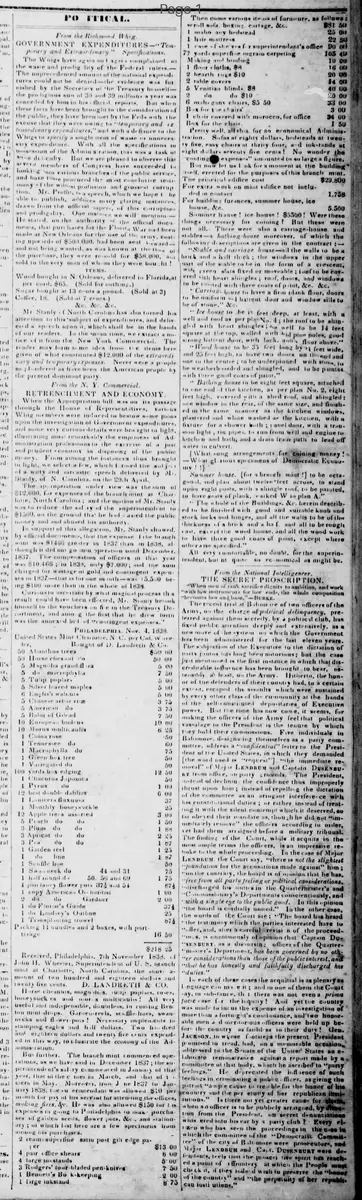
GOVERNMENT EXPENDITURES—"Temporary and Extraordinary" Specifications.
The Whigs have again and again complained of the waste and prodigality of the Federal rulers. The unprecedented amount of the national expenditures could not be denied—the evidence was furnished by the Secretary of the Treasury himself—the prodigious sum of 30 and 39 millions a year was concealed by him in his third reports. But when these facts have been brought to the consideration of the public, they have been met by the Feds with the excuse that they were owing to "temporary and extraordinary expenditures," and with a defiance to the Whigs to specify a single item of waste or unnecessary expenditure. With all the specifications in possession of the Administration, this was a task of some difficulty. But we are pleased to observe that several members of Congress, have succeeded in looking into various branches of the public service, and have thus procured the most conclusive testimony of the vilest profusion and grossest corruption. Mr. Proffit, in a speech, which we hope to be able to publish, adduces many glaring instances, drawn from the official papers, of this corruption and prodigality. One instance we will mention—
He stated, on the authority of the official documents, that purchases for the Florida War had been made at New Orleans for the use of the army, costing upwards of $500,000, had been sent forward— and not being wanted, as was known at the time of the purchase, they were re-sold for $55,000, and sold to the very man from whom they were bought!
ITEMS,
Wood bought in N. Orleans, delivered in Florida, at per cord, $65. (Sold for nothing.)
Sugar bought at 13 cents a pound. (Sold at 3)
Coffee, 18. (Sold at 7 cents.)
& c. & c. & c.
Mr. Stanly of North Carolina has also turned his attention to this subject of expenditures, and delivered a speech upon it, which shall be in the hands of our readers. In the mean time, we extract a notice of it from the New York Commercial. The reader may form some idea from the items here given of what constituted $12,000 of the extraordinary and temporary expenses. Never were a people so plundered as have been the American people by the present dominant party.
From the N. Y. Commercial.
RETRENCHMENT AND ECONOMY.
When the Appropriation bill was on its passage through the House of Representatives, various Whig members were induced to bestow some pains upon the investigation of Government expenditures, and some very curious details were brought to light, illustrating most remarkably the emptiness of Administration professions to the exercise of a just and prudent economy in disposing of the public money. From among the instances thus brought to light, we select a few, which formed the subject of a witty and sarcastic speech delivered by Mr. Stanly, of N. Carolina, on the 28th April.
The appropriation under view was the sum of $12,000, for expenses of the branch mint at Charlotte, North Carolina: and the motion of Mr. Stanly was to reduce the salary of the superintendent to $1,500, on the ground that he had wasted the public money and abused his authority.
In support of this allegation, Mr. Stanly showed, by official documents, that the expense of the branch mint was $1,466 greater in 1837 than in 1838, although it did not go into operation until December, 1837. The compensation of officers in that year was $10,466; in 1838, only $7,000; and the sum charged for wastage of gold and contingent expenses in 1837—that is for one month—was $5,500, being $500 more than in the whole of 1838
Curious to ascertain by what magical process this result could have been effected, Mr. Stanly betook himself to the vouchers on file in the Treasury Department, and among the first that he drew forth was the annexed bill of "contingent expenses."
PHILADELPHIA, Nov. 4, 1838.
United States Mint Charlotte, N. C. per Cart, Wrought by D. Landreth & Co.
To D. Landreth & Co.
$218 25
Received, Philadelphia, 7th November 1838, from John H. Wheeler, Superintendent of U. S. branch mint at Charlotte, North Carolina, the above amount of two hundred and eighteen dollars and twenty five cents.
D. LANDRETH & CO.
Horse chestnuts, magnolias, tulip poplars, roses, honeysuckles and morus multicaulis! All very useful and indispensable, doubtless, in coining Benton mint-drops. Garden-reels, scuffle-hoes, swan-necks and flower-pots! Necessary implements in stamping eagles and half dollars. Two hundred and eighteen dollars and twenty five cents expended in this way, to illustrate the economy of the Administration.
But further. The branch mint commenced operations, as we have said in December 1837; the superintendent's salary commenced in January of that year, that of the assayer in March, and that of the Clerk in May. Moreover, from Jan. 1837 to January 1838, the superintendent was allowed $10 per month for pay of his servant for attending the offices, making fires, &c. He was also allowed $150 for his expenses in going to Philadelphia to make purchases of garden seeds, flower pots, &c., and stationery; of which last here are a few specimens from among his purchases.
2 reams superfine satin post gilt edge paper $13 00
4 pair office shears 6 00
4 large inkstands 5 00
3 Rodgers' four-bladed pen-knives 7 50
1 Bennett's Book-keeping 2 00
1 large inkstand 8 75
| 50 | Achras trees | 50 | 00 |
| 50 | Horse chestnut do | 50 | 00 |
| 5 | Magnolia grandiflora | 5 | 00 |
| 5 | do macrophylla | 7 | 50 |
| 5 | Tulip poplars | 5 | 00 |
| 5 | Silver leaf maples | 5 | 00 |
| 6 | English walnuts | 5 | 00 |
| 5 | Chinese arbor vitae | 3 | 75 |
| 5 | American do | 3 | 75 |
| 5 | Balm of Gilead | 7 | 50 |
| 10 | European buddleia | 10 | 00 |
| 10 | Morus multicaulis | 6 | 25 |
| 1 | China rose | 50 | |
| 1 | Tennessee do | 60 | |
| 1 | Macrophylla do | 75 | |
| 1 | Green box tree | 50 | |
| 1 | Variegated do | 50 | |
| 100 | yards box edging | 12 | 50 |
| 1 | Camellia Japonica | 50 | |
| 1 | Pyrus do | 1 | 00 |
| 12 | best double dahlias | 6 | 00 |
| 1 | Lonicera flexuosa | 37 | |
| 1 | Monthly honeysuckle | 25 | |
| 12 | Apple trees assorted | 3 | 00 |
| 5 | Peach do do | 1 | 50 |
| 3 | Plum do do | 1 | 88 |
| 3 | Apricot do do | 2 | 25 |
| 3 | Pear do do | 1 | 87 |
| 1 | Garden reel | 1 | 25 |
| 1 | do line | 1 | 87 |
| 1 | Scuffle hoe | 50 | |
| 1 | Swan neck do | 75 | |
| 1 | half round do | 1 | 75 |
| 1 | plain fancy flower pots 3 1/2 and 5 1/2 | 87 | |
| 1 | copy American Orchard | 1 | 00 |
| 2 | do do Gardener | 2 | 00 |
| 1 | do Florist's Guide | 37 | |
| 1 | do Lindsey's Outline | 25 | |
| 1 | Transplanting trowel | 87 | |
| Packing 11 bounds and 2 boxes, with porterage |
Then came various items of furniture, as sofas, tables, chairs, &c., amounting to $91 50
1 mahogany bureau $25 00
1 hair mattress 22 50
1 rug for the superintendent's office Door $14 00
77 yards superfine ingrain carpeting 105 49
Making and binding 14 00
1 Aunt Sally, Qr 16 00
2 hearth rugs $10 20 00
2 table covers 14 00
6 Venetian blinds, $9 40 00
do $10 20 00
6 mahogany chairs, $3 50 33 00
Box for four chairs 3 9 00
1 chair covered with morocco, for office 15 00
6 rush bottom chairs 15 00
Pretty well, all this for a branch mint of the United States, built at a cost of $29,600. For extra work on manual office not included in contract 1,758. For buildings insurance, summer house, ice house, &c.: 5,500. Summer house! ice house! $5500! Were these things necessary for coining? But these were not all. There were also a carriage-house and stables—a bathing-house moreover, of which the following descriptions are given in the contract—is "Stable and carriage house—all the walls to be nine brick and a half thick; the windows in the upper part of the stable to be in the form of a crescent, with green slats fixed or moveable; roof to be covered with heart shingles; roof, doors, and windows to be painted with three coats of paint, &c. &c. Carriage house to have a firm plank floor, doors to be panel form and battened door and window sills to be of stone." &c. "Ice house to be 8 feet deep, at least, with a wall and roof as per plan No. 4; the roof to be shingled with heart shingles; the wall to be 14 feet square at the top, waled with white pine poles, good strong battened door, with lock, and floor above." "Wood house to be 35 feet long by 24 feet wide, and 25 feet high, to have two doors on the end and one in the centre; to be underpinned with stone, to be weatherboarded and shingled, and to be painted with three good coats of paint." Bathing house to be eight feet square, attached to one end of the kitchen, as per plan No. 2, eight feet high, covered with a shed roof, and shingled: one window in the rear, of the same size, and finished in the same manner as the kitchen windows, plastered and white washed as the kitchen, with a fixture for a shower bath; panel door, with a transom light, tin pipes to run from well and engine to kitchen and bath, and a drain from bath to lead off water to culvert. [What snug arrangements for coining money! —What glorious specimens of Democratic Economy!!] Summer house, [for a branch mint!] to be octagonal, and plan about twelve feet across, to stand upon eight posts, with a shingle roof, to be painted, to have seats of plank, marked W in plan A." "The whole of the Buildings, &c. herein described to be finished with good and suitable knob and stock locks and hinges, and all the walls to be of the thickness of nine brick and a half, and all to be rough cast, except the wood house, and all the wood work to have three good coats of paint, except where otherwise specified." All very comfortable, no doubt, for the superintendent, but not quite so economical as might be.
What sub-type of article is it?
What keywords are associated?
What entities or persons were involved?
Where did it happen?
Domestic News Details
Primary Location
Charlotte, North Carolina
Event Date
28th April
Key Persons
Outcome
wasteful expenditures exposed, including over $500,000 in florida war supplies resold at $55,000 loss; $12,000 mint expenses including $218.25 on plants and garden items, plus furniture and buildings totaling thousands.
Event Details
Whig members of Congress criticize federal government waste and corruption in expenditures, citing official documents on Florida War supply purchases resold at massive loss and extravagant spending at the Charlotte branch mint on gardens, furniture, stationery, and non-essential buildings like summer house and ice house.