Thank you for visiting SNEWPapers!
Sign up free
Philanthropist
Mount Pleasant, Jefferson County, Ohio
What is this article about?
A letter critiques false notions of national honor rooted in military courage and conquests, arguing instead that true honor lies in Christian virtues, equity, peace, and benevolence. It hopes the Christian Disciple will promote these ideals to preserve peace after recent European news.
Merged-components note: Continuation of the same letter to the editor across pages; original label of second component changed from literary to letter_to_editor.
Clippings
1 of 2
OCR Quality
Full Text
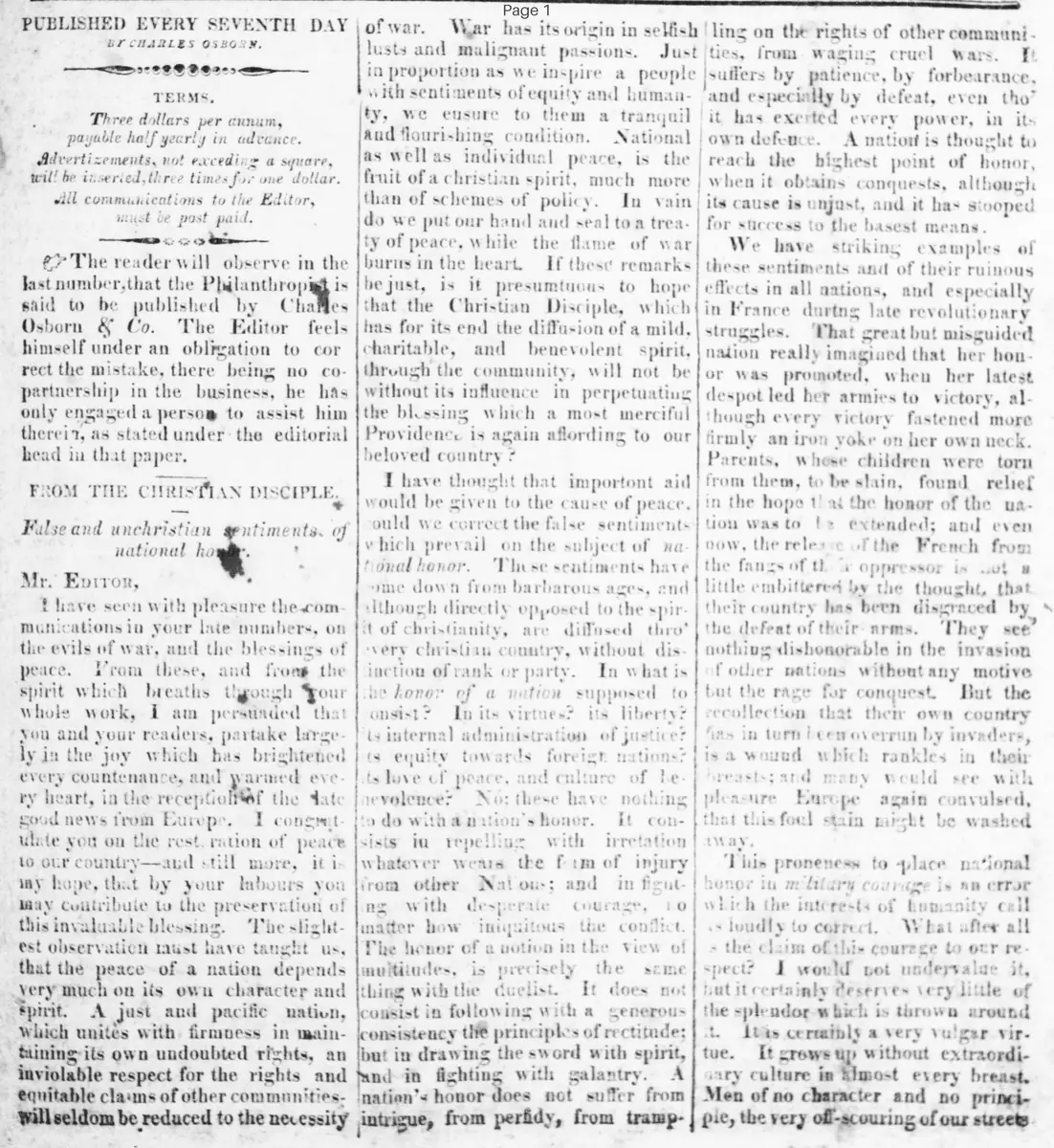
THE CHRISTIAN DISCIPLE.
False and unchristian sentiments.
of
national honor
Mr. Editor,
I have seen with pleasure the communications in your late numbers, on the evils of war, and the blessings of peace. From these, and from the spirit which breathes through your whole work, I am persuaded that you and your readers partake largely in the joy which has brightened every countenance, and warmed every heart, in the reception of the late good news from Europe. I congratulate you on the restoration of peace to our country—and still more, I rejoice in my hope, that by your labours you may contribute to the preservation of this invaluable blessing.
The slightest observation must have taught us, that the peace of a nation depends very much on its own character and spirit. A just and pacific nation, which unites with firmness in maintaining its own undoubted rights, an inviolable respect for the rights and equitable claims of other communities—will seldom be reduced to the necessity of war. War has its origin in selfish lusts and malignant passions. Just in proportion as we inspire a people with sentiments of equity and humanity, we ensure to them a tranquil and flourishing condition. National as well as individual peace, is the fruit of a christian spirit, much more than of schemes of policy. In vain do we put our hand and seal to a treaty of peace, while the flame of war burns in the heart. If these remarks be just, is it presumptuous to hope that the Christian Disciple, which has for its end the diffusion of a mild, charitable, and benevolent spirit through the community, will not be without its influence in perpetuating the blessing which a most merciful Providence is again affording to our beloved country?
I have thought that important aid would be given to the cause of peace, if we correct the false sentiments which prevail on the subject of national honor. These sentiments have come down from barbarous ages, and though directly opposed to the spirit of christianity, are diffused thro' every christian country, without distinction of rank or party.
In what is the honor of a nation supposed to consist? In its virtues? its liberty? its internal administration of justice? equity towards foreign nations? its love of peace, and culture of benevolence? No: these have nothing to do with a nation's honor. It consists in repelling with irritation whatever wears the form of injury from other nations; and in fighting with desperate courage, no matter how iniquitous the conflict. The honor of a nation in the view of multitudes, is precisely the same thing with the duellist. It does not consist in following with a generous consistency the principles of rectitude; but in drawing the sword with spirit, and in fighting with gallantry. A nation's honor does not suffer from intrigue, from perfidy, from trampling on the rights of other communities, from waging cruel wars. It suffers by patience, by forbearance, and especially by defeat, even though it has exerted every power in its own defence. A nation is thought to reach the highest point of honor, when it obtains conquests, although its cause is unjust, and it has stooped for success to the basest means.
We have striking examples of these sentiments and of their ruinous effects in all nations, and especially in France during late revolutionary struggles. That great but misguided nation really imagined that her honor was promoted, when her latest despot led her armies to victory, although every victory fastened more firmly an iron yoke on her own neck. Parents, whose children were torn from them, to be slain, found relief in the hope that the honor of the nation was to be extended; and even now, the release of the French from the fangs of their oppressors is not a little embittered by the thought, that their country has been disgraced by the defeat of their arms. They see nothing dishonorable in the invasion of other nations without any motive but the rage for conquest. But the recollection that their own country has in turn been overrun by invaders, is a wound which rankles in their breast; and many would see with pleasure Europe again convulsed, that this foul stain might be washed away.
This proneness to place national honor in military courage is an error which the interest of humanity calls loudly to correct. What after all is the claim of this courage to our respect? I would not undervalue it, but it certainly deserves very little of the splendor which is thrown around it. It is certainly a very vulgar virtue. It grows up without extraordinary culture in almost every breast. Men of no character and no principle, the very off-scouring of our streets If turned into the ranks, soon catch this contagious courage, and fight as resolutely as men of real elevation of mind. To those of us who live in a condition of ease and security, this courage seems a wonderful acquisition. But to a man living in a camp, where cowardice is not only infamy but death, and where danger is the most familiar object to the mind, it springs up almost mechanically; and a man must have more than a common share of timidity in his constitution, if he does not easily acquire it.
There is a courage of very different nature from this, the courage of principle, which in the city as well as in the camp dares say and do what conscience dictates, and dares nothing more. This courage it is most honorable to venerate and cherish: but unhappily this is not thought to enter into the constitution of a nation's honor.
The false but prevalent sentiment which I have labored to expose, that the honor of a nation consists in military courage and conquests, is most pernicious in its influence. Nations are thus brought to enter with zeal into wars which have no foundation but the ambition of rulers. They submit to intolerable burdens for the support of military establishments. They are willing that the blood and resources of the state should be wasted in pursuit of that phantom, military renown—and all the compensation which they receive for this impoverishment and slaughter is that they hear occasionally a peal of cannons and bells in celebration of a glorious victory, and are assured that never was the honor of a nation so gallantly maintained.
Let it not be imagined that I would have a nation insensible to its honor. The unhappiness is that their true glory is regarded with such entire unconcern. This, I repeat it, consists in the virtue, intelligence, and free spirit of a people, and in the adherence of its government to an upright, liberal, and pacific policy. When will nations learn these obvious truths? When will they learn to measure their honor by the aid they afford to the cause of human improvement in knowledge and liberty, in the arts and virtues, and not by the desolations they spread around them?
not by qualities in which they are equated by almost every barbarous horde, by men in the rudest stages of society:
What sub-type of article is it?
What themes does it cover?
What keywords are associated?
What entities or persons were involved?
Letter to Editor Details
Recipient
Mr. Editor
Main Argument
national honor should derive from christian virtues, equity, peace, and benevolence, not from military courage, conquests, or retaliation, as the latter leads to unnecessary wars and contradicts christian principles.
Notable Details