Thank you for visiting SNEWPapers!
Sign up free
Story
January 2, 1867
Lewistown Gazette
Lewistown, Mifflin County, Pennsylvania
What is this article about?
In the quiet town of W-, Deacon Lee, a reserved but kind man, resists a scheming visitor's attempts to oust the local minister by sharing his past regret over betraying a former pastor, emphasizing loyalty to God's servants.
Clipping
OCR Quality
95%
Excellent
Full Text
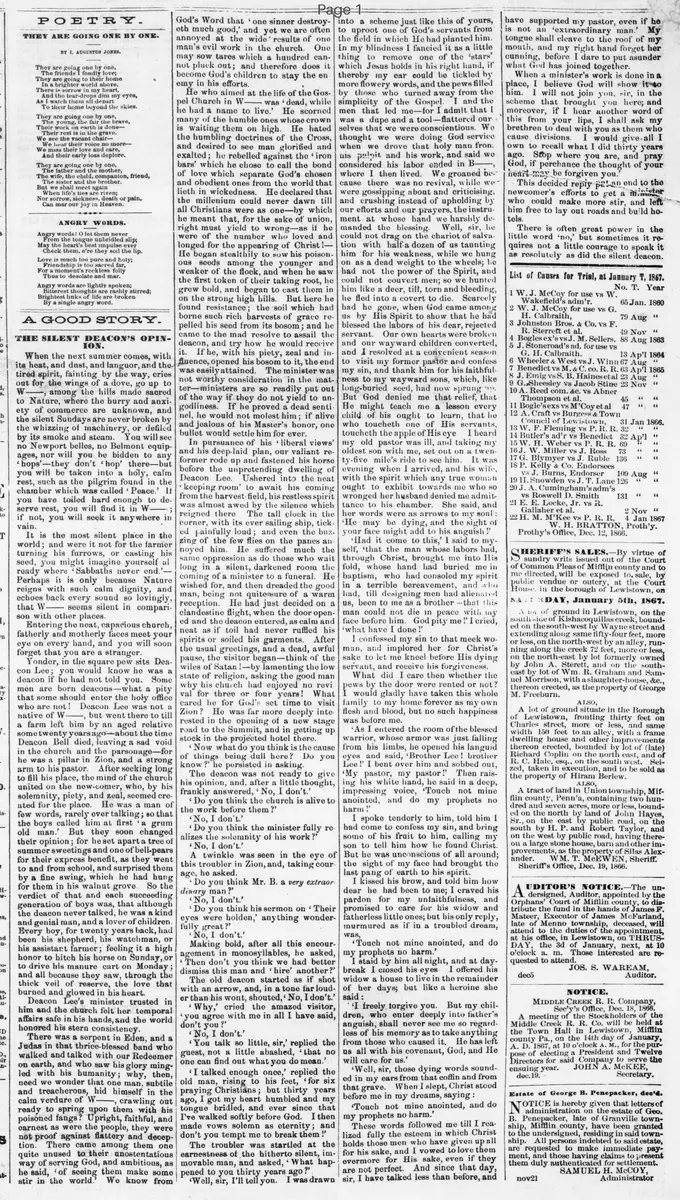
A GOOD STORY.
THE SILENT DEACON'S OPINION.
When the next summer comes, with its heat, and dust, and languor, and the tired spirit, fainting by the way, cries out for the wings of a dove, go up to W-, among the hills made sacred to Nature, where the hurry and anxiety of commerce are unknown, and the silent Sundays are never broken by the whizzing of machinery, or defiled by its smoke and steam. You will see no Newport belles, no Belmont equipages, nor will you be bidden to any 'hops'—they don't 'hop' there—but you will be taken into a holy, calm rest, such as the pilgrim found in the chamber which was called 'Peace.' If you have toiled hard enough to deserve rest, you will find it in W-; if not, you will seek it anywhere in vain.
It is the most silent place in the world; and were it not for the farmer turning his furrows, or casting his seed, you might imagine yourself already where 'Sabbaths never end.'—Perhaps it is only because Nature reigns with such calm dignity, and echoes back every sound so lovingly, that W- seems silent in comparison with other places.
Entering the neat, capacious church, fatherly and motherly faces meet your eye on every hand, and you will soon forget that you are a stranger.
Yonder, in the square pew sits Deacon Lee; you would know he was a deacon if he had not told you. Some men are born deacons—what a pity that some should enter the holy office who are not! Deacon Lee was not a native of W-, but went there to till a farm left him by an aged relative some twenty years ago—about the time Deacon Bell died, leaving a sad void in the church and the parsonage—for he was a pillar in Zion, and a strong arm to his pastor. After seeking long to fill his place, the mind of the church united on the now-comer, who, by his solemnity, piety, and zeal, seemed created for the place. He was a man of few words, rarely ever talking; so that the boys called him at first 'a grum-old man.' But they soon changed their opinion; for he set apart a tree of summer sweetings and one of bell-pears for their express benefit, as they went to and from school, and surprised them by a fine swing, which he had hung for them in his walnut grove. So the verdict of that and each succeeding generation of boys was, that although the deacon never talked, he was a kind and genial man, and a lover of children.
Every boy, for twenty years back, had been his shepherd, his watchman, or his assistant farmer; feeling it a high honor to hitch his horse on Sunday, or to drive his manure cart on Monday; and all because they saw, through the thick veil of reserve, the love that burned and glowed in his heart.
Deacon Lee's minister trusted in him and the church felt her temporal affairs safe in his hands, and the world honored his stern consistency.
There was a serpent in Eden, and a Judas in that thrice-blessed band who walked and talked with our Redeemer on earth, and who saw his glory mingled with his humanity; why, then, need we wonder that one man, subtile and treacherous, hid himself in the calm verdure of W-, crawling out ready to spring upon them with his poisoned fangs? Upright, faithful, and earnest as were the people, they were not proof against flattery and deception. There came among them one quite unused to their unostentatious way of serving God, and ambitious, as he said, of seeing them make some stir in the world. We know from God's Word that 'one sinner destroyeth much good,' and yet we are often annoyed at the wide results of one man's evil work in the church. One may sow tares which a hundred cannot pluck out: and therefore does it become God's children to stay the enemy in his efforts.
He who aimed at the life of the Gospel Church in W- was 'dead, while he had a name to live.' He scorned many of the humble ones whose crown is waiting them on high. He hated the humbling doctrines of the Cross, and desired to see man glorified and exalted; he rebelled against the 'iron bars' which he chose to call the bond of love which separate God's chosen and obedient ones from the world that lieth in wickedness. He declared that the millennium could never dawn till all Christians were as one—by which he meant that, for the sake of union, right must yield to wrong—as if he were of the number who loved and longed for the appearing of Christ!—He began stealthily to sow his poisonous seeds among the younger and weaker of the flock, and when he saw the first token of their taking root, he grew bold, and began to cast them in on the strong high walls. But here he found resistance; the soil which had borne such rich harvests of grace repelled his seed from its bosom; and he came to the mad resolve to assail the deacon, and try how he would receive it. If he, with his piety, zeal and influence, opened his bosom to it, the end was easily attained. The minister was not worthy consideration in the matter—ministers are so readily put out of the way if they do not yield to ungodliness. If he proved a dead sentry, he would not molest him: if alive and jealous of his Master's honor, one bullet would settle him for ever.
In pursuance of his liberal views' and his deep-laid plan, our valiant reformer rode up and fastened his horse before the unpretending dwelling of Deacon Lee. Ushered into the neat 'keeping room' to await his coming from the harvest-field, his restless spirit was almost awed by the silence which reigned there. The tall clock in the corner, with its ever sailing ship, ticked painfully loud: and even the buzzing of the few flies on the panes annoyed him. He suffered much the same oppression as do those who wait long in a silent, darkened room the coming of a minister to a funeral. He wished for, and then dreaded the good man, being not quite sure of a warm reception. He had just decided on a clandestine fight, when the door opened and the deacon entered, as calm and neat as if toil had never ruffled his spirits or soiled his garments. After the usual greetings, and a dead, awful pause, the visitor began—think of the wiles of Satan!—by lamenting the low state of religion, asking the good man why his church had enjoyed no revival for three or four years! What cared he for God's set time to visit Zion? He was far more deeply interested in the opening of a new stage road to the Summit, and in getting up stock in the projected hotel there.
Now what do you think is the cause of things being dull here? Do you know?' he persisted in asking.
The deacon was not ready to give his opinion, and, after a little thought, frankly answered, 'No, I don't.'
Do you think the church is alive to the work before them?'
No, I don't.'
'Do you think the minister fully realizes the solemnity of his work?'
No. I don't.'
A twinkle was seen in the eye of this troubler in Zion, and, taking courage, he asked.
Do you think Mr. B. a very extraordinary man?"
No, I don't.'
'Do you think his sermon on 'Their eyes were holden,' anything wonderfully great?'
'No, I don't.'
Making bold, after all this encouragement in monosyllables, he asked, Then don't you think we had better dismiss this man and 'hire' another?'
The old deacon started as if shot with an arrow, and, in a tone far louder than his wont, shouted, 'No, I don't.'
'Why,' cried the amazed visitor, 'you agree with me in all I have said, don't you?'
No, I don't.'
'You talk so little, sir,' replied the guest, not a little abashed, 'that no one can find out what you do mean.'
'I talked enough once,' replied the old man, rising to his feet, 'for six praying Christians; but thirty years ago, I got my heart humbled and my tongue bridled, and ever since that I've walked softly before God. I then made vows solemn as eternity; and don't you tempt me to break them!'
The troubler was startled at the earnestness of the hitherto silent, immovable man, and asked, 'What happened to you thirty years ago?'
Well, sir, I'll tell you. I was drawn into a scheme just like this of yours, to uproot one of God's servants from the field in which He had planted him. In my blindness I fancied it as a little thing to remove one of the 'stars' which Jesus holds in his right hand, if thereby my ear could be tickled by more flowery words, and the pews filled by those who turned away from the simplicity of the Gospel. I and the men that led me—for I admit that I was a dupe and a tool—flattered ourselves that we were conscientious. We thought we were doing God service when we drove that holy man from his pulpit and his work, and said we considered his labor ended in B---, where I then lived. We groaned because there was no revival, while we were gossipping about and criticising, and crushing instead of upholding by our efforts and our prayers, the instrument at whose hand we harshly demanded the blessing. Well, sir, he could not drag on the chariot of salvation with half a dozen of us taunting him for his weakness, while we hung on as a dead weight to the wheels; he had not the power of the Spirit, and could not convert men; so we hunted him like a deer, till, torn and bleeding, he fled into a covert to die. Scarcely had he gone, when God came among us by His Spirit to show that he had blessed the labors of his dear, rejected servant. Our own hearts were broken and our wayward children converted, and I resolved at a convenient season to visit my former pastor and confess my sin, and thank him for his faithfulness to my wayward sons, which, like long-buried seed, had now sprung up. But God denied me that relief, that He might teach me a lesson every child of his ought to learn, that he who toucheth one of His servants, toucheth the apple of His eye. I heard my old pastor was ill, and taking my oldest son with me, set out on a twenty-five mile's ride to see him. It was evening when I arrived, and his wife, with the spirit which any true woman ought to exhibit towards me who so wronged her husband denied me admittance to his chamber. She said, and her words were as arrows to my soul: 'He may be dying, and the sight of your face might add to his anguish!'
'Had it come to this,' I said to myself, 'that the man whose labors had, through Christ, brought me into His fold, whose hand had buried me in baptism, who had consoled my spirit in a terrible bereavement, and who had, till designing men had alienated us, been to me as a brother—that this man could not die in peace with my face before him. God pity me!' I cried, 'what have I done!'
I confessed my sin to that meek woman, and implored her for Christ's sake to let me kneel before His dying servant, and receive his forgiveness. What did I care then whether the pews by the door were rented or not? I would gladly have taken this whole family to my home forever as my own flesh and blood, but no such happiness was before me.
'As I entered the room of the blessed warrior, whose armor was just falling from his limbs, he opened his languid eyes and said, 'Brother Lee! brother Lee!' I bent over him and sobbed out, 'My pastor, my pastor!' Then raising his white hand, he said in a deep, impressing voice, 'Touch not mine anointed, and do my prophets no harm!'
I spoke tenderly to him, told him I had come to confess my sin, and bring some of his fruit to him, calling my son to tell him how he found Christ. But he was unconscious of all around; the sight of my face had brought the last pang of earth to his spirit.
I kissed his brow, and told him how dear he had been to me: I craved his pardon for my unfaithfulness, and promised to care for his widow and fatherless little ones; but his only reply, in murmured as if in a troubled dream, was, 'Touch not mine anointed, and do my prophets no harm.'
I staid by him all night, and at daybreak I closed his eyes. I offered his widow a house to live in the remainder of her days; but like a heroine she said: 'I freely forgive you. But my children, who enter deeply into father's anguish, shall never see me so regardless of his memory as to take anything from those who caused it. He has left us all with his covenant God, and He will care for us.'
Well, sir, those dying words sounded in my ears from that coffin and from that grave. When I slept, Christ stood before me in my dreams, saying: 'Touch not mine anointed, and do my prophets no harm.'
These words followed me till I realized fully the esteem in which Christ holds those men who have given up all for his sake, and I vowed to love them evermore for His sake, even if they are not perfect. And since that day, sir, I have talked less than before, and have supported my pastor, even if he is not an extraordinary man.' My tongue shall cleave to the roof of my mouth, and my right hand forget her cunning, before I dare to put asunder what God has joined together.
When a minister's work is done in a place, I believe God will show it to him. I will not join you, sir, in the scheme that brought you here; and moreover, if I hear another word of this from your lips, I shall ask my brethren to deal with you as them who cause divisions. I would give all I own to recall what I did thirty years ago. Stop where you are, and pray God, if perchance the thought of your heart may be forgiven you.
This decided reply put an end to the newcomer's efforts to get a minister who could make more stir, and left him free to lay out roads and build hotels.
There is often great power in the little word 'no,' but sometimes it requires not a little courage to speak it as resolutely as did the silent deacon.
THE SILENT DEACON'S OPINION.
When the next summer comes, with its heat, and dust, and languor, and the tired spirit, fainting by the way, cries out for the wings of a dove, go up to W-, among the hills made sacred to Nature, where the hurry and anxiety of commerce are unknown, and the silent Sundays are never broken by the whizzing of machinery, or defiled by its smoke and steam. You will see no Newport belles, no Belmont equipages, nor will you be bidden to any 'hops'—they don't 'hop' there—but you will be taken into a holy, calm rest, such as the pilgrim found in the chamber which was called 'Peace.' If you have toiled hard enough to deserve rest, you will find it in W-; if not, you will seek it anywhere in vain.
It is the most silent place in the world; and were it not for the farmer turning his furrows, or casting his seed, you might imagine yourself already where 'Sabbaths never end.'—Perhaps it is only because Nature reigns with such calm dignity, and echoes back every sound so lovingly, that W- seems silent in comparison with other places.
Entering the neat, capacious church, fatherly and motherly faces meet your eye on every hand, and you will soon forget that you are a stranger.
Yonder, in the square pew sits Deacon Lee; you would know he was a deacon if he had not told you. Some men are born deacons—what a pity that some should enter the holy office who are not! Deacon Lee was not a native of W-, but went there to till a farm left him by an aged relative some twenty years ago—about the time Deacon Bell died, leaving a sad void in the church and the parsonage—for he was a pillar in Zion, and a strong arm to his pastor. After seeking long to fill his place, the mind of the church united on the now-comer, who, by his solemnity, piety, and zeal, seemed created for the place. He was a man of few words, rarely ever talking; so that the boys called him at first 'a grum-old man.' But they soon changed their opinion; for he set apart a tree of summer sweetings and one of bell-pears for their express benefit, as they went to and from school, and surprised them by a fine swing, which he had hung for them in his walnut grove. So the verdict of that and each succeeding generation of boys was, that although the deacon never talked, he was a kind and genial man, and a lover of children.
Every boy, for twenty years back, had been his shepherd, his watchman, or his assistant farmer; feeling it a high honor to hitch his horse on Sunday, or to drive his manure cart on Monday; and all because they saw, through the thick veil of reserve, the love that burned and glowed in his heart.
Deacon Lee's minister trusted in him and the church felt her temporal affairs safe in his hands, and the world honored his stern consistency.
There was a serpent in Eden, and a Judas in that thrice-blessed band who walked and talked with our Redeemer on earth, and who saw his glory mingled with his humanity; why, then, need we wonder that one man, subtile and treacherous, hid himself in the calm verdure of W-, crawling out ready to spring upon them with his poisoned fangs? Upright, faithful, and earnest as were the people, they were not proof against flattery and deception. There came among them one quite unused to their unostentatious way of serving God, and ambitious, as he said, of seeing them make some stir in the world. We know from God's Word that 'one sinner destroyeth much good,' and yet we are often annoyed at the wide results of one man's evil work in the church. One may sow tares which a hundred cannot pluck out: and therefore does it become God's children to stay the enemy in his efforts.
He who aimed at the life of the Gospel Church in W- was 'dead, while he had a name to live.' He scorned many of the humble ones whose crown is waiting them on high. He hated the humbling doctrines of the Cross, and desired to see man glorified and exalted; he rebelled against the 'iron bars' which he chose to call the bond of love which separate God's chosen and obedient ones from the world that lieth in wickedness. He declared that the millennium could never dawn till all Christians were as one—by which he meant that, for the sake of union, right must yield to wrong—as if he were of the number who loved and longed for the appearing of Christ!—He began stealthily to sow his poisonous seeds among the younger and weaker of the flock, and when he saw the first token of their taking root, he grew bold, and began to cast them in on the strong high walls. But here he found resistance; the soil which had borne such rich harvests of grace repelled his seed from its bosom; and he came to the mad resolve to assail the deacon, and try how he would receive it. If he, with his piety, zeal and influence, opened his bosom to it, the end was easily attained. The minister was not worthy consideration in the matter—ministers are so readily put out of the way if they do not yield to ungodliness. If he proved a dead sentry, he would not molest him: if alive and jealous of his Master's honor, one bullet would settle him for ever.
In pursuance of his liberal views' and his deep-laid plan, our valiant reformer rode up and fastened his horse before the unpretending dwelling of Deacon Lee. Ushered into the neat 'keeping room' to await his coming from the harvest-field, his restless spirit was almost awed by the silence which reigned there. The tall clock in the corner, with its ever sailing ship, ticked painfully loud: and even the buzzing of the few flies on the panes annoyed him. He suffered much the same oppression as do those who wait long in a silent, darkened room the coming of a minister to a funeral. He wished for, and then dreaded the good man, being not quite sure of a warm reception. He had just decided on a clandestine fight, when the door opened and the deacon entered, as calm and neat as if toil had never ruffled his spirits or soiled his garments. After the usual greetings, and a dead, awful pause, the visitor began—think of the wiles of Satan!—by lamenting the low state of religion, asking the good man why his church had enjoyed no revival for three or four years! What cared he for God's set time to visit Zion? He was far more deeply interested in the opening of a new stage road to the Summit, and in getting up stock in the projected hotel there.
Now what do you think is the cause of things being dull here? Do you know?' he persisted in asking.
The deacon was not ready to give his opinion, and, after a little thought, frankly answered, 'No, I don't.'
Do you think the church is alive to the work before them?'
No, I don't.'
'Do you think the minister fully realizes the solemnity of his work?'
No. I don't.'
A twinkle was seen in the eye of this troubler in Zion, and, taking courage, he asked.
Do you think Mr. B. a very extraordinary man?"
No, I don't.'
'Do you think his sermon on 'Their eyes were holden,' anything wonderfully great?'
'No, I don't.'
Making bold, after all this encouragement in monosyllables, he asked, Then don't you think we had better dismiss this man and 'hire' another?'
The old deacon started as if shot with an arrow, and, in a tone far louder than his wont, shouted, 'No, I don't.'
'Why,' cried the amazed visitor, 'you agree with me in all I have said, don't you?'
No, I don't.'
'You talk so little, sir,' replied the guest, not a little abashed, 'that no one can find out what you do mean.'
'I talked enough once,' replied the old man, rising to his feet, 'for six praying Christians; but thirty years ago, I got my heart humbled and my tongue bridled, and ever since that I've walked softly before God. I then made vows solemn as eternity; and don't you tempt me to break them!'
The troubler was startled at the earnestness of the hitherto silent, immovable man, and asked, 'What happened to you thirty years ago?'
Well, sir, I'll tell you. I was drawn into a scheme just like this of yours, to uproot one of God's servants from the field in which He had planted him. In my blindness I fancied it as a little thing to remove one of the 'stars' which Jesus holds in his right hand, if thereby my ear could be tickled by more flowery words, and the pews filled by those who turned away from the simplicity of the Gospel. I and the men that led me—for I admit that I was a dupe and a tool—flattered ourselves that we were conscientious. We thought we were doing God service when we drove that holy man from his pulpit and his work, and said we considered his labor ended in B---, where I then lived. We groaned because there was no revival, while we were gossipping about and criticising, and crushing instead of upholding by our efforts and our prayers, the instrument at whose hand we harshly demanded the blessing. Well, sir, he could not drag on the chariot of salvation with half a dozen of us taunting him for his weakness, while we hung on as a dead weight to the wheels; he had not the power of the Spirit, and could not convert men; so we hunted him like a deer, till, torn and bleeding, he fled into a covert to die. Scarcely had he gone, when God came among us by His Spirit to show that he had blessed the labors of his dear, rejected servant. Our own hearts were broken and our wayward children converted, and I resolved at a convenient season to visit my former pastor and confess my sin, and thank him for his faithfulness to my wayward sons, which, like long-buried seed, had now sprung up. But God denied me that relief, that He might teach me a lesson every child of his ought to learn, that he who toucheth one of His servants, toucheth the apple of His eye. I heard my old pastor was ill, and taking my oldest son with me, set out on a twenty-five mile's ride to see him. It was evening when I arrived, and his wife, with the spirit which any true woman ought to exhibit towards me who so wronged her husband denied me admittance to his chamber. She said, and her words were as arrows to my soul: 'He may be dying, and the sight of your face might add to his anguish!'
'Had it come to this,' I said to myself, 'that the man whose labors had, through Christ, brought me into His fold, whose hand had buried me in baptism, who had consoled my spirit in a terrible bereavement, and who had, till designing men had alienated us, been to me as a brother—that this man could not die in peace with my face before him. God pity me!' I cried, 'what have I done!'
I confessed my sin to that meek woman, and implored her for Christ's sake to let me kneel before His dying servant, and receive his forgiveness. What did I care then whether the pews by the door were rented or not? I would gladly have taken this whole family to my home forever as my own flesh and blood, but no such happiness was before me.
'As I entered the room of the blessed warrior, whose armor was just falling from his limbs, he opened his languid eyes and said, 'Brother Lee! brother Lee!' I bent over him and sobbed out, 'My pastor, my pastor!' Then raising his white hand, he said in a deep, impressing voice, 'Touch not mine anointed, and do my prophets no harm!'
I spoke tenderly to him, told him I had come to confess my sin, and bring some of his fruit to him, calling my son to tell him how he found Christ. But he was unconscious of all around; the sight of my face had brought the last pang of earth to his spirit.
I kissed his brow, and told him how dear he had been to me: I craved his pardon for my unfaithfulness, and promised to care for his widow and fatherless little ones; but his only reply, in murmured as if in a troubled dream, was, 'Touch not mine anointed, and do my prophets no harm.'
I staid by him all night, and at daybreak I closed his eyes. I offered his widow a house to live in the remainder of her days; but like a heroine she said: 'I freely forgive you. But my children, who enter deeply into father's anguish, shall never see me so regardless of his memory as to take anything from those who caused it. He has left us all with his covenant God, and He will care for us.'
Well, sir, those dying words sounded in my ears from that coffin and from that grave. When I slept, Christ stood before me in my dreams, saying: 'Touch not mine anointed, and do my prophets no harm.'
These words followed me till I realized fully the esteem in which Christ holds those men who have given up all for his sake, and I vowed to love them evermore for His sake, even if they are not perfect. And since that day, sir, I have talked less than before, and have supported my pastor, even if he is not an extraordinary man.' My tongue shall cleave to the roof of my mouth, and my right hand forget her cunning, before I dare to put asunder what God has joined together.
When a minister's work is done in a place, I believe God will show it to him. I will not join you, sir, in the scheme that brought you here; and moreover, if I hear another word of this from your lips, I shall ask my brethren to deal with you as them who cause divisions. I would give all I own to recall what I did thirty years ago. Stop where you are, and pray God, if perchance the thought of your heart may be forgiven you.
This decided reply put an end to the newcomer's efforts to get a minister who could make more stir, and left him free to lay out roads and build hotels.
There is often great power in the little word 'no,' but sometimes it requires not a little courage to speak it as resolutely as did the silent deacon.
What sub-type of article is it?
Biography
Deception Fraud
Heroic Act
What themes does it cover?
Moral Virtue
Deception
Providence Divine
What keywords are associated?
Deacon
Church Deception
Minister Loyalty
Moral Regret
Religious Intrigue
Pastoral Support
Vow Of Silence
What entities or persons were involved?
Deacon Lee
Mr. B.
The Visitor
Deacon Bell
The Former Pastor
The Former Pastor's Wife
Where did it happen?
W , Among The Hills; B
Story Details
Key Persons
Deacon Lee
Mr. B.
The Visitor
Deacon Bell
The Former Pastor
The Former Pastor's Wife
Location
W , Among The Hills; B
Event Date
Thirty Years Ago
Story Details
Deacon Lee recounts to a scheming visitor his past mistake of helping oust a faithful minister, leading to regret and a vow of silence and loyalty; he refuses to join the plot against the current minister Mr. B., upholding church unity.