Thank you for visiting SNEWPapers!
Sign up free
Editorial
June 23, 1952
The Daily Record
Dunn, Harnett County, North Carolina
What is this article about?
Columnist Drew Pearson corrects errors about Kefauver's father and Alaska newsprint, defends press role in exposing senatorial misconduct like Thomas's speculation and Brewster's wire-tapping/lobbying, crediting public votes in Oklahoma and Maine for accountability.
Clipping
OCR Quality
98%
Excellent
Full Text
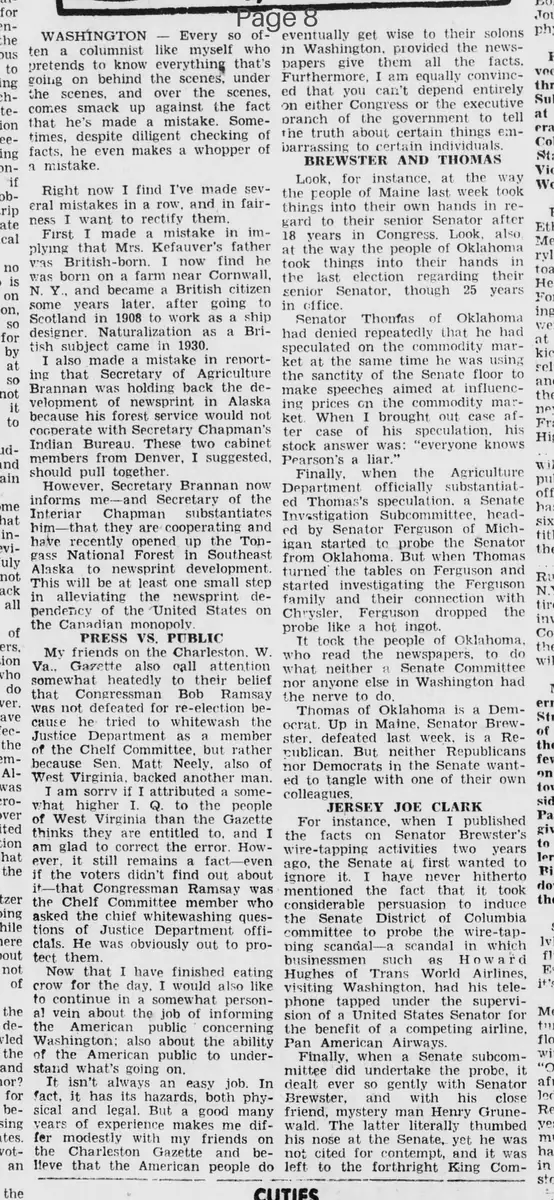
WASHINGTON
Every so often a columnist like myself who pretends to know everything that's going on behind the scenes, under the scenes, and over the scenes, comes smack up against the fact that he's made a mistake. Sometimes, despite diligent checking of facts, he even makes a whopper of a mistake.
Right now I find I've made several mistakes in a row, and in fairness I want to rectify them.
First I made a mistake in implying that Mrs. Kefauver's father was British-born. I now find he was born on a farm near Cornwall, N. Y., and became a British citizen some years later, after going to Scotland in 1908 to work as a ship designer. Naturalization as a British subject came in 1930.
I also made a mistake in reporting that Secretary of Agriculture Brannan was holding back the development of newsprint in Alaska because his forest service would not cooperate with Secretary Chapman's Indian Bureau. These two cabinet members from Denver, I suggested, should pull together.
However, Secretary Brannan now informs me—and Secretary of the Interior Chapman substantiates him—that they are cooperating and have recently opened up the Tongass National Forest in Southeast Alaska to newsprint development.
This will be at least one small step in alleviating the newsprint dependency of the United States on the Canadian monopoly.
PRESS VS. PUBLIC
My friends on the Charleston, W. Va., Gazette also call attention somewhat heatedly to their belief that Congressman Bob Ramsay was not defeated for re-election because he tried to whitewash the Justice Department as a member of the Chelf Committee, but rather because Sen. Matt Neely, also of West Virginia, backed another man.
I am sorry if I attributed a somewhat higher I. Q. to the people of West Virginia than the Gazette thinks they are entitled to, and I am glad to correct the error. However, it still remains a fact—even if the voters didn't find out about it—that Congressman Ramsay was the Chelf Committee member who asked the chief whitewashing questions of Justice Department officials. He was obviously out to protect them.
Now that I have finished eating crow for the day, I would also like to continue in a somewhat personal vein about the job of informing the American public concerning Washington; also about the ability of the American public to understand what's going on.
It isn't always an easy job. In fact, it has its hazards, both physical and legal. But a good many years of experience makes me differ modestly with my friends on the Charleston Gazette and believe that the American people do eventually get wise to their solons in Washington, provided the newspapers give them all the facts.
Furthermore, I am equally convinced that you can't depend entirely on either Congress or the executive branch of the government to tell the truth about certain things embarrassing to certain individuals.
BREWSTER AND THOMAS
Look, for instance, at the way the people of Maine last week took things into their own hands in regard to their senior Senator after 18 years in Congress. Look, also at the way the people of Oklahoma took things into their hands in the last election regarding their senior Senator, though 25 years in office.
Senator Thomas of Oklahoma had denied repeatedly that he had speculated on the commodity market at the same time he was using the sanctity of the Senate floor to make speeches aimed at influencing prices on the commodity market. When I brought out case after case of his speculation, his stock answer was: "everyone knows Pearson's a liar."
Finally, when the Agriculture Department officially substantiated Thomas's speculation, a Senate Investigation Subcommittee, headed by Senator Ferguson of Michigan started to probe the Senator from Oklahoma. But when Thomas turned the tables on Ferguson and started investigating the Ferguson family and their connection with Chrysler, Ferguson dropped the probe like a hot ingot.
It took the people of Oklahoma, who read the newspapers, to do what neither a Senate Committee nor anyone else in Washington had the nerve to do.
Thomas of Oklahoma is a Democrat. Up in Maine, Senator Brewster, defeated last week, is a Republican. But neither Republicans nor Democrats in the Senate wanted to tangle with one of their own colleagues.
JERSEY JOE CLARK
For instance, when I published the facts on Senator Brewster's wire-tapping activities two years ago, the Senate at first wanted to ignore it. I have never hitherto mentioned the fact that it took considerable persuasion to induce the Senate District of Columbia committee to probe the wire-tapping scandal—a scandal in which businessmen such as Howard Hughes of Trans World Airlines, visiting Washington, had his telephone tapped under the supervision of a United States Senator for the benefit of a competing airline, Pan American Airways.
Finally, when a Senate subcommittee did undertake the probe, it dealt ever so gently with Senator Brewster, and with his close friend, mystery man Henry Grunewald. The latter literally thumbed his nose at the Senate, yet he was not cited for contempt, and it was left to the forthright King Committee almost two years later to call the tune on Grunewald.
Even the King Committee, however, dealt Oh! so tenderly with the Senator from Maine, did not cross-examine him when he brought in his belated explanation for receiving checks from Grunewald for $10,000. For Brewster was a member of the club.
However, these and a great many other facts about the Senator from Maine; about his association with "Jersey Joe" Charles Patrick Clark, the lobbyist for Franco; and about his trip to Venezuela on behalf of Clark, have been published by this column. They were published only after a great deal of meticulous digging.
And the people of Maine, now able to get all the facts, have finally decided that Senator Brewster no longer deserves to be a member of the club.
Every so often a columnist like myself who pretends to know everything that's going on behind the scenes, under the scenes, and over the scenes, comes smack up against the fact that he's made a mistake. Sometimes, despite diligent checking of facts, he even makes a whopper of a mistake.
Right now I find I've made several mistakes in a row, and in fairness I want to rectify them.
First I made a mistake in implying that Mrs. Kefauver's father was British-born. I now find he was born on a farm near Cornwall, N. Y., and became a British citizen some years later, after going to Scotland in 1908 to work as a ship designer. Naturalization as a British subject came in 1930.
I also made a mistake in reporting that Secretary of Agriculture Brannan was holding back the development of newsprint in Alaska because his forest service would not cooperate with Secretary Chapman's Indian Bureau. These two cabinet members from Denver, I suggested, should pull together.
However, Secretary Brannan now informs me—and Secretary of the Interior Chapman substantiates him—that they are cooperating and have recently opened up the Tongass National Forest in Southeast Alaska to newsprint development.
This will be at least one small step in alleviating the newsprint dependency of the United States on the Canadian monopoly.
PRESS VS. PUBLIC
My friends on the Charleston, W. Va., Gazette also call attention somewhat heatedly to their belief that Congressman Bob Ramsay was not defeated for re-election because he tried to whitewash the Justice Department as a member of the Chelf Committee, but rather because Sen. Matt Neely, also of West Virginia, backed another man.
I am sorry if I attributed a somewhat higher I. Q. to the people of West Virginia than the Gazette thinks they are entitled to, and I am glad to correct the error. However, it still remains a fact—even if the voters didn't find out about it—that Congressman Ramsay was the Chelf Committee member who asked the chief whitewashing questions of Justice Department officials. He was obviously out to protect them.
Now that I have finished eating crow for the day, I would also like to continue in a somewhat personal vein about the job of informing the American public concerning Washington; also about the ability of the American public to understand what's going on.
It isn't always an easy job. In fact, it has its hazards, both physical and legal. But a good many years of experience makes me differ modestly with my friends on the Charleston Gazette and believe that the American people do eventually get wise to their solons in Washington, provided the newspapers give them all the facts.
Furthermore, I am equally convinced that you can't depend entirely on either Congress or the executive branch of the government to tell the truth about certain things embarrassing to certain individuals.
BREWSTER AND THOMAS
Look, for instance, at the way the people of Maine last week took things into their own hands in regard to their senior Senator after 18 years in Congress. Look, also at the way the people of Oklahoma took things into their hands in the last election regarding their senior Senator, though 25 years in office.
Senator Thomas of Oklahoma had denied repeatedly that he had speculated on the commodity market at the same time he was using the sanctity of the Senate floor to make speeches aimed at influencing prices on the commodity market. When I brought out case after case of his speculation, his stock answer was: "everyone knows Pearson's a liar."
Finally, when the Agriculture Department officially substantiated Thomas's speculation, a Senate Investigation Subcommittee, headed by Senator Ferguson of Michigan started to probe the Senator from Oklahoma. But when Thomas turned the tables on Ferguson and started investigating the Ferguson family and their connection with Chrysler, Ferguson dropped the probe like a hot ingot.
It took the people of Oklahoma, who read the newspapers, to do what neither a Senate Committee nor anyone else in Washington had the nerve to do.
Thomas of Oklahoma is a Democrat. Up in Maine, Senator Brewster, defeated last week, is a Republican. But neither Republicans nor Democrats in the Senate wanted to tangle with one of their own colleagues.
JERSEY JOE CLARK
For instance, when I published the facts on Senator Brewster's wire-tapping activities two years ago, the Senate at first wanted to ignore it. I have never hitherto mentioned the fact that it took considerable persuasion to induce the Senate District of Columbia committee to probe the wire-tapping scandal—a scandal in which businessmen such as Howard Hughes of Trans World Airlines, visiting Washington, had his telephone tapped under the supervision of a United States Senator for the benefit of a competing airline, Pan American Airways.
Finally, when a Senate subcommittee did undertake the probe, it dealt ever so gently with Senator Brewster, and with his close friend, mystery man Henry Grunewald. The latter literally thumbed his nose at the Senate, yet he was not cited for contempt, and it was left to the forthright King Committee almost two years later to call the tune on Grunewald.
Even the King Committee, however, dealt Oh! so tenderly with the Senator from Maine, did not cross-examine him when he brought in his belated explanation for receiving checks from Grunewald for $10,000. For Brewster was a member of the club.
However, these and a great many other facts about the Senator from Maine; about his association with "Jersey Joe" Charles Patrick Clark, the lobbyist for Franco; and about his trip to Venezuela on behalf of Clark, have been published by this column. They were published only after a great deal of meticulous digging.
And the people of Maine, now able to get all the facts, have finally decided that Senator Brewster no longer deserves to be a member of the club.
What sub-type of article is it?
Partisan Politics
Press Freedom
Moral Or Religious
What keywords are associated?
Senatorial Corruption
Press Role
Political Elections
Wire Tapping Scandal
Commodity Speculation
Lobbying Influence
What entities or persons were involved?
Mrs. Kefauver's Father
Secretary Brannan
Secretary Chapman
Congressman Bob Ramsay
Sen. Matt Neely
Sen. Thomas Of Oklahoma
Sen. Brewster Of Maine
Sen. Ferguson Of Michigan
Henry Grunewald
Jersey Joe Charles Patrick Clark
Editorial Details
Primary Topic
Corrections Of Factual Errors And Critique Of Senatorial Misconduct
Stance / Tone
Self Corrective And Critical Of Political Corruption, Supportive Of Press Informing Public
Key Figures
Mrs. Kefauver's Father
Secretary Brannan
Secretary Chapman
Congressman Bob Ramsay
Sen. Matt Neely
Sen. Thomas Of Oklahoma
Sen. Brewster Of Maine
Sen. Ferguson Of Michigan
Henry Grunewald
Jersey Joe Charles Patrick Clark
Key Arguments
Correction: Mrs. Kefauver's Father Born In New York, Became British Citizen Later
Correction: Brannan And Chapman Cooperating On Alaska Newsprint Development
Ramsay's Defeat Due To Neely's Backing, But He Whitewashed Justice Department
American Public Understands Washington If Newspapers Provide Facts
Cannot Rely On Congress Or Executive For Truth On Embarrassing Issues
Oklahoma Voters Ousted Sen. Thomas For Commodity Speculation Despite Senate Inaction
Maine Voters Defeated Sen. Brewster Over Wire Tapping And Lobbying Ties
Senate Committees Handled Scandals Gently To Protect Colleagues
Press Published Facts On Brewster's Associations Leading To His Defeat