Thank you for visiting SNEWPapers!
Sign up free
Editorial
January 6, 1947
The Wilmington Morning Star
Wilmington, New Hanover County, North Carolina
What is this article about?
Editorial highlights Southern U.S. economic strengths in cotton, timber, minerals, and emerging crops like tung oil, per Thurman Sensing, but questions if the region has enough self-faith, as it relies on external education, experts, and investments for growth.
Clipping
OCR Quality
100%
Excellent
Full Text
South Needs Faith
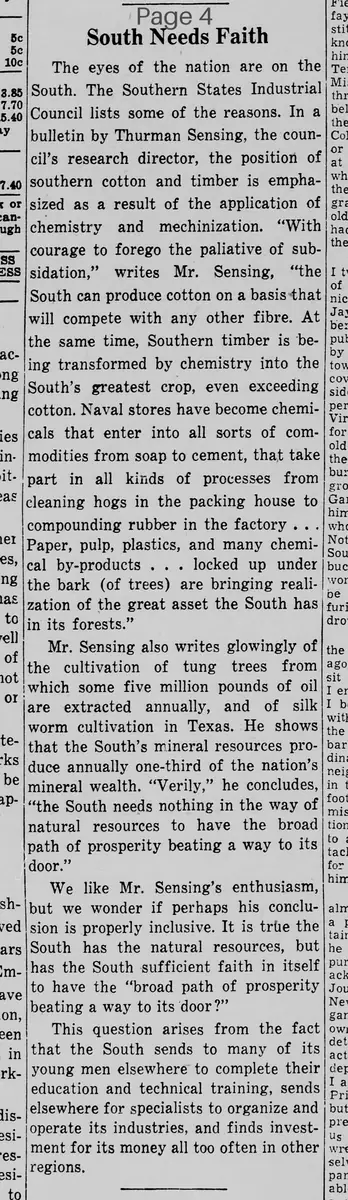
The eyes of the nation are on the South. The Southern States Industrial Council lists some of the reasons. In a bulletin by Thurman Sensing, the council's research director, the position of southern cotton and timber is emphasized as a result of the application of chemistry and mechanization. "With courage to forego the palliative of subsidation," writes Mr. Sensing, "the South can produce cotton on a basis that will compete with any other fibre. At the same time, Southern timber is being transformed by chemistry into the South's greatest crop, even exceeding cotton. Naval stores have become chemicals that enter into all sorts of commodities from soap to cement, that take part in all kinds of processes from cleaning hogs in the packing house to compounding rubber in the factory . . . Paper, pulp, plastics, and many chemical by-products . . . locked up under the bark (of trees) are bringing realization of the great asset the South has in its forests."
Mr. Sensing also writes glowingly of the cultivation of tung trees from which some five million pounds of oil are extracted annually, and of silk worm cultivation in Texas. He shows that the South's mineral resources produce annually one-third of the nation's mineral wealth. "Verily," he concludes, "the South needs nothing in the way of natural resources to have the broad path of prosperity beating a way to its door."
We like Mr. Sensing's enthusiasm, but we wonder if perhaps his conclusion is properly inclusive. It is true the South has the natural resources, but has the South sufficient faith in itself to have the "broad path of prosperity beating a way to its door?"
This question arises from the fact that the South sends to many of its young men elsewhere to complete their education and technical training, sends elsewhere for specialists to organize and operate its industries, and finds investment for its money all too often in other regions.
The eyes of the nation are on the South. The Southern States Industrial Council lists some of the reasons. In a bulletin by Thurman Sensing, the council's research director, the position of southern cotton and timber is emphasized as a result of the application of chemistry and mechanization. "With courage to forego the palliative of subsidation," writes Mr. Sensing, "the South can produce cotton on a basis that will compete with any other fibre. At the same time, Southern timber is being transformed by chemistry into the South's greatest crop, even exceeding cotton. Naval stores have become chemicals that enter into all sorts of commodities from soap to cement, that take part in all kinds of processes from cleaning hogs in the packing house to compounding rubber in the factory . . . Paper, pulp, plastics, and many chemical by-products . . . locked up under the bark (of trees) are bringing realization of the great asset the South has in its forests."
Mr. Sensing also writes glowingly of the cultivation of tung trees from which some five million pounds of oil are extracted annually, and of silk worm cultivation in Texas. He shows that the South's mineral resources produce annually one-third of the nation's mineral wealth. "Verily," he concludes, "the South needs nothing in the way of natural resources to have the broad path of prosperity beating a way to its door."
We like Mr. Sensing's enthusiasm, but we wonder if perhaps his conclusion is properly inclusive. It is true the South has the natural resources, but has the South sufficient faith in itself to have the "broad path of prosperity beating a way to its door?"
This question arises from the fact that the South sends to many of its young men elsewhere to complete their education and technical training, sends elsewhere for specialists to organize and operate its industries, and finds investment for its money all too often in other regions.
What sub-type of article is it?
Economic Policy
Agriculture
Social Reform
What keywords are associated?
Southern Economy
Natural Resources
Cotton Production
Timber Industry
Regional Faith
Industrial Development
Mineral Wealth
What entities or persons were involved?
Southern States Industrial Council
Thurman Sensing
Editorial Details
Primary Topic
Southern Economic Potential And Need For Self Faith
Stance / Tone
Optimistic About Resources But Questioning Regional Self Reliance
Key Figures
Southern States Industrial Council
Thurman Sensing
Key Arguments
South Can Produce Competitive Cotton Through Chemistry And Mechanization
Southern Timber Transformed Into Valuable Chemicals And Products Exceeding Cotton
Tung Trees And Silkworm Cultivation As Emerging Opportunities
South Produces One Third Of Nation's Mineral Wealth
South Has Abundant Natural Resources For Prosperity
South Lacks Faith In Itself, Relying On Outside Education And Specialists
Investments Often Directed To Other Regions