Thank you for visiting SNEWPapers!
Sign up free
Windham County Observer
Putnam, Windham County, Connecticut
What is this article about?
In post-Revolutionary Pomfret, CT, church schism arises when charismatic but profligate Harvard grad Oliver Dodge assists aging pastor Rev. Aaron Putnam, splitting congregation; Dodge's drunken downfall leads to dismissal and reunion under Rev. Asa King, fostering temperance. (248 chars)
Clipping
OCR Quality
Full Text
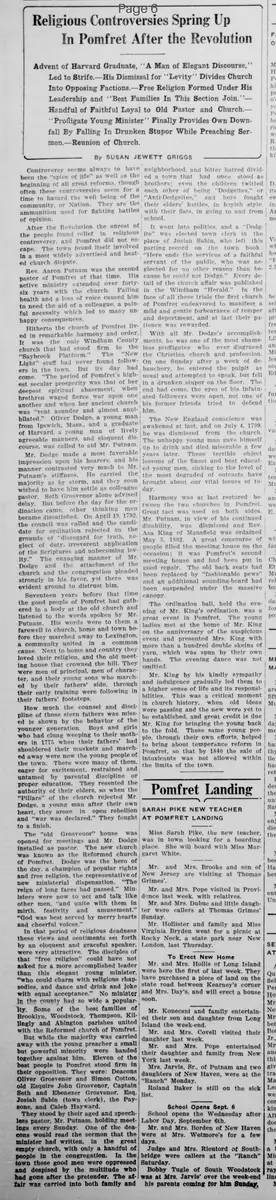
In Pomfret After the Revolution
Advent of Harvard Graduate, "A Man of Elegant Discourse,"
Led to Strife.-His Dismissal for "Levity" Divides Church
Into Opposing Factions.-Free Religion Formed Under His
Leadership and "Best Families In This Section Join."—
Handful of Faithful Loyal to Old Pastor and Church.—
"Profligate Young Minister" Finally Provides Own Down-
fall By Falling In Drunken Stupor While Preaching Ser.
mon.-Reunion of Church,
By SUSAN JEWETT GRIGGS
Controversy seems always to have
been the "spice of life" as well as the
beginning of all great reforms, though
often these controversies seem for a
time to hazard the well being of the
community or Nation. They are the
ammunition used for fighting battles
of opinion.
After the Revolution the unrest of
the people found relief in religious
controversy, and Pomfret did not es-
cape. The town found itself involved
in a most widely advertised and heat-
ed church dispute.
Rev. Aaron Putnam was the second
pastor of Pomfret at that time. His
active ministry extended over forty-
six years with the church. Failing
health and a loss of voice caused him
to need the aid of a colleague, a pain-
ful necessity which led to many un-
happy consequences.
Hitherto the church of Pomfret liv-
ed in remarkable harmony and order.
It was the only Windham County
church that had stood firm to the
"Saybrook Platform."
The "New
Light" stuff had never found follow-
ers in the town. But its day had
come. "The period of Pomfret's high-
est secular prosperity was that of her
deepest spiritual abasement, when
brethren waged fierce war upon one
another and when her ancient church
was "rent asunder and almost anni-
hilated." Oliver Dodge, a young man
from Ipswich, Mass. and a graduate
of Harvard, a young man of lively
agreeable manners, and eloquent dis-
course, was called to aid Mr. Putnam.
Mr. Dodge made a most favorable
impression upon his hearers, and his
manner contrasted very much to Mr.
Putnam's stiffness. He carried the
majority as by storm, and they soon
wished to have him settle as colleague
pastor. Seth Grosvenor alone advised
delay. But before the day for the or-
dination came, other thinking men
became dissatisfied. On April 19, 1792,
the council was called and the candi-
date for ordination rejected on the
grounds of "disregard for truth, ne-
glect of duty, irreverent application
of the Scriptures and unbecoming lev-
ity." The engaging manner of Mr.
Dodge and the attachment of the
church and the congregation pleaded
strongly in his favor, yet there was
evident ground to distrust him.
Seventeen years before that time
the good people of Pomfret had gath-
ered in a body at the old church and
listened to the words spoken by Mr.
Putnam. His words were to them a
farewell to church, home and town be-
fore they marched away to Lexington,
a community united in a common
cause. Next to home and country they
loved their religion, and the old meet-
ing house that crowned the hill. They
were men of principle, men of charac-
ter, and their young sons who march-
ed by their fathers' side, through
their early training were following in
their fathers' footsteps.
How much the counsel and disci-
pline of those stern fathers was miss-
ed is shown by the behavior of the
younger generation. Boys and girls
who had clung weeping to their moth-
ers in 1775 when their fathers had
shouldered their muskets and march-
ed away were now the young people of
the town. There were many of them,
eager for excitement, restrained and
untamed by parental discipline or
proper education. They resented the
authority of their elders, so when the
"Pillars" of the church rejected Mr.
Dodge, a young man after their own
heart, they arose in open rebellion
and "war was declared." They fought
to a finish.
The "old
Grosvenor" house
was
opened for meetings and Mr. Dodge
installed as pastor. The new church
was known as the Reformed church
of Pomfret. Dodge was the hero of
the day, a champion of popular rights
and free religion, the representative of
new ministerial dispensation. "The
reign of long faces had passed." Min-
isters were now to act and talk like
other men, "and unite with them in
mirth, festivity and
amusement."
"God was best served by merry hearts
and cheerful voices."
In that period of religious deadness
these views and sentiments set forth
by an eloquent and graceful speaker,
were very attractive. The disciples of
that "free religion" could have not
asked for a more accomplished leader
than this elegant young minister,
"who could charm with religious rhap-
sodies, and dance and drink and joke
with equal acceptance." No minister
in the county had so wide a popular-
ity. Some of the best families of
Brooklyn, Woodstock, Thompson, Kil-
lingly and Abington parishes united
with the Reformed church of Pomfret.
But while the majority was carried
away with the young preacher a small
but powerful minority
were banded
together against him. Eleven of the
best people in Pomfret stood firm in
their opposition. They were: Deacons
Oliver Grosvenor and Simon Cotton,
old Esquire John Grosvenor, Captain
Seth and Ebenezer Grosvenor, Esq.
Josiah Sabin (town clerk), the Pay-
sons, and Caleb Hayward.
They stood by their aged and speech-
less pastor, Mr. Putnam, holding meet-
ings every Sunday. One of the dea-
cons would read the sermon that the
minister had written, in the great
empty church, with only a handful of
people in the congregation. In the
town these good men were oppressed
and despised by the multitude who
had gone after the pretender. The af-
fair was carried into both family and
neighborhood, and bitter hatred divid-
ed a town that had once stood as
brothers: even the children twitted
each other of being "Dodgeites," or
"Anti-Dodgeites," and boys fought
their elders' battles, in boyish style,
with their fists, in going to and from
school.
It went into politics, and a "Dodg-
ite" was elected town clerk in the
place of Josiah Sabin, who left this
parting record on the town book:
"Here ends the services of a faithful
servant of the public, who was ne-
glected for no other reason than be-
cause he could not Dodge." Every de-
tail of the church affair was published
in the Windham "Herald." In the
face of all these trials the first church
of Pomfret endeavored to manifest a
mild and gentle forbearance of temper
and deportment, and at last their pa-
tience was rewarded.
With all Mr. Dodge's accomplish-
ments, he was one of the most shame-
less profligates who ever disgraced
the Christian church and profession.
On one Sunday after a week of de-
baucherly, he entered the pulpit as
usual and attempted to speak, but fell
in a drunken stupor on the floor. The
end had come, the eyes of his infatu-
ated followers were open, not one of
his former friends tried to defend
him.
The New England conscience was
awakened at last, and on July 4, 1799,
he was dismissed from the church.
The unhappy young man gave himself
up to drink and died miserable a few
years later. These terrible object
lessons of the finest and best educat-
ed young men, sinking to the level of
the most degraded of outcasts have
brought about our vital issues of to-
day.
Harmony was at last restored be-
tween the two churches in Pomfret.
Great tact was used on both sides.
Mr. Putnam, in view of his continued
disability, was dismissed and Rev.
Asa King of Mansfield was ordained
May 5, 1802. A great concourse of
people filled the meeting house on the
occasion: it was Pomfret's second
meeting house and had been put in
good repair. The old back seats had
been replaced by "fashionable pews"
and an additional sounding-board had
been suspended under the massive
canopy.
The ordination ball, held the eve-
ning of Mr. King's ordination, was a
great event in Pomfret. The young
ladies met at the home of Mr. King
on the anniversary of the auspicious
event and presented Mrs. King with
more than a hundred double skeins of
yarn, which was spun by their own
hands. The evening dance was not
omitted.
Mr. King by his kindly sympathy
and indulgence gradually led them to
a higher sense of life and its responsi-
bilities. This was a critical moment
in church history, when old ideas
were passing and the new were yet to
be established, and great credit is due
Mr. King for bringing the young back
to the fold. These same young peo-
ple, through their own efforts, helped
to bring about temperance reform in
Pomfret, so that by 1840 the sale of
intoxicants was not allowed within
the limits of the town.
What sub-type of article is it?
What themes does it cover?
What keywords are associated?
What entities or persons were involved?
Where did it happen?
Story Details
Key Persons
Location
Pomfret, Windham County, Connecticut
Event Date
Post Revolution, 1792 1802
Story Details
Post-Revolution, aging Rev. Aaron Putnam of Pomfret church seeks colleague; Harvard graduate Oliver Dodge's eloquent but levitous style wins majority, leading to schism and formation of Reformed church under Dodge; minority loyal to Putnam endures; Dodge dismissed July 4, 1799 after drunken pulpit collapse; church reunites under Rev. Asa King ordained May 5, 1802, leading to temperance reforms.