Thank you for visiting SNEWPapers!
Sign up free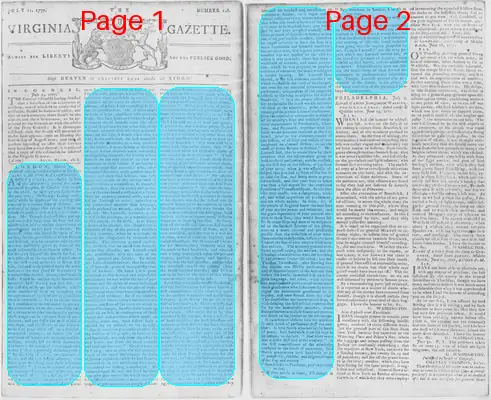
The Virginia Gazette
Williamsburg, Virginia
What is this article about?
In the House of Commons on March 30, 1777, a debate occurred on voting 45,000 seamen for the year amid criticisms of the navy's weakness and Lord Sandwich's administration, in the context of the American war and threats from France and Spain. Mr. Temple Luttrell moved for naval accounts to expose government falsehoods, but it was opposed by administration.
Merged-components note: This is a continuation of the report on the debate in the House of Commons, split across pages 1 and 2, with sequential reading order.
Clippings
1 of 2
OCR Quality
Full Text
March 30.
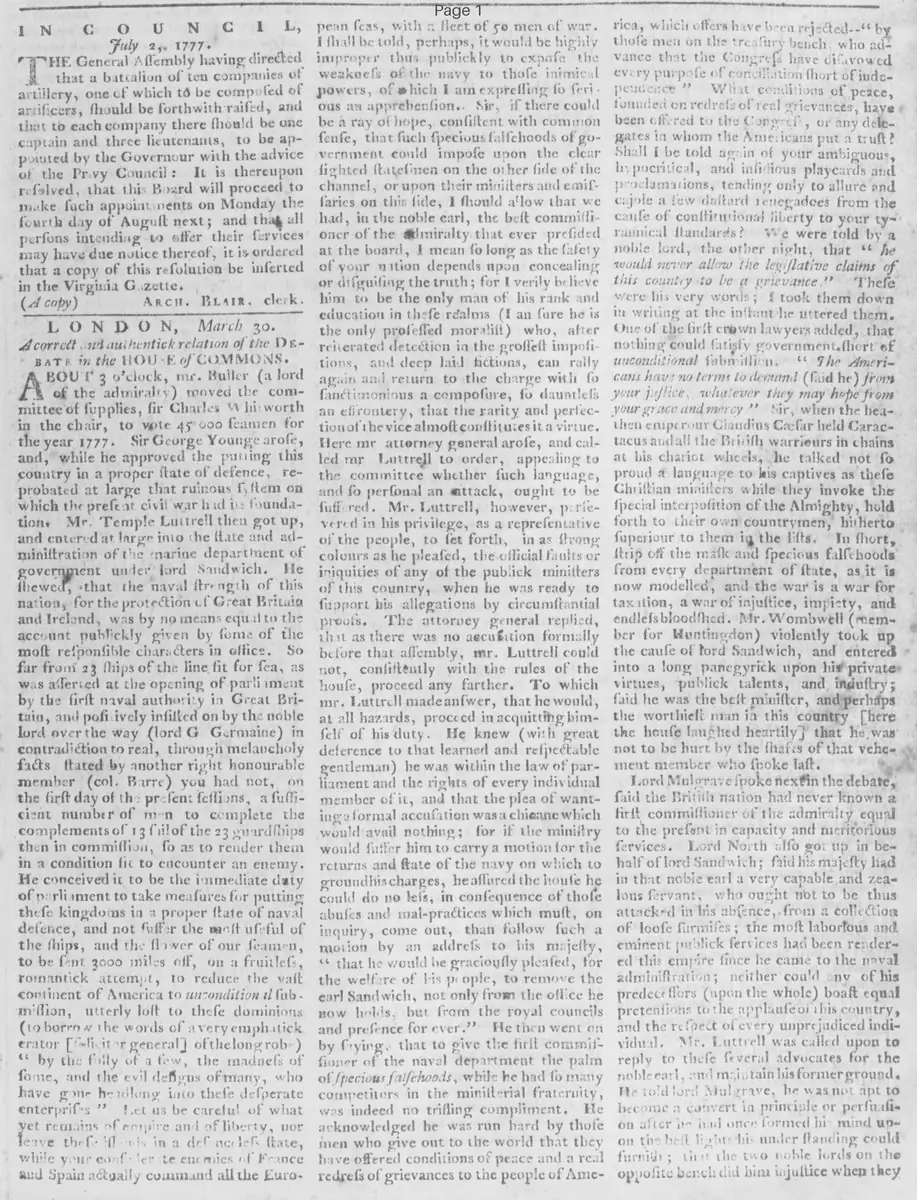
A correct and authentick relation of the DEBATE in the HOUSE of COMMONS.
ABOUT 3 o'clock, mr. Buller (a lord of the admiralty) moved the committee of supplies, sir Charles Whitworth in the chair, to vote 45000 seamen for the year 1777. Sir George Younge arose, and, while he approved the putting this country in a proper state of defence, reprobated at large that ruinous system on which the present civil war had its foundation. Mr. Temple Luttrell then got up, and entered at large into the state and administration of the marine department of government under lord Sandwich. He shewed, that the naval strength of this nation, for the protection of Great Britain and Ireland, was by no means equal to the account publickly given by some of the most responsible characters in office. So far from 23 ships of the line fit for sea, as was asserted at the opening of parliament by the first naval authority in Great Britain, and positively insisted on by the noble lord over the way (lord G. Germaine) in contradiction to real, though melancholy facts stated by another right honourable member (col. Barre) you had not, on the first day of the present sessions, a sufficient number of men to complete the complements of 13 ships of the 23 guardships then in commission, so as to render them in a condition fit to encounter an enemy. He conceived it to be the immediate duty of parliament to take measures for putting these kingdoms in a proper state of naval defence, and not suffer the best of the ships, and the flower of our seamen, to be sent 3000 miles off, on a fruitless, romantick attempt, to reduce the vast continent of America to unconditional submission, utterly lost to these dominions (to borrow the words of a very emphatick orator [col. it r general of the long robe]) "by the folly of a few, the madness of some, and the evil designs of many, who have gone headlong into these desperate enterprizes." Let us be careful of what yet remains of empire and of liberty, nor leave these islands in a defenceless state, while your confederal enemies of France and Spain actually command all the European seas, with a fleet of so many men of war.
I shall be told, perhaps, it would be highly improper thus publickly to expose the weakness of the navy to those inimical powers, of which I am expressing so serious an apprehension. Sir, if there could be a ray of hope, consistent with common sense, that such specious falsehoods of government could impose upon the clear sighted statesmen on the other side of the channel, or upon their ministers and emissaries on this side, I should allow that we had, in the noble earl, the best commissioner of the admiralty that ever presided at the board, I mean so long as the safety of your nation depends upon concealing or disguising the truth; for I verily believe him to be the only man of his rank and education in these realms (I am sure he is the only professed moralist) who, after reiterated detection in the grossest impositions, and deep laid fictions, can rally again and return to the charge with so sanctimonious a composure, so dauntless an effrontery, that the rarity and perfection of the vice almost constitutes it a virtue.
Here mr attorney general arose, and called mr Luttrell to order, appealing to the committee whether such language, and so personal an attack, ought to be suffered. Mr. Luttrell, however, persevered in his privilege, as a representative of the people, to set forth, in as strong colours as he pleased, the official faults or iniquities of any of the publick ministers of this country, when he was ready to support his allegations by circumstantial proofs. The attorney general replied, that as there was no accusation formally before that assembly, mr. Luttrell could not, consistently with the rules of the house, proceed any farther. To which mr. Luttrell made answer, that he would, at all hazards, proceed in acquitting himself of his duty. He knew (with great deference to that learned and respectable gentleman) he was within the law of parliament and the rights of every individual member of it, and that the plea of wanting a formal accusation was a chicane which would avail nothing; for if the ministry would suffer him to carry a motion for the returns and state of the navy on which to ground his charges, he assured the house he could do no less, in consequence of those abuses and mal-practices which must, on inquiry, come out, than follow such a motion by an address to his majesty, "that he would be graciously pleased, for the welfare of his people, to remove the earl Sandwich, not only from the office he now holds, but from the royal councils and presence for ever." He then went on by saying that to give the first commissioner of the naval department the palm of specious falsehoods, while he had so many competitors in the ministerial fraternity, was indeed no trifling compliment. He acknowledged he was run hard by those men who give out to the world that they have offered conditions of peace and a real redress of grievances to the people of Ame-
rica, which offers have been rejected by those men on the treasury bench who advance that the Congress have disavowed every purpose of conciliation short of independence. What conditions of peace, founded on redress of real grievances, have been offered to the Congress, or any delegates in whom the Americans put a trust? Shall I be told again of your ambiguous, hypocritical, and insidious placards and proclamations, tending only to allure and cajole a few dastard renegades from the cause of constitutional liberty to your tyrannical standards? We were told by a noble lord, the other night, that the legislative claims of this country to be a grievance. These were his very words; I took them down in writing at the instant he uttered them. One of the first crown lawyers added, that nothing could satisfy government short of unconditional submission. The Americans have no terms to demand (said he) from your justice, whatever they may hope from your grace and mercy. Sir, when the heathen emperor Claudius Caesar held Caractacus and all the British warriors in chains at his chariot wheels, he talked not so proud a language to his captives as these Christian ministers while they invoke the special interposition of the Almighty, hold forth to their own countrymen, hitherto superior to them in the lists. In short, strip off the mask and specious falsehoods from every department of state, as it is now modelled, and the war is a war for taxation, a war of injustice, impiety, and endless bloodshed. Mr. Wombwell (member for Huntingdon) violently took up the cause of lord Sandwich, and entered into a long panegyrick upon his private virtues, publick talents, and industry; said he was the best minister, and perhaps the worthiest man in this country. There the house laughed heartily that he was not to be hurt by the shafts of that vehement member who spoke last. Lord Mulgrave spoke next in the debate, said the British nation had never known a first commissioner of the admiralty equal to the present in capacity and meritorious services. Lord North also got up in behalf of lord Sandwich; said his majesty had in that noble earl a very capable and zealous servant, who ought not to be thus attacked in his absence, from a collection of loose surmises; the most laborious and eminent publick services had been rendered this empire since he came to the naval administration; neither could any of his predecessors (upon the whole) boast equal pretensions to the applause of this country, and the respect of every unprejudiced individual. Mr. Luttrell was called upon to reply to these several advocates for the noble earl, and maintain his former ground. He told lord Mulgrave, he was not apt to be a convert in principle or persuasion after he had once formed his mind upon the best lights his understanding could furnish: thus the two noble lords on the opposite bench did him injustice when they
imputed his conduct and accusations to anonymous slander, or a vague unsubstantial testimony of any nature whatever; that when this boasted service of the noble earl came to be inquired into, you would find he had been intruded annually with twice as much of the publick money as any one of his predecessors in office, therefore he ought certainly to have the fleet in a more formidable and splendid condition; but certain it was, that a great part of this treasure was not applied to the use for which it was granted; there had been a multitude of errors, and much corruption, which he was prepared to produce evidence of whenever the house would give a candid hearing. Mr. Luttrell then moved, as the first evidence necessary on which to establish the truth of his charges, and even for the material information of parliament, independent of the proposed address to the king to displace the earl of Sandwich, "that the proper officers do lay on the table the latest weekly accounts received at the admiralty, prior to the opening of the present session of parliament, from the admiral or commander in chief of all his majesty's ships and vessels of the several departments of Portsmouth, Chatham, and Plymouth, together with the latest weeks accounts received at the said board, prior to the commencement of this session, of all ships and vessels of war employed on channel service, or on the coast of Great Britain or Ireland." Mr. Luttrell said, that he would show by these accounts that the information given to both houses of parliament, and the publick, on the first day of this session, of the state of your navy, when it was officially alleged that you had 23 ships of the line fit to take the seas, and many more in great forwardness, and that your fleet at home was then a full match for the combined squadrons of France and Spain, should they visit your coasts, was a dangerous, wicked, and wilful imposition on parliament, and the whole nation. In short, sir, if the people of England knew the real state of your marine power and resources, and the great superiority of your natural enemies in the seas, they would scarce suffer so many ships and men to be dispatched to the farthest quarter of the globe, even on a more rational and profitable pursuit than the reduction of your American colonies to despotism, before you have secured the seat of your empire from invasion and ruin. The attorney general commented against taking the motion, and the friends of administration were for throwing it out without farther discussion; but mr. Thomas Townshend, after showing that the motion was strictly parliamentary, and of material import to the business then before the house, seconded it in very forcible language, and asked, what opinion any unprejudiced person could entertain of those gentlemen who so strenuously encouraged the honourable gentleman in his inquiry, and now shrunk from the trial? This clandestine and unwarranted step, of withholding the first official papers called for by the honourable member, would stamp sentence on their friend and patron, not much to his honour or his advantage. It is curious to observe how the ministers in each house of parliament push one another. Is lord North attacked in the house of peers, lord Sandwich is on his legs in an instant, to declare, "that there never was a better first lord of the treasury." Is the first commissioner of the admiralty censured in the house of commons, lord North pronounces lord Sandwich to be "a most able, faithful, and diligent servant of his king and country."
"Says Lockit to Peachum, you've nothing to fear:
If they battle in front, I'll defend in the rear."
"Says Peachum to Lockit, I laugh at the hum,
Let me finger the pelf, they may all kiss my ---"
Lord North, in the house of commons, on Friday, pretended, "that the official conduct of lord Sandwich would stand the test of the severest scrutiny; and therefore, that nothing of discredit could redound from going into the inquiry proposed by mr. Temple Luttrell;" yet the very papers which mr. Luttrell moved for, as the necessary grounds of inquiry, were refused by lord North, and the ministerial members. Administration dare not submit the transactions of their several departments to parliamentary inspection. Mr. Temple Luttrell proved this as a member of the senate, in his place, to the utter confusion of the purchased hirelings of government.
What sub-type of article is it?
What keywords are associated?
What entities or persons were involved?
Where did it happen?
Foreign News Details
Primary Location
London
Event Date
March 30
Key Persons
Outcome
motion for naval accounts opposed and refused by administration supporters
Event Details
Debate in House of Commons on voting 45,000 seamen for 1777; criticisms of naval weakness, Lord Sandwich's administration, and American war policy; Mr. Temple Luttrell accused government of falsehoods on navy strength and moved for admiralty accounts, seconded by Mr. Thomas Townshend but opposed by administration