Thank you for visiting SNEWPapers!
Sign up free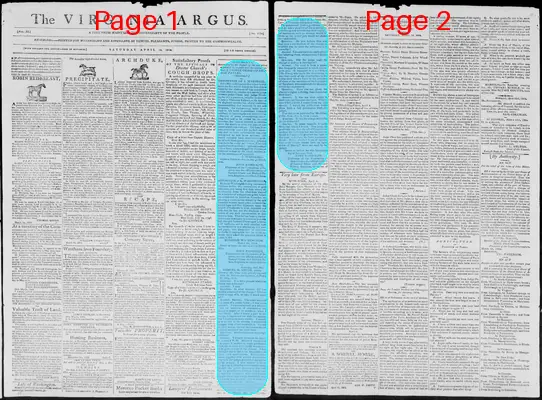
Virginia Argus
Richmond, Virginia
What is this article about?
Depositions from John Marshall, Bushrod Washington, and Samuel H. Smith regarding an inquiry into the official conduct of Judges Samuel Chase and Richard Peters, focusing on conversations about Callender's trial and the delivery of Chase's grand jury charge in May 1803.
Merged-components note: Continuation of testimony in the documents accompanying the report on Samuel Chase and Richard Peters, indicated by '(Continued.)' and seamless text flow across pages.
Clippings

1 of 2
OCR Quality
Full Text
Accompanying the Report of the committee appointed to enquire into the official conduct of SAMUEL CHASE and RICHARD PETERS.
(Continued.)
DEPOSITION OF J. MARSHALL.
John Marshall deposes that when he first heard the fact which Jonathan Snowden is stated by the chairman of this committee to have sworn to, relative to a conversation between judge Chase and judge Washington in his presence, relative to the trial of James Thomson Callender, he had not the slightest recollection of any conversation resembling that reported by the said Snowden. On endeavoring since to retrace in his mind impressions formerly received, he has a vague and indistinct recollection of some conversation resembling that said to be stated by the said Snowden, but cannot pretend to particularise the words, or even the precise sentiment which was uttered. He does, however, positively assert his perfect conviction, that no such conversation was ever understood by him to be serious. He should certainly have entertained opinions of both those gentlemen very different from those he really entertains, if he had supposed such motives to judicial conduct to have been acknowledged by the one, or attributed to him by the other, without even the semblance of reproach.
J. MARSHALL.
Sworn to before me this 2d day of March, 1804.
JOHN RANDOLPH,
Chairman of the Committee of Enquiry into the official conduct of Samuel Chase and Richard Peters, Esquires, or either of them.
DEPOSITION of B. WASHINGTON
Bushrod Washington being summoned to appear before this committee to give testimony, and being first duly sworn, after hearing from the chairman thereof the substance of a deposition given before the committee by Jonathan Snowden, respecting a conversation stated by the said Snowden to have taken place between Samuel Chase and this deponent upon the subject of Callender's trial, deposeth and saith that he has not the slightest recollection of any such conversation as that stated to him. That he has been in the habit for some years past to converse jocosely with the said Samuel Chase upon a variety of subjects, and is well satisfied that the conversation now alluded to, if it ever took place, was altogether of this cast. He thinks it impossible that he could seriously have asked the question which it is said he did.
BUSHROD WASHINGTON.
March 2d, 1804.
Sworn to before me this 2d day of March, 1804,
JOHN RANDOLPH,
Chairman of the Committee of Enquiry, into the official conduct of Samuel Chase and Richard Peters, Esquires, or either of them—
Saturday, 14th Jan.
SAMUEL H. SMITH, sworn.
Charge of Mr. Chase to the grand jury, read from the National Intelligencer, of Friday 20 May, 1803.
Question. You were present when that charge was delivered?
Answer. I was.
Question. In what manner did you become possessed of the charge? Did you obtain a copy of it, or take it down yourself?
Answer. Neither. The court was held in a room of a public house; it was much crowded. I was summoned as a witness. I had no intention of committing the charge to paper, or to memory, when I went there. After I heard a part of the charge, it impressed me with the opinion that it ought to be made public. I attended to it, and in the evening I committed to paper what I had recollected, I could not do it sooner, having business to attend to which occupied me until then.
Question. At what time was the charge delivered?
Answer. I believe between the hours of 12 and 2 P. M. Before I committed it to paper, I applied to some gentlemen of the bar to know if the judge would, probably grant a copy of the charge. I was informed that it had been his practice to refuse such applications. This circumstance, together with a want of acquaintance with the judge, prevented my applying for a copy. I also wished to know whether an application could not be made through the grand jury—and was told that the grand jury (although they agreed in political sentiment with Mr: Chase) thought the charge a very imprudent one, and would not, probably, assent to be instrumental in making a public.
Questioned by a member of the Committee.
Does not recollect which of the gentlemen told him so. Conversed with several.
Mr. J. T. Mason, Mr. Montgomery,
(whom he did not know at the time) Mr. Carr. of Virginia, and several others.
He understood from a gentleman who said he was a member of the grand jury, and who agreed with the deponent in political sentiment, such an attempt would be futile, as the grand jury would not make the application.
Question. Do you believe that you had such a recollection of the charge as enabled you to state the substance of it correctly?
Answer. I do, except those parts which (as believing them unimportant) I did not notice.
Question. Did the judge read the charge or deliver it extempore?
Answer. He read it from a paper. But frequently appeared to speak extempore also. It appeared to a gentleman (Mr. Carr,) who made the observation to me, that many of the observations of the judge were drawn forth by the presence of some of the members of the legislature of Maryland, who supported the measures which he condemned.
Question. Have you not given the charge a higher coloring, than it received from him?
Answer. It was my wish rather to under-charge than over-charge it. Wherever I had a doubt I erased from my first sketch. I hoped my publication would draw forth a full publication from the judge.
The charge as published by Mr. Chase (Nat. Intel. Aug. 6, 1803.) read.
Question. Is this the charge which the judge delivered?
Answer. In some respects it varies from that which I heard. The judge did positively say, that the act of Congress repealing the judiciary law was unconstitutional and expressly asserted the right of the court to declare the laws unconstitutional. These words "I am of opinion that every citizen should have an equal share of liberty," were not used by the judge.
Sworn to before me this fourteenth day of January, 1804.
JOHN RANDOLPH,
Chairman of the Committee of Inquiry, into the official conduct of Samuel Chase and Richard Peters, Esquires, or either of them.
What sub-type of article is it?
What keywords are associated?
What entities or persons were involved?
Domestic News Details
Event Date
January 14, 1804 And March 2, 1804
Key Persons
Event Details
Depositions provided to the committee inquiring into the official conduct of Judges Samuel Chase and Richard Peters, including John Marshall's vague recollection of a non-serious conversation about Callender's trial, Bushrod Washington's denial of a serious conversation with Chase, and Samuel H. Smith's testimony on Chase's grand jury charge from May 20, 1803, noting discrepancies between his recollection and the published version.