Thank you for visiting SNEWPapers!
Sign up free
Editorial
December 17, 1805
The Enquirer
Richmond, Henrico County, Virginia
What is this article about?
This editorial praises President Jefferson's message to Congress for its dignified firmness, contrasting the republican style of U.S. leadership with European monarchies. It defends Jefferson against Federalist accusations of cowardice, highlights the virtues of republican government in avoiding unnecessary wars, and notes preparations amid European conflicts.
Clipping
OCR Quality
98%
Excellent
Full Text
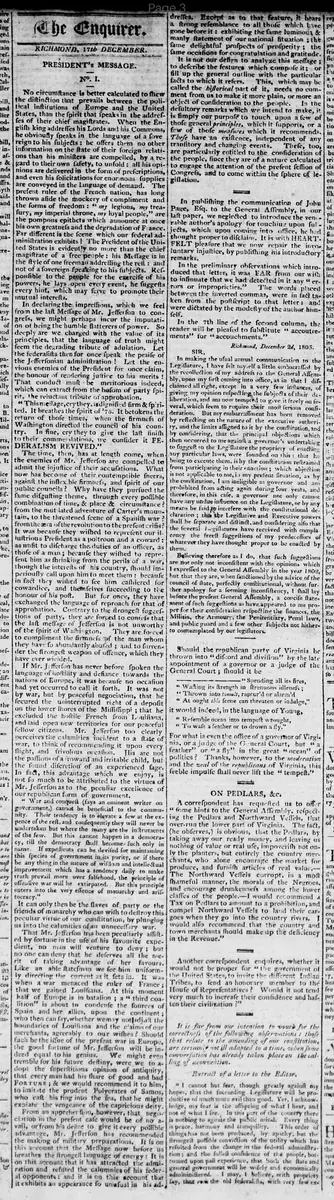
No circumstance is better calculated to shew the distinction that prevails between the political institutions of Europe and the United States, than the spirit that speaks in the addresses of their chief magistrates. When the English king addresses his Lords and his Commons, he obviously speaks in the language of a sovereign to his subjects: he offers them no other information on the state of their foreign relations than his ministers are compelled, by a regard to their own safety, to unfold: all his opinions are delivered in the form of prescriptions, and even his solicitations for enormous supplies are conveyed in the language of demand. The present ruler of the French nation, has long thrown aside the mockery of compliment and the forms of freedom: "my legions, my treasury, my imperial throne, my loyal people," are the pompous epithets which announce at once his own greatness and the degradation of France.
Far different is the scene which our federal administration exhibits! The President of the United States is evidently no more than the chief magistrate of a free people: his Message is in the style of one freeman addressing the rest: and not of a sovereign speaking to his subjects. Responsible to the people for the exercise of his powers, he lays open every event, he suggests every hint, which may serve to promote their mutual interests.
In declaring the impressions, which we feel from the last Message of Mr. Jefferson to congress, we might perhaps incur the imputation of being the humble flatterers of power. So deeply are we charged with the value of its principles, that the language of truth might seem the degrading tribute of adulation, Let the federalists then for once speak the praise of the Jeffersonian administration! Let the envious enemies of the President for once claim, the honour of rendering justice to his merits! That conduct must be meritorious indeed, which can extract from the bosom of party spirit, the reluctant tribute of approbation.
"This message, cry they, is dignified firm spirited. It breathes the spirit of '76. It betokens the return of those times, when the firmness of Washington directed the council of his country. In fine, cry they to give the last finish to their commendations, we consider it FEDERALISM REVIVED."
The time, then, has at length come, when the enemies of Mr. Jefferson are compelled to admit the injustice of their accusations. What now has become of their contemptible sneers, against the inflexible firmness, and spirit of our public councils? Why have they pursued the same disgusting theme, through every possible combination of time, & place & circumstance? from the mutilated adventure of Carter's mountain, to the threatened scene of a Spanish war? from the æra of the revolution to the present crisis?
It was because they wished to represent our illustrious President as a poltroon and a coward: as unfit to discharge the duties of an officer, as those of a man; because they wished to represent him as shrinking from the perils of a war, though the interests of his country, should imperiously call upon him to meet them: because in fact they wished to see him cashiered for cowardice, and themselves succeeding to the honour of his post. But for once, they have exchanged the language of reproach for that of approbation. Contrary to the strongest suggestions of party, they are forced to confess that the last message of Jefferson is not unworthy of the spirit of Washington.
They are forced to compliment the firmness of the man whom they have so abundantly abused; and to surrender the strongest weapon of offence, which they have ever wielded.
If Mr. Jefferson has never before spoken the language of hostility and defiance towards the nations of Europe, it was because no occasion had yet occurred to call it forth. It was not by war, but by peaceful negociation, that he secured the uninterrupted right of a deposit on the lower shores of the Mississippi; that he excluded the hostile French from Louisiana, and laid open new territories for our peaceful fellow citizens. Mr. Jefferson too clearly perceives the calamities incident to a state of war, to think of recommending it upon every slight, and frivolous occasion. His are not the passions of a froward and irritable child, but the sound discretion of an experienced sage.
In fact, this advantage which we enjoy, is not so much to be attributed to the virtues of Mr. Jefferson as to the peculiar excellence of our republican form of government.
"War and conquest (says an eminent writer on government,) cannot be beneficial to the community. Their tendency is to elevate a few at the expence of the rest, and consequently they will never be undertaken but where the many are the instruments of the few. But this cannot happen in a democracy, till the democracy shall become--such only in name. If expedients can be devised for maintaining this species of government in its purity, or if there be any thing in the nature of wisdom and intellectual improvement which has a tendency daily to make truth prevail more over falsehood, the principle of offensive war will be extirpated. But this principle enters into the very essence of monarchy and aristocracy."
It can only then be the slaves of party or the friends of monarchy who can wish to destroy this peculiar virtue of our constitution, by plunging us into the calamities of an unnecessary war.
That Mr. Jefferson has been peculiarly assisted by fortune in the use of his favourite expedient, no man will venture to deny; but no one can deny that he deserves all the merit of taking advantage of her favours. Like an able statesman we see him uniformly directing the current as it sets in. It was when a war menaced the ruler of France; that we gained Louisiana. At this moment half of Europe is in battalion; a "third coalition" is about to condense the forces of Spain and her allies, upon the continent: who then can say, whether we may not add just the boundaries of Louisiana and the claims of our merchants, agreeably to our wishes? Should such be the issue of the present war in Europe, the good fortune of Mr. Jefferson will be indeed equal to his genius. We might even tremble for his future destiny, were we to adopt the superstitious opinion of antiquity, that every man had his share of good and bad Fortune; & we would recommend it to him, to imitate the prudent Polycrates of Samos, who cast his ring into the sea, that he might expiate the vengeance of the capricious deity.
From an apprehension, however, that negociation in the present case would be of no avail, or from his desire to give it every possible advantage, Mr. Jefferson has recommended the making of military preparations. It is on this account that the Message now before us breathes the strongest language of energy: It is on this account that it has attracted the admiration and refuted the calumnies of his federal opponents: and it is on this account that it exhibits an appearance so unusual in his addresses. Except as to that feature, it bears a strong resemblance to all those which have gone before it: exhibiting the same luminous & manly statement of our national situation; the same delightful prospects of prosperity; the same occasions for congratulation and gratitude.
It is not our design to analyze this message; to describe the features which compose it; or fill up the general outline with the particular facts to which it refers. This, which may be called the historical part of it, needs no comment from us to make it more plain, or more an object of consideration to the people. In the desultory remarks which we intend to make, it is simply our purpose to touch upon a few of those general principles, which it supports, or a few of those measures which it recommends.
These have an existence, independent of any transitory and changing events. These, too, are particularly entitled to the consideration of the people, since they are of a nature calculated to engage the attention of the present session of Congress, and to come within the sphere of legislation.
Far different is the scene which our federal administration exhibits! The President of the United States is evidently no more than the chief magistrate of a free people: his Message is in the style of one freeman addressing the rest: and not of a sovereign speaking to his subjects. Responsible to the people for the exercise of his powers, he lays open every event, he suggests every hint, which may serve to promote their mutual interests.
In declaring the impressions, which we feel from the last Message of Mr. Jefferson to congress, we might perhaps incur the imputation of being the humble flatterers of power. So deeply are we charged with the value of its principles, that the language of truth might seem the degrading tribute of adulation, Let the federalists then for once speak the praise of the Jeffersonian administration! Let the envious enemies of the President for once claim, the honour of rendering justice to his merits! That conduct must be meritorious indeed, which can extract from the bosom of party spirit, the reluctant tribute of approbation.
"This message, cry they, is dignified firm spirited. It breathes the spirit of '76. It betokens the return of those times, when the firmness of Washington directed the council of his country. In fine, cry they to give the last finish to their commendations, we consider it FEDERALISM REVIVED."
The time, then, has at length come, when the enemies of Mr. Jefferson are compelled to admit the injustice of their accusations. What now has become of their contemptible sneers, against the inflexible firmness, and spirit of our public councils? Why have they pursued the same disgusting theme, through every possible combination of time, & place & circumstance? from the mutilated adventure of Carter's mountain, to the threatened scene of a Spanish war? from the æra of the revolution to the present crisis?
It was because they wished to represent our illustrious President as a poltroon and a coward: as unfit to discharge the duties of an officer, as those of a man; because they wished to represent him as shrinking from the perils of a war, though the interests of his country, should imperiously call upon him to meet them: because in fact they wished to see him cashiered for cowardice, and themselves succeeding to the honour of his post. But for once, they have exchanged the language of reproach for that of approbation. Contrary to the strongest suggestions of party, they are forced to confess that the last message of Jefferson is not unworthy of the spirit of Washington.
They are forced to compliment the firmness of the man whom they have so abundantly abused; and to surrender the strongest weapon of offence, which they have ever wielded.
If Mr. Jefferson has never before spoken the language of hostility and defiance towards the nations of Europe, it was because no occasion had yet occurred to call it forth. It was not by war, but by peaceful negociation, that he secured the uninterrupted right of a deposit on the lower shores of the Mississippi; that he excluded the hostile French from Louisiana, and laid open new territories for our peaceful fellow citizens. Mr. Jefferson too clearly perceives the calamities incident to a state of war, to think of recommending it upon every slight, and frivolous occasion. His are not the passions of a froward and irritable child, but the sound discretion of an experienced sage.
In fact, this advantage which we enjoy, is not so much to be attributed to the virtues of Mr. Jefferson as to the peculiar excellence of our republican form of government.
"War and conquest (says an eminent writer on government,) cannot be beneficial to the community. Their tendency is to elevate a few at the expence of the rest, and consequently they will never be undertaken but where the many are the instruments of the few. But this cannot happen in a democracy, till the democracy shall become--such only in name. If expedients can be devised for maintaining this species of government in its purity, or if there be any thing in the nature of wisdom and intellectual improvement which has a tendency daily to make truth prevail more over falsehood, the principle of offensive war will be extirpated. But this principle enters into the very essence of monarchy and aristocracy."
It can only then be the slaves of party or the friends of monarchy who can wish to destroy this peculiar virtue of our constitution, by plunging us into the calamities of an unnecessary war.
That Mr. Jefferson has been peculiarly assisted by fortune in the use of his favourite expedient, no man will venture to deny; but no one can deny that he deserves all the merit of taking advantage of her favours. Like an able statesman we see him uniformly directing the current as it sets in. It was when a war menaced the ruler of France; that we gained Louisiana. At this moment half of Europe is in battalion; a "third coalition" is about to condense the forces of Spain and her allies, upon the continent: who then can say, whether we may not add just the boundaries of Louisiana and the claims of our merchants, agreeably to our wishes? Should such be the issue of the present war in Europe, the good fortune of Mr. Jefferson will be indeed equal to his genius. We might even tremble for his future destiny, were we to adopt the superstitious opinion of antiquity, that every man had his share of good and bad Fortune; & we would recommend it to him, to imitate the prudent Polycrates of Samos, who cast his ring into the sea, that he might expiate the vengeance of the capricious deity.
From an apprehension, however, that negociation in the present case would be of no avail, or from his desire to give it every possible advantage, Mr. Jefferson has recommended the making of military preparations. It is on this account that the Message now before us breathes the strongest language of energy: It is on this account that it has attracted the admiration and refuted the calumnies of his federal opponents: and it is on this account that it exhibits an appearance so unusual in his addresses. Except as to that feature, it bears a strong resemblance to all those which have gone before it: exhibiting the same luminous & manly statement of our national situation; the same delightful prospects of prosperity; the same occasions for congratulation and gratitude.
It is not our design to analyze this message; to describe the features which compose it; or fill up the general outline with the particular facts to which it refers. This, which may be called the historical part of it, needs no comment from us to make it more plain, or more an object of consideration to the people. In the desultory remarks which we intend to make, it is simply our purpose to touch upon a few of those general principles, which it supports, or a few of those measures which it recommends.
These have an existence, independent of any transitory and changing events. These, too, are particularly entitled to the consideration of the people, since they are of a nature calculated to engage the attention of the present session of Congress, and to come within the sphere of legislation.
What sub-type of article is it?
Partisan Politics
Foreign Affairs
Constitutional
What keywords are associated?
Jefferson Message
Federalist Criticism
Republican Government
Foreign Negotiations
Presidential Firmness
European Monarchies
Louisiana Acquisition
What entities or persons were involved?
Mr. Jefferson
Federalists
Washington
English King
French Ruler
Editorial Details
Primary Topic
Praise Of Jefferson's Message To Congress And Republican Government Virtues
Stance / Tone
Supportive Of Jefferson, Critical Of Federalists And Monarchies
Key Figures
Mr. Jefferson
Federalists
Washington
English King
French Ruler
Key Arguments
Jefferson's Message Exhibits Firmness And Spirit Of 1776, Reviving Federalism
Us Presidential Addresses Differ From European Sovereign Demands
Federalists Forced To Praise Jefferson Despite Past Accusations Of Cowardice
Jefferson Prefers Peaceful Negotiation Over War, As In Louisiana Acquisition
Republican Government Prevents Unnecessary Offensive Wars Unlike Monarchies
Military Preparations Recommended To Support Negotiations Amid European Conflicts