Thank you for visiting SNEWPapers!
Sign up free
The Rhode Island American, And General Advertiser
Providence, Providence County, Rhode Island
What is this article about?
Report on U.S. 17th Congress proceedings in Washington, Dec. 9-11, 1822: Senate elects chaplain, appoints committees, receives messages on copper mines and pirates; House debates bills on debt imprisonment, public moneys, militia, captives relief, submits resolutions on defense, naval establishment, and Columbia River occupation.
Merged-components note: These components are sequential reports on the proceedings of the U.S. Senate and House of Representatives during early December 1822, forming a single logical unit on congressional news.
Clipping
OCR Quality
Full Text
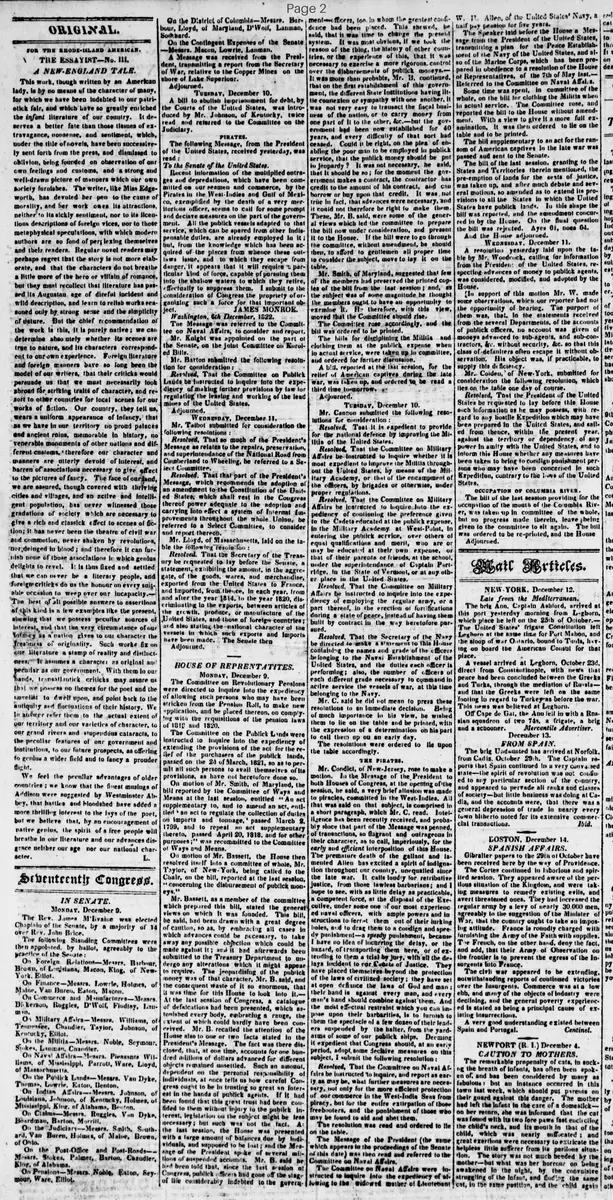
IN SENATE.
Monday, December 9.
The Rev. James M'Ilvaine was elected Chaplain of the Senate, by a majority of 14 over Rev. John Brice.
The following Standing Committees were then appointed, by ballot, agreeably to the practice of the Senate:
On Foreign Relations--Messrs. Barbour, Brown, of Louisiana, Macon, King, of New-York, Elliot.
On Finance--Messrs. Lowrie, Holmes, of Maine, Van Buren, Eaton, Macon.
On Commerce and Manufactures--Messrs. Dickerson, Ruggles, D'Wolf, Findlay, Lanman.
On Military Affairs--Messrs. Williams, of Tennessee, Chandler, Taylor, Johnson, of Kentucky, Elliot.
On the Militia--Messrs. Noble, Seymour, Stokes, Lanman, Chandler.
On Naval Affairs--Messrs. Pleasant, Williams, of Mississippi, Parrott, Ware, Lloyd, of Massachusetts.
On the Public Lands--Messrs. Van Dyke, Thomas, Lowrie, Eaton, Benton.
On Indian Affairs--Messrs. Johnson, of Louisiana, Johnson, of Kentucky, Holmes, of Mississippi, King, of Alabama, Benton.
On Claims--Messrs. Ruggles, Van Dyke, Boardman, Barton, Morrill.
On the Judiciary--Messrs. Smith, Southard, Van Buren, Holmes, of Maine, Brown, of Ohio.
On the Post-Office and Post-Roads--Messrs. Stokes, Palmer, Barton, Chandler, King, of Alabama.
On Pensions--Messrs. Noble, Eaton, Seymour, Ware, Elliot.
On the District of Columbia--Messrs. Barbour, Lloyd, of Maryland, D'Wolf, Lanman, Southard.
On the Contingent Expenses of the Senate--Messrs. Macon, Lowrie, Lanman.
A Message was received from the President, transmitting a report from the Secretary of War, relative to the Copper Mines on the shore of Lake Superior.
Adjourned.
Tuesday, December 10.
A bill to abolish imprisonment for debt, by the Courts of the United States, was introduced by Mr. Johnson, of Kentucky, twice read and referred to the Committee on the Judiciary.
PIRATES.
The following Message, from the President of the United States, received yesterday, was read:
To the Senate of the United States:
Recent information of the multiplied outrages and depredations, which have been committed on our seamen and commerce, by the Pirates in the West Indies and Gulf of Mexico, exemplified by the death of a very meritorious officer, seems to call for some prompt and decisive measures on the part of the government. All the public vessels adapted to that service, which can be spared from other indispensable duties, are already employed in it; but, from the knowledge which has been acquired of the places from whence these outlaws issue, and to which they escape from danger, it appears that it will require a particular kind of force, capable of pursuing them into the shallow waters to which they retire, effectually to suppress them. I submit to the consideration of Congress the propriety of organizing such a force for that important object.
JAMES MONROE.
Washington, 6th December, 1822.
The Message was referred to the Committee on Naval Affairs, to consider and report.
Mr. Knight was appointed on the part of the Senate, on the joint Committee on Enrolled Bills.
Mr. Barton submitted the following resolution for consideration:
Resolved, That the Committee on Public Lands be instructed to inquire into the expediency of making further provisions by law for regulating the leasing and working of the lead mines of the United States.
Adjourned.
Wednesday, December 11.
Mr. Talbot submitted for consideration the following resolutions:
Resolved, That so much of the President's Message as relates to the repairs, preservation, and superintendence of the National Road from Cumberland to Wheeling, be referred to a Select Committee.
Resolved, That that part of the President's Message, which recommends the adoption of an amendment to the Constitution of the United States, which shall vest in the Congress thereof power adequate to the adoption and carrying into effect a system of Internal Improvements throughout the whole Union, be referred to a Select Committee, to consider and report thereon.
Mr. Lloyd, of Massachusetts, laid on the table the following resolution:
Resolved, That the Secretary of the Treasury be requested to lay before the Senate, a statement, exhibiting the amount, in the aggregate, of the goods, wares, and merchandise, exported from the United States to France, and imported, thence, in each year, from and after the year 1814, to the year 1820, discriminating in the exports, between articles of the growth, produce, or manufacture of the United States, and those of foreign countries; and also stating the national character of the vessels in which such exports and imports have been made. The Senate then Adjourned.
HOUSE OF REPRESENTATIVES.
Monday, December 9.
The Committee on Revolutionary Pensions were directed to inquire into the expediency of allowing such persons who may have been stricken from the Pension Roll, to make new application, and be placed thereon, on complying with the requisitions of the pension laws of 1818 and 1820.
The Committee on the Public Lands were instructed to inquire into the expediency of extending the provisions of the act for the relief of the purchasers of the public lands, passed on the 2d of March, 1821, so as to permit all such persons to avail themselves of its provisions, as have not heretofore done so.
On motion of Mr. Smith, of Maryland, the bill reported by the Committee of Ways and Means at the last session, entitled "An act supplementary to, and to amend an act, entitled an act to regulate the collection of duties on imports and tonnage," passed March 2, 1799, and to repeal an act supplementary thereto, passed April 20, 1818, and for other purposes; was recommitted to the Committee of Ways and Means.
On motion of Mr. Bassett, the House then resolved itself into a committee of the whole, Mr. Taylor, of New-York, being called to the Chair, on the bill, reported at the last session, "concerning the disbursement of public moneys."
Mr. Bassett, as a member of the committee which prepared this bill, stated the general views on which it was founded. This bill, he said, had been drawn with a great degree of caution, so as, by embracing all cases in which advances could be necessary, to take away any possible objection which could be made against it; and it had afterwards been submitted to the Treasury Department to undergo any alterations which it might appear to require. The jeopardising of the public money was of that character, Mr. B. said, and the consequent waste of it so enormous, that it was time for this House to look into it. At the last session of Congress, a catalogue of defalcations had been presented, which astonished every body, embracing a range, the extent of which could hardly have been conceived. Mr. B. recalled the attention of the House also to one or two facts stated in the President's Message. The fact was there disclosed, that, at one time, accounts for one hundred millions of dollars advanced for different objects remained unsettled. Such an amount, dependent on the personal responsibility of individuals, at once tells us how careful Congress ought to be in trusting so great an interest in the hands of public agents. If it had been found that this great trust had been confided to them without injury to the public interest, legislation on the subject might be less necessary; but such was not the fact. At the last session, the House was presented with a large amount of balances due by individuals, and supposed to be lost; and the Message of the President spoke of several millions of suspended accounts. Mr. B. said he had been told that, since the last session of Congress, public officers had gone off the stage of life considerably indebted to the government--officers, too, in whom the greatest confidence had been placed. This shewed, he said, that it was time to change the present system. It was most obvious, if we took the reason of the thing, the history of other countries, or the experience of this, that it was necessary to exercise a more rigorous control over the disbursements of public moneys. It was more than probable, Mr. B. continued, that on the first establishment of this government, the different State institutions having little connexion or sympathy with one another, it was not very easy to transact the fiscal business of the nation, or to carry money from one part of it to the other, &c.--but the government had been now established for 40 years, and every difficulty of that sort had ceased. Could it be right, on the plea of enabling the poor man to be employed in public service, that the public money should be put in jeopardy? It was not necessary, he said, that it should be so; for the moment the government makes a contract, the contractor has credit to the amount of his contract, and can borrow or buy upon that credit. It was not true in fact, that advances were necessary, and it could not therefore be right to make them. These, Mr. B. said, were some of the general views which led the committee to prepare the bill now under consideration, and present it to the House. If the bill were to go through the committee, without amendment, he should then, to afford to gentlemen all proper time to consider the subject, move to lay it on the table.
Mr. Smith, of Maryland, suggested that few of the members had preserved the printed copies of the bill from the last session; and, as the subject was of some magnitude he thought the members ought to have an opportunity to examine it. He therefore, with this view, moved that the Committee should rise.
The Committee rose accordingly, and the bill was ordered to be printed.
The bills for disciplining the Militia and clothing them at the public expense when in actual service, were taken up in committee, and ordered for further discussion.
Bill, reported at the last session, for the relief of American captives during the late war, was taken up, and ordered to be read a third time to-morrow.
Adjourned.
Tuesday, December 10.
Mr. Cannon submitted the following resolutions for consideration:
Resolved, That it is expedient to provide for the national defence by improving the Militia of the United States.
Resolved That the Committee on Military Affairs be instructed to inquire whether it is most expedient to improve the Militia throughout the United States, by means of the Military Academy, or that of the encampment of the officers, by brigades or otherwise, under proper regulations.
Resolved, That the Committee on Military Affairs be instructed to inquire into the expediency of continuing the preference given to the Cadets educated at the public expense, in the Military Academy at West-Point, in entering the public service, over others of equal qualifications and merit, who are or may be educated at their own expense, or that of their parents or friends, at the school, under the superintendence of Captain Partridge, in the State of Vermont, or at any other place in the United States.
Resolved, That the Committee on Military Affairs be instructed to inquire into the expediency of employing the regular army, or a part thereof, in the erection of fortifications during a state of peace, instead of having them built by contract in the way heretofore pursued.
Resolved, That the Secretary of the Navy be directed to make a statement to this House containing the names and grade of the officers belonging to the Naval Establishment of the United States, and the duties each officer is performing; also, the number of officers of each different grade necessary to command in active service the vessels of war, at this time belonging to the Navy.
Mr. C. said he did not mean to press these resolutions to an immediate decision. Being of much importance in his view, he wished them to lie on the table and be printed, with the expression of a determination on his part to call them up on an early day.
The resolutions were ordered to lie upon the table accordingly.
THE PIRATES.
Mr. Condict, of New-Jersey, rose to make a motion. In the Message of the President to both Houses of Congress, at the opening of the session, he said, a very brief allusion was made to piracies, committed in the West-Indies. All that was said on that subject, is comprised in a short paragraph, which Mr. C. read. Intelligence has been recently received, and probably since that part of the Message was penned, of transactions, so flagrant and outrageous in their character, as to call, imperiously, for the early and efficient interposition of this House. The premature death of the gallant and lamented Allen has excited a spirit of indignation throughout our country, unequalled since the late war. It calls loudly for retributive justice, from those lawless barbarians; and I hope to see, with as little delay as practicable, a competent force, at the disposal of the Executive, under some one of our most experienced naval officers, with ample powers and instructions to ferret them out of their lurking holes, and to drag them to a condign and speedy punishment--a speedy punishment, because I have no idea of incurring the delay, or the hazard, of transporting them here, or of extending to them a trial by jury, with all the delays incident to our courts of Justice. They have placed themselves beyond the protection of the laws of civilized society: they have set at open defiance the laws of God and man; their hand is against every man, and every man's hand should combine against them. And the most effectual restraint which you can impose upon their barbarities, is to furnish to them the spectacle of a few dozen of their leaders suspended by the halter, from the yard-arms of some of our public ships. Deeming it expedient that Congress should, at an early period, adopt, some decisive measures on this subject, I submit the following resolution:
Resolved, That the Committee on Naval Affairs be instructed to inquire, and report as early as may be, what further measures are necessary, not only for the more efficient protection of our commerce in the West-India Seas from piracy, but for the entire extirpation of those freebooters, and the punishment of those who may be found to aid and abet them.
The resolution was read and ordered to lie on the table.
The Message of the President (the same which appears in the proceedings of the Senate of this date) was then read and referred to the Committee on Naval Affairs.
The Committee on Naval Affairs were instructed to inquire into the expediency of allowing to the widowed mother of Lieutenant W. J. Allen, of the United States' Navy, a half pay pension for five years.
The Speaker laid before the House a Message from the President of the United States, transmitting a plan for the Peace Establishment of the Navy of the United States, and also of the Marine Corps, which has been prepared in obedience to a resolution of the House of Representatives, of the 7th of May last.
Referred to the Committee on Naval Affairs.
Some time was spent, in committee of the whole, on the bill for clothing the Militia when in actual service. The Committee rose, and reported the bill to the House without amendment. With a view to give it a more full examination, it was then ordered to lie on the table and to be printed.
The bill supplementary to an act for the ransom of American captives in the late war was passed and sent to the Senate.
The bill of the last session, granting to the States and Territories therein mentioned, the pre-emption of lands for the seats of justice, was taken up, and after much debate and several motions, so amended as to extend its provisions to all the States in which the United States have public lands. In this shape the bill was reported, and the amendment concurred in by the House. On the final question the bill was rejected. Ayes 61, noes 64.
And the House adjourned.
Wednesday, December 11.
A resolution yesterday laid upon the table by Mr. Woodcock, calling for information from the President of the United States, respecting advances of money to public agents, was considered, modified, and adopted by the House.
(In support of this motion Mr. W. made some observations, which your reporter had not the opportunity of hearing. The purport of them was, that, in the statements received from the several Departments, of the accounts of public officers, no account was given of moneys advanced to sub-agents, and sub-contractors, &c. without security, &c. so that this class of defaulters often escape it without observation. His object was, if practicable, to supply this deficiency.)
Mr. Colden, of New-York, submitted for consideration the following resolution, which lies on the table one day of course.
Resolved, That the President of the United States be requested to lay before this House such information as he may possess, with regard to any hostile Expedition which may have been prepared in the United States, and sailed from thence, within the present year, against the territory or dependency of any power in amity with the United States, and to inform the House whether any measures have been taken to bring to condign punishment persons who may have been concerned in such Expedition, contrary to the laws of the United States.
OCCUPATION OF COLUMBIA RIVER.
The bill of the last session providing for the occupation of the mouth of the Columbia River, was taken up in committee of the whole, but no progress made therein, leave being given to the committee to sit again. The bill was ordered to be re-printed, and the House Adjourned.
What sub-type of article is it?
What keywords are associated?
What entities or persons were involved?
Where did it happen?
Domestic News Details
Primary Location
Washington
Event Date
December 9 11, 1822
Key Persons
Outcome
election of rev. james m'ilvaine as senate chaplain by majority of 14; appointment of various standing committees; referral of presidential messages on copper mines and pirates to committees; introduction and referral of bills including abolition of imprisonment for debt; submission of resolutions on public lands, national road, internal improvements, trade with france, pensions, militia, naval affairs, and occupation of columbia river; debate and printing of bills on public moneys disbursement, militia clothing, and american captives relief; passage of some bills and rejection of pre-emption bill.
Event Details
Proceedings of the Seventeenth Congress in Senate and House of Representatives from December 9 to 11, 1822, including election of chaplain, appointment of committees, presidential messages on copper mines and West Indies pirates, introduction of bills and resolutions on judiciary, naval affairs, public lands, internal improvements, trade, pensions, militia, and Columbia River occupation, with debates on public moneys and pirate suppression.