Thank you for visiting SNEWPapers!
Sign up free
Editorial
February 21, 1940
The Wilmington Morning Star
Wilmington, New Hanover County, North Carolina
What is this article about?
The Tampa Tribune editorial argues that motorists pay substantial taxes ($1.6B annually) for roads via fuel taxes and fees, but criticizes the diversion of $161M to other purposes, which could clear road debts; public votes oppose this, deeming it unfair special assessment.
Clipping
OCR Quality
98%
Excellent
Full Text
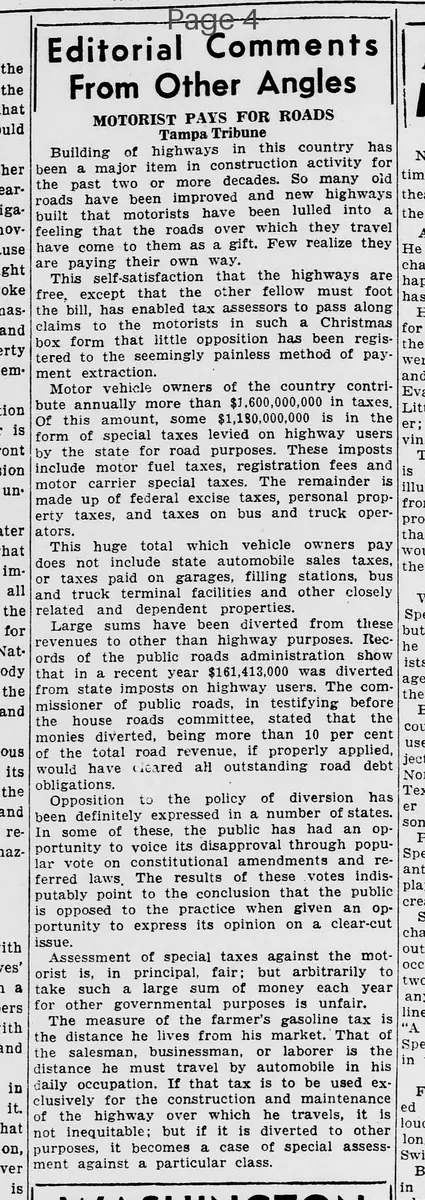
Editorial Comments From Other Angles
MOTORIST PAYS FOR ROADS
Tampa Tribune
Building of highways in this country has been a major item in construction activity for the past two or more decades. So many old roads have been improved and new highways built that motorists have been lulled into a feeling that the roads over which they travel have come to them as a gift. Few realize they are paying their own way.
This self-satisfaction that the highways are free, except that the other fellow must foot the bill, has enabled tax assessors to pass along claims to the motorists in such a Christmas box form that little opposition has been registered to the seemingly painless method of payment extraction.
Motor vehicle owners of the country contribute annually more than $1,600,000,000 in taxes. Of this amount, some $1,180,000,000 is in the form of special taxes levied on highway users by the state for road purposes. These imposts include motor fuel taxes, registration fees and motor carrier special taxes. The remainder is made up of federal excise taxes, personal property taxes, and taxes on bus and truck operators.
This huge total which vehicle owners pay does not include state automobile sales taxes, or taxes paid on garages, filling stations, bus and truck terminal facilities and other closely related and dependent properties.
Large sums have been diverted from these revenues to other than highway purposes. Records of the public roads administration show that in a recent year $161,413,000 was diverted from state imposts on highway users. The commissioner of public roads, in testifying before the house roads committee, stated that the monies diverted, being more than 10 per cent of the total road revenue, if properly applied, would have cleared all outstanding road debt obligations.
Opposition to the policy of diversion has been definitely expressed in a number of states. In some of these, the public has had an opportunity to voice its disapproval through popular vote on constitutional amendments and referred laws. The results of these votes indisputably point to the conclusion that the public is opposed to the practice when given an opportunity to express its opinion on a clear-cut issue.
Assessment of special taxes against the motorist is, in principal, fair; but arbitrarily to take such a large sum of money each year for other governmental purposes is unfair.
The measure of the farmer's gasoline tax is the distance he lives from his market. That of the salesman, businessman, or laborer is the distance he must travel by automobile in his daily occupation. If that tax is to be used exclusively for the construction and maintenance of the highway over which he travels, it is not inequitable; but if it is diverted to other purposes, it becomes a case of special assessment against a particular class.
MOTORIST PAYS FOR ROADS
Tampa Tribune
Building of highways in this country has been a major item in construction activity for the past two or more decades. So many old roads have been improved and new highways built that motorists have been lulled into a feeling that the roads over which they travel have come to them as a gift. Few realize they are paying their own way.
This self-satisfaction that the highways are free, except that the other fellow must foot the bill, has enabled tax assessors to pass along claims to the motorists in such a Christmas box form that little opposition has been registered to the seemingly painless method of payment extraction.
Motor vehicle owners of the country contribute annually more than $1,600,000,000 in taxes. Of this amount, some $1,180,000,000 is in the form of special taxes levied on highway users by the state for road purposes. These imposts include motor fuel taxes, registration fees and motor carrier special taxes. The remainder is made up of federal excise taxes, personal property taxes, and taxes on bus and truck operators.
This huge total which vehicle owners pay does not include state automobile sales taxes, or taxes paid on garages, filling stations, bus and truck terminal facilities and other closely related and dependent properties.
Large sums have been diverted from these revenues to other than highway purposes. Records of the public roads administration show that in a recent year $161,413,000 was diverted from state imposts on highway users. The commissioner of public roads, in testifying before the house roads committee, stated that the monies diverted, being more than 10 per cent of the total road revenue, if properly applied, would have cleared all outstanding road debt obligations.
Opposition to the policy of diversion has been definitely expressed in a number of states. In some of these, the public has had an opportunity to voice its disapproval through popular vote on constitutional amendments and referred laws. The results of these votes indisputably point to the conclusion that the public is opposed to the practice when given an opportunity to express its opinion on a clear-cut issue.
Assessment of special taxes against the motorist is, in principal, fair; but arbitrarily to take such a large sum of money each year for other governmental purposes is unfair.
The measure of the farmer's gasoline tax is the distance he lives from his market. That of the salesman, businessman, or laborer is the distance he must travel by automobile in his daily occupation. If that tax is to be used exclusively for the construction and maintenance of the highway over which he travels, it is not inequitable; but if it is diverted to other purposes, it becomes a case of special assessment against a particular class.
What sub-type of article is it?
Taxation
Infrastructure
Economic Policy
What keywords are associated?
Motorist Taxes
Highway Funding
Tax Diversion
Road Construction
Public Opposition
Gasoline Tax
Registration Fees
What entities or persons were involved?
Motorists
Tampa Tribune
Public Roads Administration
Commissioner Of Public Roads
House Roads Committee
States
Editorial Details
Primary Topic
Motorists Paying For Roads Through Taxes And Opposition To Diversion Of Funds
Stance / Tone
Critical Of Diverting Highway User Taxes To Non Road Purposes; Advocates Exclusive Use For Road Construction And Maintenance
Key Figures
Motorists
Tampa Tribune
Public Roads Administration
Commissioner Of Public Roads
House Roads Committee
States
Key Arguments
Motorists Contribute Over $1,600,000,000 Annually In Taxes, With $1,180,000,000 In State Special Taxes For Roads Including Fuel Taxes, Registration Fees, And Motor Carrier Taxes
Federal Excise Taxes, Personal Property Taxes, And Taxes On Bus And Truck Operators Make Up The Remainder
$161,413,000 Was Diverted From State Highway User Taxes In A Recent Year
Diverted Funds, Over 10% Of Total Road Revenue, Could Clear All Outstanding Road Debts If Applied To Roads
Public Opposition To Diversion Shown Through Votes On Constitutional Amendments And Referred Laws In Several States
Special Taxes On Motorists Are Fair In Principle If Used Exclusively For Highway Construction And Maintenance
Diversion Constitutes Unfair Special Assessment Against Motorists, Measured By Travel Distance For Farmers, Salesmen, Businessmen, Or Laborers