Thank you for visiting SNEWPapers!
Sign up free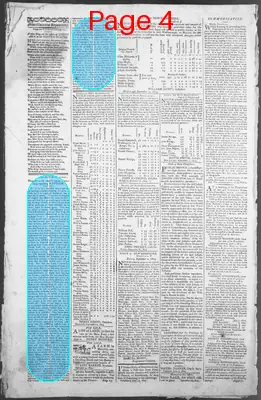
Letter to Editor
September 20, 1803
The New Hampshire Gazette
Portsmouth, Rockingham County, New Hampshire
What is this article about?
This letter, part of a series on the baptism controversy, argues for infant baptism by emphasizing that justification comes through imputation of Christ's righteousness, not personal acts of faith, critiquing Baptist views that exclude infants.
Clipping
OCR Quality
95%
Excellent
Full Text
For the N. H. GAZETTE.
Thoughts on the modern warm Controversy respecting BAPTISM.
[No. VII.]
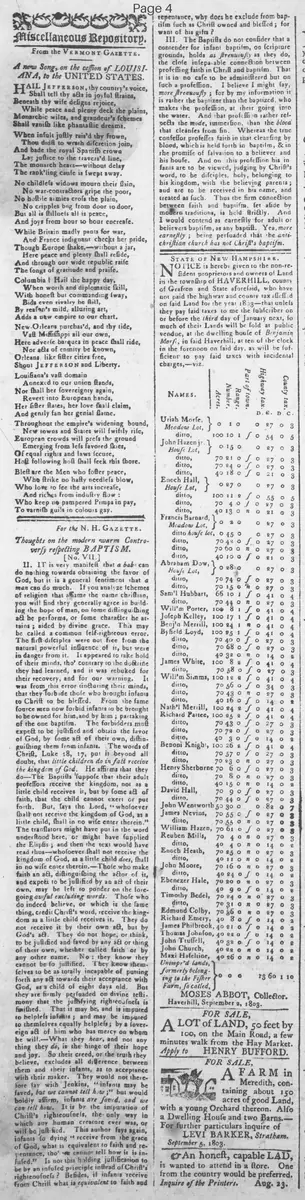
II. It is very manifest that a babe can do nothing towards obtaining the favor of God, but it is a general sentiment that a man can do much. If you analyze schemes of religion that aim at the same Christian, you will find they generally agree in building the hope of man, on some distinguishing act he performs, or some character he attains; aided by divine grace. This may be called a common self-righteous error. The first-disciples were not free from the natural powerful influence of it, but were in danger from it. It appeared to take hold of their minds, tho' contrary to the doctrine they had learned, and it was rebuked for their recovery, and for our warning. It was from this error tincturing their minds, that they forbade those who brought infants to Christ to be blessed. From the same source men now forbid infants to be brought to be baptized for him, and by him; partaking of the one baptism. The forbidders must expect to be justified and obtain the favor of God, by some act of their own, distinguishing them from infants. The words of Christ, Luke 18, 17. put it beyond all doubt, that little children do in fact receive the kingdom of God. He affirms that they do—The Baptists suppose that their adult professors receive the kingdom, not as a little child receives it, but by some act of faith, that the child cannot exert or put forth. But, says the Lord, "whosoever shall not receive the kingdom of God, as a little child, shall in no wise enter therein." The translators might have put in the word understood here, or might have supplied the Ellipsis; and then the text would have read thus—whosoever shall not receive the kingdom of God, as a little child does, shall in no wise enter therein.—Those who make faith an act, distinguishing the actor of it, and expect to be justified by an act of their own, may be left to ponder on the foregoing awful excluding words. Those who do indeed believe, or which is the same thing, credit Christ's word, receive the kingdom as a little child receives it. They do not receive it by their own act, but by God's act. They do not hope, or think, to be justified and saved by any act or thing of their own, whether called faith or by any other name. No: they know they cannot be so justified. They know themselves to be as totally incapable of putting forth any act towards their acceptance with God, as a child of eight days old. But they are firmly persuaded on divine testimony that the justifying righteousness is finished. That it may be, and is imputed to helpless infants; and may be imputed to themselves equally helpless; by a sovereign act of him who has mercy on whom he will.—What they hear, and not any thing they do, is the hinge of their hope and joy. So their creed, or the truth they believe, excludes all difference between them and their infants, as to acceptance with their maker. They would not therefore say with Jenkins, "infants may be saved, but we cannot tell how;" but would boldly affirm, infants are saved, and we can tell how. It is by the imputation of Christ's righteousness, the only way in which any human creature ever was, or will be justified. This author says again, infants so dying "receive from the grace of God, what is equivalent to faith and repentance, tho' we cannot tell how it is infused." Is not this holding justification to be by an infused principle instead of Christ's righteousness? Besides, if infants receive from Christ what is equivalent to faith and repentance, why does he exclude from baptism such as Christ owned and blessed: for want of his gifts?
III. The Baptists do not consider that a contender for infant baptism, on scripture grounds, holds as strenuously as they do, the close inseparable connection between professing faith in Christ and baptism. That it is in no case to be administered but on such a profession. I believe I might say, more strenuously; for by my information it is rather the baptizer than the baptized, who makes the profession, at their going into the water. And that profession rather respects the mode, immersion, than the blood that cleanses from sin. Whereas the true confessor professes faith in that cleansing by blood, which is held forth in baptism, & in the promise of salvation to a believer. and his house. And on this profession his infants are to be viewed, judging by Christ's word, to be disciples, holy, belonging to his kingdom, with the believing parents; and are to be received in his name, and treated as such. Thus the firm connection between faith and baptism. set aside by modern traditions. is held strictly. And I would contend as earnestly for adult or believers baptism, as any baptist. Yea, more earnestly; being persuaded that the anti-christian church has not Christ's baptism.
Thoughts on the modern warm Controversy respecting BAPTISM.
[No. VII.]
II. It is very manifest that a babe can do nothing towards obtaining the favor of God, but it is a general sentiment that a man can do much. If you analyze schemes of religion that aim at the same Christian, you will find they generally agree in building the hope of man, on some distinguishing act he performs, or some character he attains; aided by divine grace. This may be called a common self-righteous error. The first-disciples were not free from the natural powerful influence of it, but were in danger from it. It appeared to take hold of their minds, tho' contrary to the doctrine they had learned, and it was rebuked for their recovery, and for our warning. It was from this error tincturing their minds, that they forbade those who brought infants to Christ to be blessed. From the same source men now forbid infants to be brought to be baptized for him, and by him; partaking of the one baptism. The forbidders must expect to be justified and obtain the favor of God, by some act of their own, distinguishing them from infants. The words of Christ, Luke 18, 17. put it beyond all doubt, that little children do in fact receive the kingdom of God. He affirms that they do—The Baptists suppose that their adult professors receive the kingdom, not as a little child receives it, but by some act of faith, that the child cannot exert or put forth. But, says the Lord, "whosoever shall not receive the kingdom of God, as a little child, shall in no wise enter therein." The translators might have put in the word understood here, or might have supplied the Ellipsis; and then the text would have read thus—whosoever shall not receive the kingdom of God, as a little child does, shall in no wise enter therein.—Those who make faith an act, distinguishing the actor of it, and expect to be justified by an act of their own, may be left to ponder on the foregoing awful excluding words. Those who do indeed believe, or which is the same thing, credit Christ's word, receive the kingdom as a little child receives it. They do not receive it by their own act, but by God's act. They do not hope, or think, to be justified and saved by any act or thing of their own, whether called faith or by any other name. No: they know they cannot be so justified. They know themselves to be as totally incapable of putting forth any act towards their acceptance with God, as a child of eight days old. But they are firmly persuaded on divine testimony that the justifying righteousness is finished. That it may be, and is imputed to helpless infants; and may be imputed to themselves equally helpless; by a sovereign act of him who has mercy on whom he will.—What they hear, and not any thing they do, is the hinge of their hope and joy. So their creed, or the truth they believe, excludes all difference between them and their infants, as to acceptance with their maker. They would not therefore say with Jenkins, "infants may be saved, but we cannot tell how;" but would boldly affirm, infants are saved, and we can tell how. It is by the imputation of Christ's righteousness, the only way in which any human creature ever was, or will be justified. This author says again, infants so dying "receive from the grace of God, what is equivalent to faith and repentance, tho' we cannot tell how it is infused." Is not this holding justification to be by an infused principle instead of Christ's righteousness? Besides, if infants receive from Christ what is equivalent to faith and repentance, why does he exclude from baptism such as Christ owned and blessed: for want of his gifts?
III. The Baptists do not consider that a contender for infant baptism, on scripture grounds, holds as strenuously as they do, the close inseparable connection between professing faith in Christ and baptism. That it is in no case to be administered but on such a profession. I believe I might say, more strenuously; for by my information it is rather the baptizer than the baptized, who makes the profession, at their going into the water. And that profession rather respects the mode, immersion, than the blood that cleanses from sin. Whereas the true confessor professes faith in that cleansing by blood, which is held forth in baptism, & in the promise of salvation to a believer. and his house. And on this profession his infants are to be viewed, judging by Christ's word, to be disciples, holy, belonging to his kingdom, with the believing parents; and are to be received in his name, and treated as such. Thus the firm connection between faith and baptism. set aside by modern traditions. is held strictly. And I would contend as earnestly for adult or believers baptism, as any baptist. Yea, more earnestly; being persuaded that the anti-christian church has not Christ's baptism.
What sub-type of article is it?
Religious
Persuasive
Philosophical
What themes does it cover?
Religion
What keywords are associated?
Infant Baptism
Baptist Controversy
Justification Faith
Christ Righteousness
Luke 18:17
Imputation Salvation
What entities or persons were involved?
N. H. Gazette
Letter to Editor Details
Recipient
N. H. Gazette
Main Argument
infants receive the kingdom of god like adults through imputation of christ's righteousness, not personal acts; thus, they should be baptized based on parental faith, critiquing baptist exclusion of infants.
Notable Details
References Luke 18:17
Critiques Jenkins On Infant Salvation
Discusses Ellipsis In Biblical Translation
Emphasizes Justification By God's Act, Not Human Faith As An Act