Thank you for visiting SNEWPapers!
Sign up free
Daily National Intelligencer
Washington, District Of Columbia
What is this article about?
In the U.S. House of Representatives on January 18, 1817, Mr. Taul of Kentucky spoke in favor of repealing the previous session's compensation law, arguing that representatives have a duty to follow constituents' instructions, defending this constitutional principle against opposition.
Clipping
OCR Quality
Full Text
[CONTINUED.]
HOUSE OF REPRESENTATIVES.
JANUARY 18, 1817.
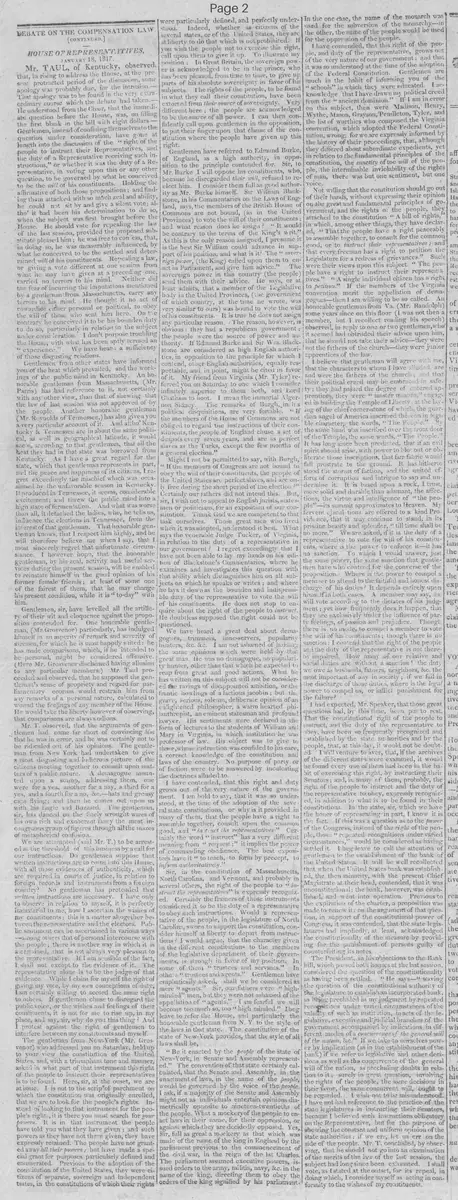
Mr. TAUL, of Kentucky, observed that, in rising to address the House, at the present protracted period of the discussion, some apology was probably due, for the intrusion. That apology was to be found in the very extraordinary course which the debate had taken. He understood from the Chair, that the immediate question before the House, was, on filling the first blank in the bill with eight dollars per day. Gentlemen, instead of confining themselves to the question under consideration, have gone at length into the discussion of the "right of the people to instruct their Representatives, and the duty of a Representative receiving such instructions," or whether it was the duty of a Representative, in voting upon this or any other question, to be governed by what he conceived to be the will of his constituents. Holding the affirmative of both those propositions: and finding them attacked with so much zeal and ability, he could not sit by and give a silent vote; although it had been his determination to do so, when the subject was first brought before the House. He should vote for repealing the law of the last session, provided the proposed substitute pleased him; he was free to confess, that, in doing so, he was measurably influenced, by what he conceived to be the settled and determined will of his constituents. Repealing a law, or giving a vote different at one session from what he may have given at a preceding one, carried no terrors to his mind. Neither did the fear of incurring the imputations mentioned by a gentleman from Massachusetts, carry any terrors to his mind. He thought it no act of cowardice either personal or political, to obey the will of those who sent him here. On the contrary he conceived it to be his bounden duty to do so, particularly in relation to the subject under consideration. I don't purpose troubling the House, with what has been aptly termed an "experience." We have heard a sufficiency of those disgusting relations. Gentlemen from other states have informed you of the heat which prevailed, and the workings of the public mind in Kentucky. An honorable gentleman from Massachusetts, (Mr. Parris) has had reference to it, not certainly with any other view, than that of shewing that the law of last session was not approved of by the people. Another honorable gentleman (Mr. Reynolds of Tennessee.) has also given you a very particular account of it. And although Kentucky & Tennessee are in about the same political, as well as geographical latitude, it would seem, according to that gentleman, that all the heat they had in that state was borrowed from Kentucky. As I have a great regard for the state, which that gentleman represents in part, and the peace and happiness of its citizens, I regret exceedingly the mischief which was occasioned by the unfavorable season in Kentucky. It produced in Tennessee, it seems, considerable excitement; and threw the public mind into a high state of fermentation. And what was worse than all, it detached the ladies, who, he tells us, influence the elections in Tennessee, from the interest of that gentleman. That honorable gentleman knows, that I respect him highly, and he will therefore believe me when I say, that I most sincerely regret that unfortunate circumstance. I however hope, that the honorable gentleman, by his zeal, activity and useful services during the present session, will be enabled to reinstate himself in the good opinion of his former female friends; at least of some one of the fairest of them. that he may change his present condition, while it is "to-day" with him.
Gentlemen, sir, have levelled all the artillery of their wit and eloquence against the proposition contended for. One honorable gentleman, (Mr. Grosvenor) particularly, has indulged himself in an asperity of remark and severity of sarcasm, for which he is most happily suited: he has made comparisons, which, if he intended to be personal, might be considered offensive. (Here Mr. Grosvenor disclaimed having allusion to any particular members.) Mr. Taul proceeded and observed, that he supposed the gentleman's sense of propriety and regard for parliamentary decorum would restrain him from any remarks of a personal nature, calculated to wound the feelings of any member of the House. He would take the liberty however of observing, that comparisons are always odious.
Mr. T. observed, that the arguments of gentlemen had come far short of convincing him that he was in error, and he was certainly not to be ridiculed out of his opinions. The gentleman from New York had undertaken to give a most disgusting and ludicrous picture of the citizens meeting together to consult upon matters of a public nature. A demagogue mounted upon a stump, addressing them, one were for a yea, another for a nay, a third for a yes, and a fourth for a no, &c.—hats and greasy caps flying; and then he comes out upon us with his Eagle and Buzzard. The gentleman, sir, has danced on the finely wrought wires of his own rich and exuberant fancy the most incongruous group of figures through all the mazes of metaphorical confusion.
We are attempted (said Mr. T.) to be arrested at the threshold of this business by a call for our instructions. Do gentlemen suppose that written instructions are to come into this House, with all those evidences of authenticity, which are required in courts of justice, in relation to foreign records and instruments from a foreign country? No gentleman has pretended that written instructions are necessary. I have only to observe in relation to myself, it is perfectly immaterial to me, how I ascertain the wishes of my constituents; this is a matter altogether between the representative and the electors. Public sentiment can be ascertained in various ways—among others that of personal intercourse with the people; there is another way in which it is ascertained, that is not always very pleasant to the representative. If I am sensible of the fact, I shall not except to the evidence of it. The representative alone is to be the judge of that evidence. While I claim for myself the right of giving my vote, by my own conceptions of duty, I am certainly willing to accord the same right to others. If gentlemen choose to disregard the public voice, or the wishes and feelings of their constituents, it is not for me to rise up, in my place, and say, sir, why do you this thing? And I protest against the right of gentlemen to interfere between my constituents and myself.
The gentleman from New-York (Mr. Grosvenor) who addressed you on Saturday, held up to your view the constitution of the United States, and, with a triumphant tone and manner, asked in what part of that instrument this right of the people to instruct their representatives is to be found. Here, sir, at the outset, we are at issue. It is not to the scrip of parchment on which the constitution was originally enrolled, that we are to look for the people's rights. Instead of looking to that instrument for the people's right, it is there you must search for your powers. It is in that instrument the people have told you what they have given; and such powers as they have not there given, they have expressly retained. The people have not granted away all their powers; but have made a special grant for purposes particularly defined and enumerated. Previous to the adoption of the constitution of the United States, they were citizens of separate, sovereign and independent states, in the constitutions of which their rights were particularly defined, and perfectly understood. Indeed, whether as citizens of the several states, or of the United States, they are at liberty to do that which is not prohibited. If you wish the people not to exercise this right, call upon them to give it up. To illustrate my position: In Great Britain, the sovereign power is acknowledged to be in the prince, who has been pleased, from time to time, to give up parts of his absolute sovereignty in favor of his subjects. The rights of the people, to be found in what they call their constitution, have been extorted from their source of sovereignty. Very different here; the people are acknowledged to be the source of all power. I can then confidently call upon gentlemen in the opposition, to put their finger upon that clause of the constitution where the people have given up this right.
Gentlemen have referred to Edmund Burke, of England, as a high authority, in opposition to the principle contended for. Sir, to Mr. Burke I will oppose his constituents, who, because he disregarded their will, refused to re-elect him. I consider them full as good authority as Mr. Burke himself. Sir William Blackstone, in his Commentaries on the Laws of England, says, the members of the British House of Commons are not bound, (as in the United Provinces) to vote the will of their constituents; and what reason does he assign? "It would be contrary to the terms of the King's writ." As this is the only reason assigned, I presume it is the best Sir William could advance in support of his position; and what is it? The "sovereign power, (the King) called upon them to enact in Parliament, and give him advice." The sovereign power in this country (the people) send them with their advice. He says, or at least admits, that a member of the legislative body in the United Provinces, (the government of which country, at the time he wrote, was very similar to ours) was bound to vote the will of his constituents. It is true he does not assign any particular reason. The reason, however, is obvious: they had a republican government; the people were the source of power and authority. If Edmund Burke and Sir Wm. Blackstone are considered as high English authorities, in opposition to the principle for which I contend, other English authorities, equally respectable, and in point, might be cited in favor of it. My friend from Virginia (Mr. Tyler) referred you on Saturday to one which I consider infinitely superior to them both, and Lord Chatham to boot. I mean the immortal Algernon Sidney. The remarks of Burgh, in his political disquisitions, are very forcible. "If the members of the House of Commons are not obliged to regard the instructions of their constituents, the people of England choose a set of despots every seven years, and are as perfect slaves as the Turks, except the few months of a general election."
Might I not be permitted to say, with Burgh, "If the members of Congress are not bound to obey the will of their constituents, the people of the United States are perfect slaves, and are only free during the short period of the election?" Certainly our fathers did not intend this. But, sir, I wish not to appeal to English jurists, statesmen or politicians, for an exposition of our constitution. Thank God we are competent to that task ourselves. Those great men who lived when it was adopted, understood it best. What says the venerable Judge Tucker, of Virginia, in relation to the duty of a representative in our government? I regret exceedingly that I have not been able to lay my hands on his edition of Blackstone's Commentaries, where he examines and investigates this question with that ability which distinguishes him on all subjects on which he speaks or writes; and where he lays it down as the bounden and indispensable duty of the representative to vote the will of his constituents. He does not stop to enquire about the right of the people to instruct. He doubtless supposed the right could not be questioned.
We have heard a great deal about demagogues, trimmers, time-servers, popularity hunters, &c. &c. I am not ashamed of holding the same opinions which were held by that great man. He was no demagogue, no popularity hunter, other than that which he expected to reap from great and good actions. What he has written on this subject will not be considered the ravings of disappointed ambition, or the frantic howlings of a factious jacobin: but the grave, serious, solemn, deliberate opinion of an enlightened philosopher, a warm hearted philanthropist, an eminent statesman and profound lawyer. His sentiments were declared in the form of lectures to the students of William and Mary in Virginia, in which institution he was professor of law. His object was to give to those, whose instruction was confided to his care, a correct knowledge of the constitution and laws of the country. No purpose of party or of faction were to be answered by inculcating the doctrines alluded to.
I have contended, that this right and duty grows out of the very nature of the government. I am bold to say, that it was so understood, at the time of the adoption of the several state constitutions, or why is it provided in many of them, that the people have a right to assemble together, consult upon the common good, and "instruct the representatives." Certainly the word "instruct" has a very different meaning from "request;" it implies the power of commanding obedience. The best expositors have it "to teach, to form by precept, to inform authoritatively."
Sir, in the constitution of Massachusetts, North Carolina, and Vermont, and probably in several others, the right of the people to "instruct the representatives" is expressly recognized. Certainly the framers of those instruments considered it to be the duty of a representative to obey such instructions. Would a representative of the people, in the legislature of North Carolina, sworn to support the constitution, consider himself at liberty to depart from instructions? I would argue, that the character given in the different constitutions to the members of the legislative department of their governments, is strongly in favor of my position. In some of them "trustees and servants." In others "trustees and agents." Gentlemen have emphatically asked, shall we be considered as mere "agents." Sir, our fathers were "high-minded" men, but they were not ashamed of the appellation of "agents." I am fearful we will become too much so, too "high minded." I beg leave to refer the House, and particularly the honorable gentleman from N. Y. to the style of the laws in that state. The constitution of the state of New-York provides, that the style of all laws shall be,
"Be it enacted by the people of the state of New-York, in Senate and Assembly represented." The convention of that state certainly calculated, that the Senate and Assembly, in the enactment of laws, in the name of the people, would be governed by the voice of the people.
I ask, if a majority of the Senate and Assembly might not as individuals entertain opinions diametrically opposite to nineteen-twentieths of the people. What a mockery of the people to enact laws in their name, for their oppression, or against which they are decidedly opposed. Yes, Sir, full as great a mockery as that which was made of the name of the king in England by the parliament previous to the commencement of the civil war, in the reign of the 1st Charles. The parliament assumed executive powers, issued orders to the army, militia, navy, &c. in the name of the king, directing them to obey the orders of the king signified by his parliament.
In the one case, the name of the monarch was used for the subversion of the monarchy—in the other, the name of the people would be used for the oppression of the people.
I have contended, that this right of the people, and duty of the representative, grows out of the very nature of our government; and that it was so understood at the time of the adoption of the Federal Constitution. Gentlemen are much in the habit of informing you of the "schools" in which they were educated. I acknowledge the knowledge that I have drawn my political creed from the "ancient dominion." If I am in error on this subject, then were Madison, Henry, Wythe, Mason, Grayson, Pendleton, Tyler, and the list of worthies who composed the Virginia convention, which adopted the Federal Constitution, wrong; for we are expressly informed by the history of their proceedings, that, although they differed about subordinate expedients, yet in relation to the fundamental principles of the constitution, the sanctity of the will of the people, the interminable inviolability of the rights of man, there was but one sentiment, but one voice.
Not willing that the constitution should go out of their hands, without expressing their opinion on the great and fundamental principles of government, and the rights of the people, they attached to the constitution "A bill of rights," in which, among other things, they have declared, "That the people have a right peaceably to assemble together, to consult for the common good, or to instruct their representatives; and that every freeman has a right to petition the Legislature for a redress of grievances." Such were their views upon this subject. "The people have a right to instruct their representatives." "A single individual citizen has a right to petition." If the members of the Virginia convention merit the appellation of demagogues—then I am willing to be so called. An honorable gentleman from Va. (Mr. Randolph) some years since on this floor (I was not then a member, but I recollect reading his speech) observed, in reply to one or two gentlemen, who it seemed had obtruded their advice upon him, that he should not take their advice—they were not the fathers of the church—they were junior apprentices of the law.
I believe that gentleman will agree with me, that the characters to whom I have alluded are and were the fathers of the church: and that their political creed may be embraced in safety; they had passed the degree of entered apprentices, they were "master masons," engaged in building the Temple of Liberty at the laying of the chief corner-stone of which, the guardian angel of America inscribed thereon in legible character, the words, "The People." By the same hand was inscribed over the front door of the Temple, the same words, "The People."
It has long since been predicted, that if an evil spirit should arise, with power to blot out or obliterate those inscriptions, that fair fabric would fall prostrate to the ground. It has hitherto stood the storms of faction, and the united efforts of corruption and intrigue to sap and undermine it. It is based upon a rock, I trust, more solid and durable than adamant, the affections, the virtue and intelligence of "the people" —its summit approximates to Heaven. My fervent ejaculations are offered to a kind Providence, that it may continue to stand, in its pristine beauty and splendor, "till time shall be no more."
We are asked, if it is the duty of a representative to vote the will of his constituents, where is the power to enforce it—it has no sanction. To which I would answer, just the same power, the same sanction that gentlemen have who contend for the converse of the proposition. Where is the power to compel a member to attend to the faithful and honest discharge of his duties? It depends entirely upon himself in both cases. A member may say, he will vote according to the dictates of his judgment; yet how frequently does it happen, that they are exclusively under the influence of party feelings, of passion and prejudice. Though there is no motive, to compel a member to vote the will of his constituents; though there is no sanction: I contend that the right of the people and the duty of the representative is not thereby impaired. How many of our relative and social duties are without a sanction! the duty we owe as husbands, fathers, neighbors, &c. the most important of any in society; if we fail in the discharge of those duties, where is the legal power to compel us, or inflict punishment for the failure?
I had expected, Mr. Speaker, that those great questions had, by this time, been put to rest. That the constitutional right of the people to instruct, and the duty of the representative to obey, have been so frequently recognized and established by the state authorities and by the people, that, at this day, it would not be doubted. I will venture to aver, that, if the archives of the different states were examined, it would be found every one of them had been in the habit of exercising this right, by instructing their Senators; and, in many of them, probably, the right of the people to instruct and the duty of the representative to obey, expressly recognized, in addition to what is to be found in their constitutions. In the state, sir, which we have the honor of representing in part, I know it is the fact. If this was a question as to the power of the Congress, instead of the right of the people, those "repeated recognitions under varied circumstances," would be considered as having settled it. I beg leave to call the attention of gentlemen to the establishment of the bank of the United States. It will be well recollected that when the United States bank was established, the then minority, with the present Chief Magistrate at their head, contended, that it was unconstitutional; the bank, however, was established, and went into operation. Previous to the expiration of the charter, a proposition was made to renew it; on the argument of that question, in support of the constitutional power of Congress, it was contended, that the state legislatures had impliedly, at least, acknowledged the constitutionality of the measure by providing for the punishment of persons guilty of counterfeiting its notes.
The President, in his objections to the Bank bill, which passed both houses at the last session, considered the question of the constitutionality as having been settled. "He says—waiving the question of the constitutional authority of the legislature to establish an incorporated bank, as being precluded in my judgment by repeated recognitions under varied circumstances of the validity of such an institution, in acts of the legislative, executive and judicial branches of the government accompanied by indications in different modes of a concurrence of the general will of the nation, &c." If we take to ourselves power by implication (as in the establishment of the bank) if we refer to legislative and other decisions as well as the concurrence of the general will of the nation, as precluding doubts in relation to it; surely in great question, involving the rights of the people, the same decisions in their favor, the same concurrent will, ought to be regarded. I wish not to be misunderstood. I have not had reference to the practice of the state legislatures in instructing their Senators, because I believed such instructions obligatory on the Representative, but for the purpose of shewing the constant and uniform opinion of the state authorities; if we err, let us err on the side of the people. Mr. T. concluded, by observing, that he should not go into an examination of the merits of the law of the last session, the subject had long since been exhausted. I shall vote, as I stated at the outset, for its repeal, in doing which, I consider myself as acting in conformity to the wishes of my constituents.
What sub-type of article is it?
What keywords are associated?
What entities or persons were involved?
Where did it happen?
Domestic News Details
Primary Location
House Of Representatives
Event Date
January 18, 1817.
Key Persons
Outcome
mr. taul announces he will vote for repealing the compensation law of the previous session, influenced by his constituents' will.
Event Details
Mr. Taul defends the right of the people to instruct their representatives and the duty of representatives to obey those instructions, in the context of debating the repeal of the previous session's compensation law. He counters arguments from opponents, cites historical and constitutional precedents, and rejects notions of independent judgment overriding constituents' will.