Thank you for visiting SNEWPapers!
Sign up free
Arizona State Miner
Wickenburg, Maricopa County, Arizona
What is this article about?
Ninth anniversary of Grand Canyon National Park highlights its delayed 1919 establishment despite 1540 discovery, conservation struggles, and rapid developments in infrastructure, sanitation, roads, and accommodations amid surging tourism from 1,575 autos in 1919 to 22,849 in 1926.
Clipping
OCR Quality
Full Text
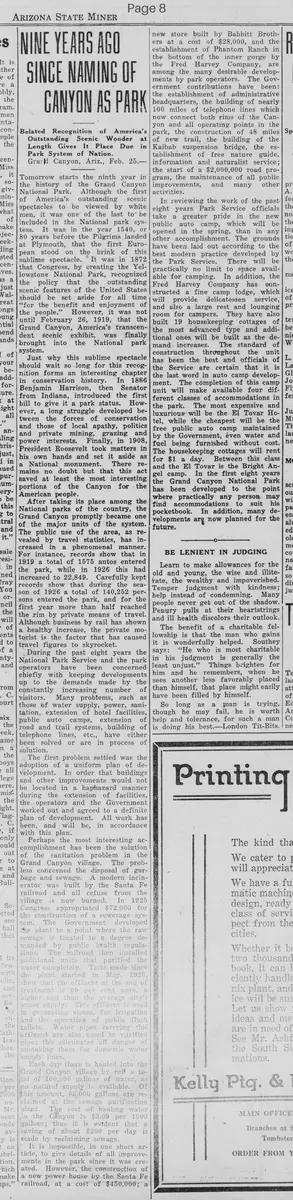
NINE YEARS AGO SINCE NAMING OF CANYON AS PARK
Belated Recognition of America's Outstanding Scenic Wonder at Length Gives It Place Due in Park System of Nation.
Grand Canyon, Ariz., Feb. 25.--Tomorrow starts the ninth year in the history of the Grand Canyon National Park. Although the first of America's outstanding scenic spectacles to be viewed by white men, it was one of the last to be included in the National park system. It was in the year 1540, or 80 years before the Pilgrims landed at Plymouth, that the first European stood on the brink of this sublime spectacle. It was in 1872 that Congress, by creating the Yellowstone National Park, recognized the policy that the outstanding scenic features of the United States should be set aside for all time "for the benefit and enjoyment of the people." However, it was not until February 26, 1919, that the Grand Canyon, America's transcendent scenic exhibit, was finally brought into the National park system.
Just why this sublime spectacle should wait so long for this recognition forms an interesting chapter in conservation history. In 1886 Benjamin Harrison, then Senator from Indiana, introduced the first bill to give it a park status. However, a long struggle developed between the forces of conservation and those of local apathy, politics and private mining, grazing and power interests. Finally, in 1908, President Roosevelt took matters in his own hands and set it aside as a National monument. There remains no doubt but that this act saved at least the most interesting portions of the Canyon for the American people.
After taking its place among the National parks of the country, the Grand Canyon promptly became one of the major units of the system. The public use of the area, as revealed by travel statistics, has increased in a phenomenal manner. For instance, records show that in 1919 a total of 1575 autos entered the park, while in 1926 this had increased to 22,849. Carefully kept records show that during the season of 1926 a total of 140,252 persons entered the park, and for the first year more than half reached the rim by private means of travel. Although business by rail has shown a healthy increase, the private motorist is the factor that has caused travel figures to skyrocket.
During the past eight years the National Park Service and the park operators have been concerned chiefly with keeping developments up to the demands made by the constantly increasing number of visitors. Many problems, such as those of water supply, power, sanitation, extension of hotel facilities, public auto camps, extension of road and trail systems, building of telephone lines, etc., have either been solved or are in process of solution.
The first problem settled was the adoption of a uniform plan of development. In order that buildings and other improvements would not be located in a haphazard manner during the extension of facilities, the operators and the Government worked out and agreed to a definite plan of development. All work has been, and will be, in accordance with this plan.
Perhaps the most interesting accomplishment has been the solution of the sanitation problem in the Grand Canyon village. The problem concerned the disposal of garbage and sewage. A modern incinerator was built by the Santa Fe railroad and all refuse from the village is now burned. In 1925 Congress appropriated $72,000 for the construction of a sewerage system. The Government developed the plant to a point where the raw sewage is treated to a degree demanded by public health regulations. The railroad then installed additional units that purified the water completely. Tests made since the plant started in May, 1926, show that the effluent at the end of treatment is 97 per cent pure, a higher test than the average city's water supply. This effluent is used in generating steam, for irrigation and the operation of public flush toilets. Water pipes carrying this effluent are also cased in vitrified pipe; this eliminates all danger of mistaking them for domestic water supply lines.
Each day there is hauled into the Grand Canyon village by rail a total of 100,000 gallons of water, as no natural supply is available. Of this amount, 65,000 gallons are reclaimed at the sewage purification plant. The cost of hauling water to the Canyon is $3.09 per 1000 gallons; thus it is evident that a saving of about $200 per day is made by reclaiming sewage.
It is impossible, in one short article, to give details of all improvements in the park since it was created. However, the construction of a new power house by the Santa Fe railroad, at a cost of $450,000; a new store built by Babbitt Brothers at a cost of $28,000, and the establishment of Phantom Ranch in the bottom of the inner gorge by the Fred Harvey Company, are among the many desirable developments by park operators. The Government contributions have been: the establishment of administrative headquarters, the building of nearly 100 miles of telephone lines which now connect both rims of the Canyon and all operating points in the park, the construction of 48 miles of new trail, the building of the Kaibab suspension bridge, the establishment of free nature guide, information and naturalist service; the start of a $2,000,000 road program, the maintenance of all public improvements, and many other activities.
In reviewing the work of the past eight years Park Service officials take a greater pride in the new public auto camp, which will be opened in the spring, than in any other accomplishment. The grounds have been laid out according to the best modern practice developed by the Park Service. There will be practically no limit to space available for camping. In addition, the Fred Harvey Company has constructed a fine camp lodge, which will provide delicatessen service, and also a large rest and lounging room for campers. They have also built 19 housekeeping cottages of the most advanced type and additional ones will be built as the demand increases. The standard of construction throughout the unit has been the best and officials of the Service are certain that it is the last word in auto camp development. The completion of this camp unit will make available four different classes of accommodations in the park. The most expensive and luxurious will be the El Tovar Hotel, while the cheapest will be the free public auto camp maintained by the Government, even water and fuel being furnished without cost. The housekeeping cottages will rent for $1 a day. Between this class and the El Tovar is the Bright Angel camp. In the first eight years the Grand Canyon National Park has been developed to the point where practically any person may find accommodations to suit his pocketbook. In addition, many developments are now planned for the future.
What sub-type of article is it?
What themes does it cover?
What keywords are associated?
What entities or persons were involved?
Where did it happen?
Story Details
Key Persons
Location
Grand Canyon, Ariz.
Event Date
February 26, 1919
Story Details
The Grand Canyon National Park marks its ninth year, recounting its late inclusion in the national park system despite early discovery in 1540. After struggles against local interests, it was established in 1919 following Roosevelt's 1908 monument designation. Developments include infrastructure improvements, increased visitation, sanitation solutions, and expanded accommodations.