Thank you for visiting SNEWPapers!
Sign up free
Toledo Union Journal
Toledo, Lucas County, Ohio
What is this article about?
Secretary Martin P. Durkin resigns as Labor Secretary after Eisenhower aides renege on Taft-Hartley reform agreement. Labor figures Meany and Reuther back him, decrying anti-labor policies; Republicans criticize the appointment and favor tougher laws. (198 chars)
Clipping
OCR Quality
Full Text
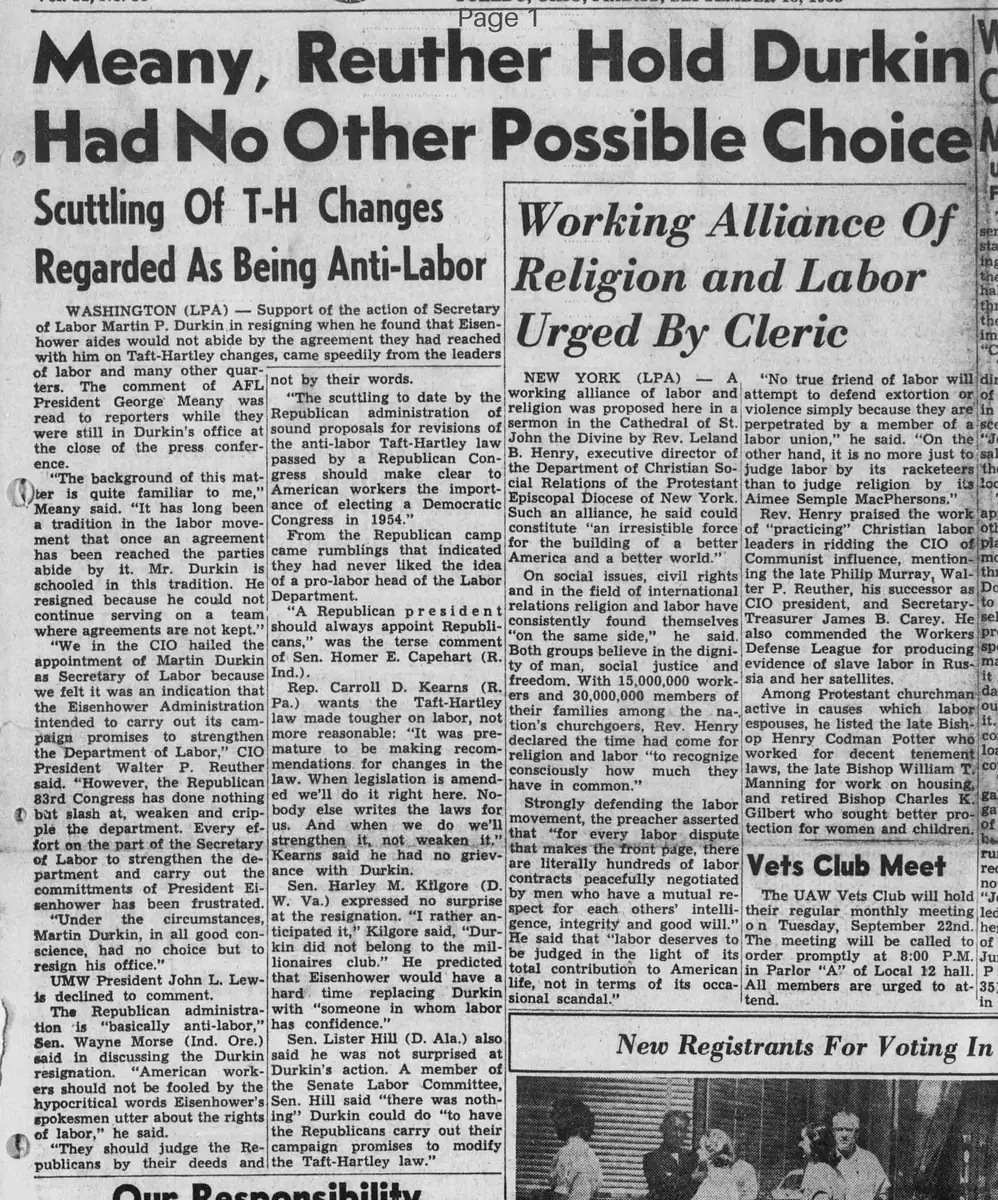
WASHINGTON (LPA)—Secretary of Labor Martin P. Durkin in resigning said Eisenhower aides would not abide by the agreement they had reached with him on Taft-Hartley changes.
Support of the action of Secretary resigning when he found that Eisenhower aides would not abide by the agreement they had reached with him on Taft-Hartley changes, came speedily from the leaders of labor in their words.
The comment of AFL President George Meany was read to reporters while they were still in Durkin's office at the close of the press conference.
"The background of this matter is quite familiar to me," Meany said. "It has long been a tradition in the labor movement that once an agreement has been reached the parties abide by it. Mr. Durkin is schooled in this tradition. He resigned because he could not continue serving on a team where agreements are not kept."
"We in the CIO hailed the appointment of Martin Durkin as Secretary of Labor because we felt it was an indication that the Eisenhower Administration intended to carry out its campaign promises to strengthen the Department of Labor," CIO President Walter P. Reuther said. "However, the Republican 83rd Congress has done nothing but slash at, weaken and cripple the department. Every effort on the part of the Secretary of Labor to strengthen the department and carry out the commitments of President Eisenhower has been frustrated.
"Under the circumstances, Martin Durkin, in all good conscience, had no choice but to resign his office."
UMW President John L. Lewis declined to comment.
The Republican administration 'is "basically anti-labor," Sen. Wayne Morse (Ind. Ore.) said in discussing the Durkin resignation. "American workers should not be fooled by the hypocritical words Eisenhower's spokesmen utter about the rights of labor," he said.
"The scuttling to date by the Republican administration of sound proposals for revisions of the anti-labor Taft-Hartley law passed by a Republican Congress should make clear to American workers the importance of electing a Democratic Congress in 1954."
From the Republican camp came rumblings that indicated they had never liked the idea of a pro-labor head of the Labor Department.
"A Republican president should always appoint Republicans," was the terse comment of Sen. Homer E. Capehart (R. Ind.).
Rep. Carroll D. Kearns (R. Pa.) wants the Taft-Hartley law made tougher on labor, not more reasonable: "It was premature to be making recommendations for changes in the law. When legislation is amended we'll do it right here. Nobody else writes the laws for us. And when we do we'll strengthen it, not weaken it."
Kearns said he had no grievance with Durkin.
Sen. Harley M. Kilgore (D. W. Va.) expressed no surprise at the resignation. "I rather anticipated it," Kilgore said, "Durkin did not belong to the millionaires club." He predicted that Eisenhower would have a hard time replacing Durkin with "someone in whom labor has confidence."
Sen. Lister Hill (D. Ala.) also said he was not surprised at Durkin's action. A member of the Senate Labor Committee, Sen. Hill said "there was nothing" Durkin could do "to have his.
They should judge the Republicans by their deeds and the campaign promises to modify the Taft-Hartley law."
What sub-type of article is it?
What themes does it cover?
What keywords are associated?
What entities or persons were involved?
Where did it happen?
Story Details
Key Persons
Location
Washington
Story Details
Secretary of Labor Martin P. Durkin resigns because Eisenhower aides refuse to abide by their agreement on Taft-Hartley changes. Labor leaders like AFL President George Meany and CIO President Walter P. Reuther support the resignation, citing broken promises and anti-labor policies. UMW President John L. Lewis declines comment. Democratic senators criticize the administration, while Republicans oppose labor-friendly appointments and seek to strengthen Taft-Hartley.