Thank you for visiting SNEWPapers!
Sign up free
Literary
November 26, 1795
Gazette Of The United States
Philadelphia, Philadelphia County, Pennsylvania
What is this article about?
Description of a public monument in Chichester to poet William Collins, depicting him recovering from frenzy and seeking solace in the Gospel, with lyre and poem nearby, flanked by figures of Love and Pity, sculpted by Flaxman. Includes an epitaph by Mr. Hayley praising Collins' genius amid misfortune and faith, plus reference to Dr. Johnson's biography.
Clipping
OCR Quality
95%
Excellent
Full Text
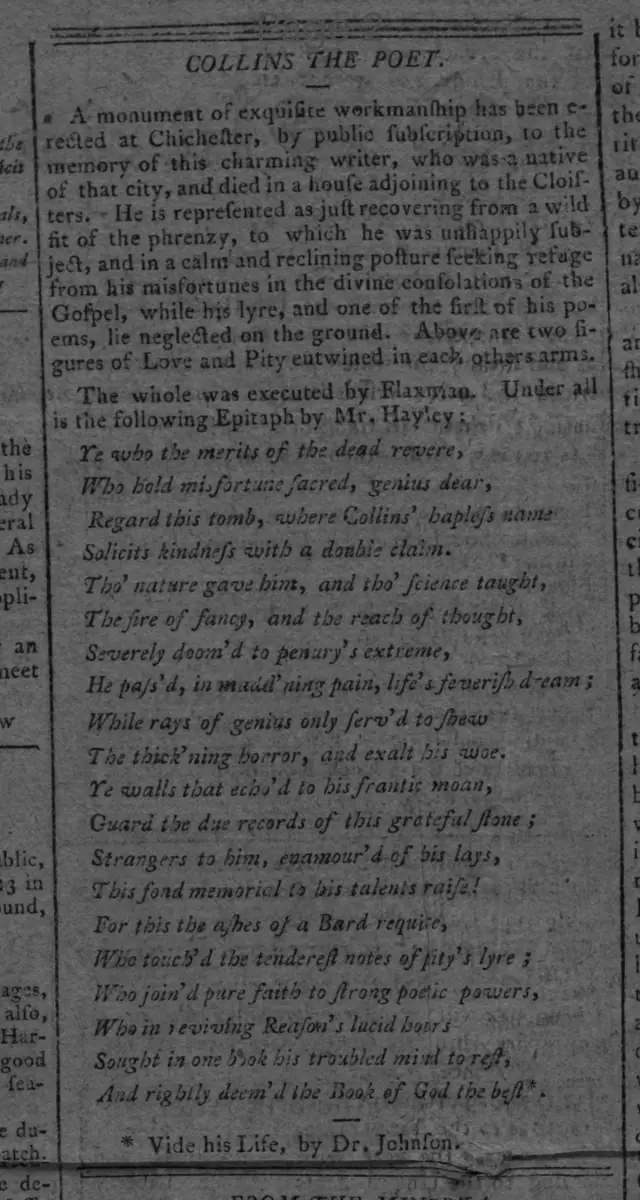
COLLINS THE POET.
A monument of exquisite workmanship has been erected at Chichester, by public subscription, to the memory of this charming writer, who was a native of that city, and died in a house adjoining to the Cloisters. - He is represented as just recovering from a wild fit of the phrensy, to which he was unhappily subject, and in a calm and reclining posture seeking refuge from his misfortunes in the divine consolations of the Gospel, while his lyre, and one of the first of his poems, lie neglected on the ground. Above are two figures of Love and Pity entwined in each others arms.
The whole was executed by Flaxman. Under all is the following Epitaph by Mr. Hayley;
Ye who the merits of the dead revere,
Who hold misfortune sacred, genius dear,
Regard this tomb, where Collins' hapless name
Solicits kindness with a double claim.
Tho' nature gave him, and tho' science taught,
The fire of fancy, and the reach of thought.
Severely doom'd to penury's extreme,
He pass'd, in madd'ning pain, life's feverish dream;
While rays of genius only serv'd to shew
The thickning horror, and exalt his woe.
Ye walls that echo'd to his frantic moan,
Guard the due records of this grateful tone;
Strangers to him, enamour'd of his lays,
This fond memorial to his talents raise!
For this the ashes of a Bard require
Who touch'd the tenderest notes of pity's lyre;
Who join'd pure faith to strong poetic powers,
Who in reviving Reason's lucid hours
Sought in one book his troubled mind to rest.
And rightly deem'd the Book of God the best.
* Vide his Life, by Dr. Johnson.
A monument of exquisite workmanship has been erected at Chichester, by public subscription, to the memory of this charming writer, who was a native of that city, and died in a house adjoining to the Cloisters. - He is represented as just recovering from a wild fit of the phrensy, to which he was unhappily subject, and in a calm and reclining posture seeking refuge from his misfortunes in the divine consolations of the Gospel, while his lyre, and one of the first of his poems, lie neglected on the ground. Above are two figures of Love and Pity entwined in each others arms.
The whole was executed by Flaxman. Under all is the following Epitaph by Mr. Hayley;
Ye who the merits of the dead revere,
Who hold misfortune sacred, genius dear,
Regard this tomb, where Collins' hapless name
Solicits kindness with a double claim.
Tho' nature gave him, and tho' science taught,
The fire of fancy, and the reach of thought.
Severely doom'd to penury's extreme,
He pass'd, in madd'ning pain, life's feverish dream;
While rays of genius only serv'd to shew
The thickning horror, and exalt his woe.
Ye walls that echo'd to his frantic moan,
Guard the due records of this grateful tone;
Strangers to him, enamour'd of his lays,
This fond memorial to his talents raise!
For this the ashes of a Bard require
Who touch'd the tenderest notes of pity's lyre;
Who join'd pure faith to strong poetic powers,
Who in reviving Reason's lucid hours
Sought in one book his troubled mind to rest.
And rightly deem'd the Book of God the best.
* Vide his Life, by Dr. Johnson.
What sub-type of article is it?
Elegy
Poem
What themes does it cover?
Death Mortality
Religious
Moral Virtue
What keywords are associated?
Epitaph
Collins
Hayley
Monument
Genius
Misfortune
Faith
Phrensy
What entities or persons were involved?
Mr. Hayley
Literary Details
Title
Epitaph
Author
Mr. Hayley
Subject
To The Memory Of Collins
Key Lines
Ye Who The Merits Of The Dead Revere,
Who Hold Misfortune Sacred, Genius Dear,
Who In Reviving Reason's Lucid Hours
Sought In One Book His Troubled Mind To Rest.
And Rightly Deem'd The Book Of God The Best.