Thank you for visiting SNEWPapers!
Sign up free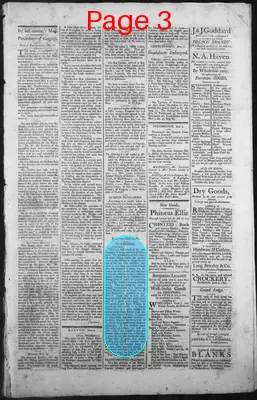
Editorial
June 6, 1797
The New Hampshire Gazette
Portsmouth, Rockingham County, New Hampshire
What is this article about?
An anonymous contributor to The Centinel advises farmers to plant buckwheat and oats as substitutes for Indian corn, which may be scarce due to prolonged wet and cold weather preventing timely planting.
Clipping
OCR Quality
95%
Excellent
Full Text
From The CENTINEL.
TO FARMERS.
GENTLEMEN,
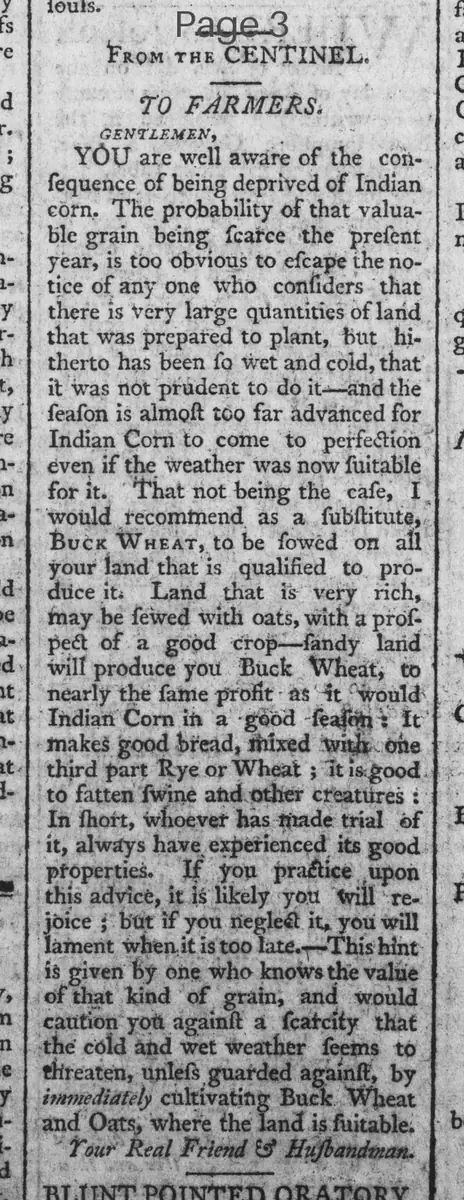
YOU are well aware of the consequence of being deprived of Indian corn. The probability of that valuable grain being scarce the present year, is too obvious to escape the notice of any one who considers that there is very large quantities of land that was prepared to plant, but hitherto has been so wet and cold, that it was not prudent to do it --and the season is almost too far advanced for Indian Corn to come to perfection even if the weather was now suitable for it. That not being the case, I would recommend as a substitute, Buck Wheat, to be sowed on all your land that is qualified to produce it. Land that is very rich, may be sowed with oats, with a prospect of a good crop --sandy land will produce you Buck Wheat, to nearly the same profit as it would Indian Corn in a good season: It makes good bread, mixed with one third part Rye or Wheat ; it is good to fatten swine and other creatures : In short, whoever has made trial of it, always have experienced its good properties. If you practice upon this advice, it is likely you will rejoice ; but if you neglect it, you will lament when it is too late. This hint is given by one who knows the value of that kind of grain, and would caution you against a scarcity that the cold and wet weather seems to threaten, unless guarded against, by immediately cultivating Buck Wheat and Oats, where the land is suitable
Your Real Friend & Husbandman.
TO FARMERS.
GENTLEMEN,
YOU are well aware of the consequence of being deprived of Indian corn. The probability of that valuable grain being scarce the present year, is too obvious to escape the notice of any one who considers that there is very large quantities of land that was prepared to plant, but hitherto has been so wet and cold, that it was not prudent to do it --and the season is almost too far advanced for Indian Corn to come to perfection even if the weather was now suitable for it. That not being the case, I would recommend as a substitute, Buck Wheat, to be sowed on all your land that is qualified to produce it. Land that is very rich, may be sowed with oats, with a prospect of a good crop --sandy land will produce you Buck Wheat, to nearly the same profit as it would Indian Corn in a good season: It makes good bread, mixed with one third part Rye or Wheat ; it is good to fatten swine and other creatures : In short, whoever has made trial of it, always have experienced its good properties. If you practice upon this advice, it is likely you will rejoice ; but if you neglect it, you will lament when it is too late. This hint is given by one who knows the value of that kind of grain, and would caution you against a scarcity that the cold and wet weather seems to threaten, unless guarded against, by immediately cultivating Buck Wheat and Oats, where the land is suitable
Your Real Friend & Husbandman.
What sub-type of article is it?
Agriculture
What keywords are associated?
Indian Corn Scarcity
Buckwheat Substitute
Oats Crop
Farming Advice
Wet Weather Impact
What entities or persons were involved?
Farmers
Husbandman
Editorial Details
Primary Topic
Recommendation To Plant Buckwheat And Oats Due To Indian Corn Scarcity
Stance / Tone
Practical Cautionary Advice
Key Figures
Farmers
Husbandman
Key Arguments
Wet And Cold Weather Has Prevented Timely Planting Of Indian Corn
Season Too Advanced For Corn To Mature Even If Planted Now
Recommend Sowing Buckwheat On Suitable Land As Substitute
Rich Land Suitable For Oats With Good Crop Prospect
Buckwheat Yields Similar Profit To Corn, Makes Good Bread When Mixed With Rye Or Wheat
Buckwheat Good For Fattening Swine And Other Animals
Following Advice Will Prevent Regret From Scarcity