Thank you for visiting SNEWPapers!
Sign up free
Editorial
December 26, 1849
The North Carolina Standard
Raleigh, Wake County, North Carolina
What is this article about?
Editorial quotes Sen. John M. Clayton's 1835 Senate speeches opposing presidential removals for political reasons, advocating rejection of nominees and impeachment if needed. Argues this Whig principle should guide Senate actions in 1849 to check proscriptions.
Clipping
OCR Quality
98%
Excellent
Full Text
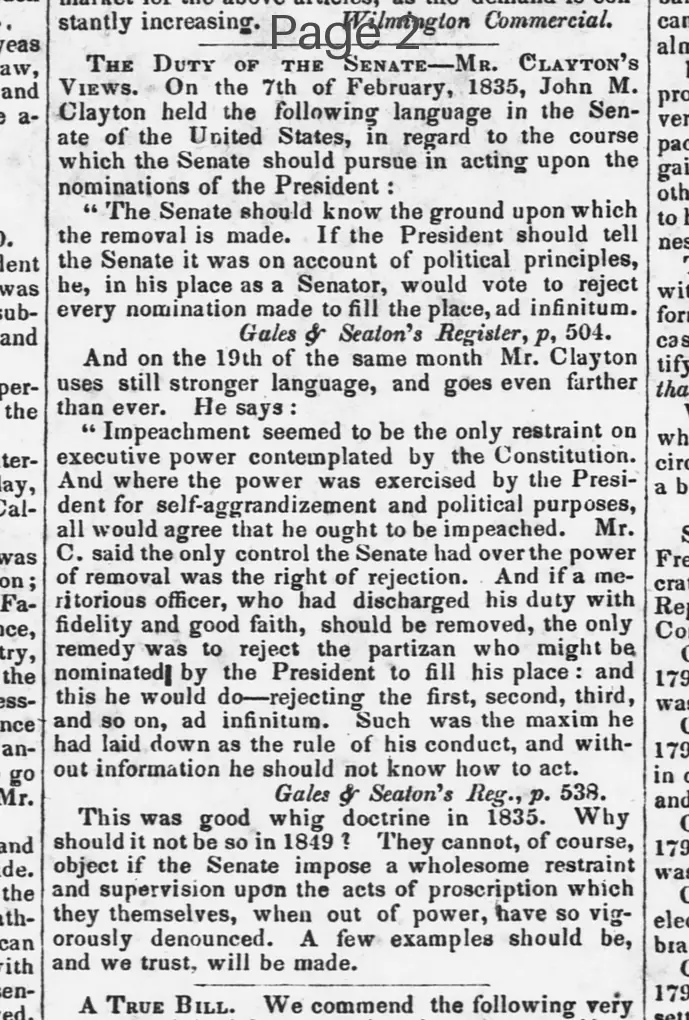
The DUTY of The Senate-MR. Clayton's Views. On the 7th of February, 1835, John M. Clayton held the following language in the Senate of the United States, in regard to the course which the Senate should pursue in acting upon the nominations of the President:
"The Senate should know the ground upon which the removal is made. If the President should tell the Senate it was on account of political principles, he, in his place as a Senator, would vote to reject every nomination made to fill the place, ad infinitum."
Gales & Seaton's Register, p. 504.
And on the 19th of the same month Mr. Clayton uses still stronger language, and goes even farther than ever. He says:
"Impeachment seemed to be the only restraint on executive power contemplated by the Constitution. And where the power was exercised by the President for self-aggrandizement and political purposes, all would agree that he ought to be impeached." Mr. C. said the only control the Senate had over the power of removal was the right of rejection. And if a meritorious officer, who had discharged his duty with fidelity and good faith, should be removed, the only remedy was to reject the partizan who might be nominated by the President to fill his place: and this he would do-rejecting the first, second, third, and so on, ad infinitum. Such was the maxim he had laid down as the rule of his conduct, and without information he should not know how to act.
Gales & Seaton's Reg., p. 538.
This was good whig doctrine in 1835. Why should it not be so in 1849? They cannot, of course, object if the Senate impose a wholesome restraint and supervision upon the acts of proscription which they themselves, when out of power, have so vigorously denounced. A few examples should be, and we trust, will be made.
"The Senate should know the ground upon which the removal is made. If the President should tell the Senate it was on account of political principles, he, in his place as a Senator, would vote to reject every nomination made to fill the place, ad infinitum."
Gales & Seaton's Register, p. 504.
And on the 19th of the same month Mr. Clayton uses still stronger language, and goes even farther than ever. He says:
"Impeachment seemed to be the only restraint on executive power contemplated by the Constitution. And where the power was exercised by the President for self-aggrandizement and political purposes, all would agree that he ought to be impeached." Mr. C. said the only control the Senate had over the power of removal was the right of rejection. And if a meritorious officer, who had discharged his duty with fidelity and good faith, should be removed, the only remedy was to reject the partizan who might be nominated by the President to fill his place: and this he would do-rejecting the first, second, third, and so on, ad infinitum. Such was the maxim he had laid down as the rule of his conduct, and without information he should not know how to act.
Gales & Seaton's Reg., p. 538.
This was good whig doctrine in 1835. Why should it not be so in 1849? They cannot, of course, object if the Senate impose a wholesome restraint and supervision upon the acts of proscription which they themselves, when out of power, have so vigorously denounced. A few examples should be, and we trust, will be made.
What sub-type of article is it?
Constitutional
Partisan Politics
What keywords are associated?
Senate Nominations
Presidential Removals
Whig Doctrine
Impeachment
Political Proscription
Executive Power
What entities or persons were involved?
John M. Clayton
Senate Of The United States
President
Editorial Details
Primary Topic
Senate's Role In Presidential Nominations And Removals
Stance / Tone
Advocacy For Senate Rejection Of Partisan Nominations To Restrain Executive Power
Key Figures
John M. Clayton
Senate Of The United States
President
Key Arguments
Senate Should Know Grounds For Removal; Reject Nominations If Based On Political Principles
Impeachment Is The Constitutional Restraint On Executive Power Used For Self Aggrandizement
Senate's Control Is Rejection Of Nominees To Replace Meritorious Officers
Whig Doctrine From 1835 Should Apply In 1849 To Impose Restraint On Proscriptions