Thank you for visiting SNEWPapers!
Sign up free
The Milwaukee Leader
Milwaukee, Milwaukee County, Wisconsin
What is this article about?
Historical account of Socialist aldermen's reforms in Milwaukee's fire department, exposing abuses and improving conditions. Focuses on Chief Peter Steinkellner's 1925 appointment, his successful handling of a major fire, departmental modernization, and new fire safety measures against gasoline hazards.
Clipping
OCR Quality
Full Text
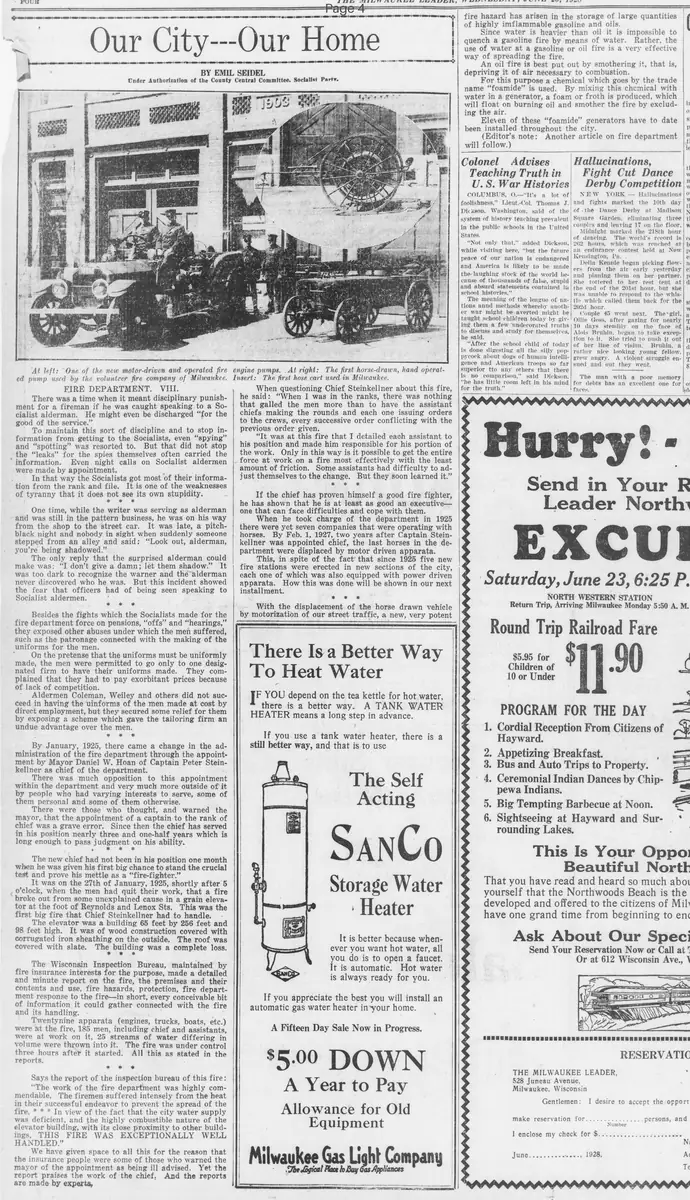
There was a time when it meant disciplinary punishment for a fireman if he was caught speaking to a Socialist alderman. He might even be discharged "for the good of the service."
To maintain this sort of discipline and to stop information from getting to the Socialists, even "spying" and "spotting" was resorted to. But that did not stop the "leaks" for the spies themselves often carried the information. Even night calls on Socialist aldermen were made by appointment.
In that way the Socialists got most of their information from the rank and file. It is one of the weaknesses of tyranny that it does not see its own stupidity.
One time, while the writer was serving as alderman and was still in the pattern business, he was on his way from the shop to the street car. It was late, a pitch-black night and nobody in sight when suddenly someone stepped from an alley and said: "Look out, alderman, you're being shadowed."
The only reply that the surprised alderman could make was: "I don't give a damn; let them shadow." It was too dark to recognize the warner and the alderman never discovered who he was. But this incident showed the fear that officers had of being seen speaking to Socialist aldermen.
Besides the fights which the Socialists made for the fire department force on pensions, "offs" and "hearings," they exposed other abuses under which the men suffered, such as the patronage connected with the making of the uniforms for the men.
On the pretense that the uniforms must be uniformly made, the men were permitted to go only to one designated firm to have their uniforms made. They complained that they had to pay exorbitant prices because of lack of competition.
Aldermen Coleman, Weiley and others did not succeed in having the uniforms of the men made at cost by direct employment, but they secured some relief for them by exposing a scheme which gave the tailoring firm an undue advantage over the men.
By January, 1925, there came a change in the administration of the fire department through the appointment by Mayor Daniel W. Hoan of Captain Peter Steinkellner as chief of the department.
There was much opposition to this appointment within the department and very much more outside of it by people who had varying interests to serve, some of them personal and some of them otherwise.
There were those who thought, and warned the mayor, that the appointment of a captain to the rank of chief was a grave error. Since then the chief has served in his position nearly three and one-half years which is long enough to pass judgment on his ability.
The new chief had not been in his position one month when he was given his first big chance to stand the crucial test and prove his mettle as a "fire-fighter."
It was on the 27th of January, 1925, shortly after 5 o'clock, when the men had quit their work, that a fire broke out from some unexplained cause in a grain elevator at the foot of Reynolds and Lenox Sts. This was the first big fire that Chief Steinkellner had to handle.
The elevator was a building 65 feet by 256 feet and 98 feet high. It was of wood construction covered with corrugated iron sheathing on the outside. The roof was covered with slate. The building was a complete loss.
The Wisconsin Inspection Bureau, maintained by fire insurance interests for the purpose, made a detailed and minute report on the fire, the premises and their contents and use, fire hazards, protection, fire department response to the fire--in short, every conceivable bit of information it could gather connected with the fire and its handling.
Twenty-nine apparata (engines, trucks, boats, etc.) were at the fire. 185 men, including chief and assistants, were at work on it. 25 streams of water differing in volume were thrown into it. The fire was under control three hours after it started. All this as stated in the reports.
Says the report of the inspection bureau of this fire:
"The work of the fire department was highly commendable. The firemen suffered intensely from the heat in their successful endeavor to prevent the spread of the fire.
* * * In view of the fact that the city water supply was deficient, and the highly combustible nature of the elevator building, with its close proximity to other buildings, THIS FIRE WAS EXCEPTIONALLY WELL HANDLED."
We have given space to all this for the reason that the insurance people were some of those who warned the mayor of the appointment as being ill advised. Yet the report praises the work of the chief. And the reports are made by experts.
When questioning Chief Steinkellner about this fire, he said: "When I was in the ranks, there was nothing that galled the men more than to have the assistant chiefs making the rounds and each one issuing orders to the crews, every successive order conflicting with the previous order given.
"It was at this fire that I detailed each assistant to his position and made him responsible for his portion of the work. Only in this way is it possible to get the entire force at work on a fire most effectively with the least amount of friction. Some assistants had difficulty to adjust themselves to the change. But they soon learned it."
If the chief has proven himself a good fire fighter, he has shown that he is at least as good an executive--one that can face difficulties and cope with them.
When he took charge of the department in 1925 there were yet seven companies that were operating with horses. By Feb. 1, 1927, two years after Captain Steinkellner was appointed chief, the last horses in the department were displaced by motor driven apparata.
This, in spite of the fact that since 1925 five new fire stations were erected in new sections of the city, each one of which was also equipped with power driven apparata. How this was done will be shown in our next installment.
With the displacement of the horse drawn vehicle by motorization of our street traffic, a new, very potent
fire hazard has arisen in the storage of large quantities of highly inflammable gasoline and oils.
Since water is heavier than oil it is impossible to quench a gasoline fire by means of water. Rather, the use of water at a gasoline or oil fire is a very effective way of spreading the fire.
An oil fire is best put out by smothering it, that is, depriving it of air necessary to combustion.
For this purpose a chemical which goes by the trade name "foamide" is used. By mixing this chemical with water in a generator, a foam or froth is produced, which will float on burning oil and smother the fire by excluding the air.
Eleven of these "foamide" generators have to date been installed throughout the city.
(Editor’s note: Another article on fire department will follow.)
What sub-type of article is it?
What themes does it cover?
What keywords are associated?
What entities or persons were involved?
Where did it happen?
Story Details
Key Persons
Location
Milwaukee
Event Date
January 1925 To February 1927
Story Details
Socialist aldermen exposed abuses in the fire department, including uniform patronage, and fought for better conditions. Mayor Hoan appointed Captain Peter Steinkellner as chief in January 1925, despite opposition. Steinkellner successfully handled a major grain elevator fire on January 27, 1925, praised by experts. He improved organization, motorized the department by 1927, and addressed new fire hazards like gasoline with foamide generators.