Thank you for visiting SNEWPapers!
Sign up free
Editorial
June 7, 1837
Morning Star
Limerick, York County, Maine
What is this article about?
Editorial from Dover, June 7, 1837, emphasizing the destructive effects of immorality on individuals and nations, particularly in republics where it leads to corrupt governance, vicious laws, and eventual anarchy. Contrasts moral nations like England with depraved ones, urging patriots to safeguard public morals to preserve liberties.
Clipping
OCR Quality
98%
Excellent
Full Text
DOVER:
WEDNESDAY, JUNE 7, 1837.
THE IMPORTANCE OF GOOD MORALS IN A REPUBLIC.
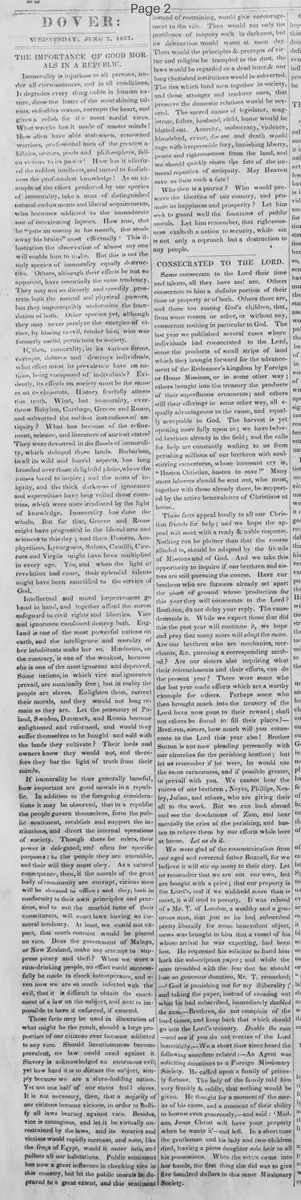
Immorality is injurious to all persons, under all circumstances, and in all conditions. It degrades every thing noble in human nature, dims the lustre of the most shining talents, enfeebles reason, corrupts the heart, and gives a relish for the most sordid vices. What wrecks has it made of master minds! How often have able statesmen, renowned warriors, professional men of the greatest abilities, orators, poets and philosophers, fallen victims to its power! How has it idiotized the noblest intellects, and turned to foolishness the profoundest knowledge! As an example of the effect produced by one species of immorality, take a man of distinguished natural endowments and liberal acquirements, who becomes addicted to the immoderate use of intoxicating liquors. How true, that he "puts an enemy in his mouth, that steals away his brains" most effectually! This illustration the observation of almost any one will enable him to make. But this is not the only species of immorality equally destructive. Others, although their effects be not so apparent, have essentially the same tendency. They may not so directly and speedily prostrate both the mental and physical powers, but they imperceptibly undermine the foundation of both. Other species yet, although they may never paralyze the energies of either, by biasing to evil, render him, who was formerly useful, pernicious to society. If, then, immorality, in its various forms, corrupts, debases and destroys individuals, what effect must its prevalence have on nations, being composed of individuals? Evidently, its effects on society must be the same as on its elements. History fearfully attests this truth. What, but immorality, overthrew Babylon, Carthage, Greece and Rome, and subverted the noblest institutions of antiquity? What has become of the refinement, science, and literature of ancient states? They were devoured in the floods of immorality, which deluged those lands. Barbarism, in all its wild and horrid aspects, has long brooded over those delightful plains, where the muses loved to inspire; and the mists of iniquity, and the thick darkness of ignorance and superstition have long veiled those countries, which were once irradiated by the light of knowledge. Immorality has done the whole. But for that, Greece and Rome might have progressed in the liberal arts and sciences to this day; and their Homers, Amphictyons, Lycurguses, Solons, Camilli, Ciceros and Virgils might have been multiplied in every age. Yes, and when the light of revelation had come, their splendid talents might have been sanctified to the service of God.
Intellectual and moral improvement go hand in hand, and together afford the surest safeguard to civil rights and liberties. Vice and ignorance combined destroy both. England is one of the most powerful nations on earth, and the intelligence and morality of her inhabitants make her so. Hindostan, on the contrary, is one of the weakest, because she is one of the most ignorant and depraved. Some nations, in which vice and ignorance prevail, are nominally free; but in reality the people are slaves. Enlighten them, correct their morals, and they would not long remain as they are. Let the peasantry of Poland, Sweden, Denmark, and Russia become enlightened and reformed, and would they suffer themselves to be bought and sold with the lands they cultivate? Their lords and owners know they would not, and therefore they bar the light of truth from their minds.
If immorality be thus generally baneful, how important are good morals in a republic. In addition to the foregoing considerations it may be observed, that in a republic the people govern themselves, form the public sentiment, establish and support the institutions, and direct the internal operations of society. Though there be rulers, their power is delegated, and often for specific purposes: to the people they are amenable, and their will they must obey. As a natural consequence, then, if the morals of the great body of community are corrupt, vicious men will be elevated to office; and they, both in conformity to their own principles and practices, and to suit the morbid taste of their constituents, will enact laws having an immoral tendency. At least, we could not expect, that much restraint would be placed on vice. Does the government of Malaga, or New Zealand, make any attempt to suppress piracy and theft? When we were a rum-drinking people, no effort could successfully be made to check intemperance, and even now we are so much infected with the evil, that it is difficult to obtain the enactment of a law on the subject, and next to impossible to have it enforced, if enacted. These facts may be used in illustration of what might be the result, should a large proportion of our citizens ever become addicted to any vice. Should licentiousness become prevalent, no law could avail against it. Slavery is acknowledged an enormous evil: yet how hard it is to discuss the subject, simply because we are a slave-holding nation. Yet not one half of our states hold slaves. It is not necessary, then, that a majority of our citizens become vicious, in order to nullify all laws bearing against vice. Besides, vice is contagious, and let it be virtually unrestrained by the laws, and its votaries and victims would rapidly increase, and soon, like the frogs of Egypt, would it enter into, and pollute all our habitations. Public sentiment has now a great influence in checking vice in this country, but let the public morals be depraved to a great extent, and this sentiment instead of restraining, would give encouragement to the vile. Then would not only the pestilence of iniquity walk in darkness, but its destruction would waste at noon day. Then would the principles & precepts of virtue and religion be trampled in the dust, the laws would be regarded as a dead letter, & our long cherished institutions would be subverted. The ties which bind men together in society, and those stronger and tenderer ones, that preserve the domestic relations would be severed. The sacred names of legislator, magistrate, father, husband, child, home would be blotted out. Anarchy, mobocracy, violence, bloodshed, crime, disease and death would rage with irrepressible fury, banishing liberty, peace and righteousness from the land, and we should quickly share the fate of the immoral republics of antiquity. May Heaven save us from such a fate!
Who then is a patriot? Who would preserve the liberties of our country, and promote its happiness and prosperity? Let him seek to guard well the fountains of public morals. Let him remember, that righteousness exalteth a nation to security, while sin is not only a reproach but a destruction to any people.
WEDNESDAY, JUNE 7, 1837.
THE IMPORTANCE OF GOOD MORALS IN A REPUBLIC.
Immorality is injurious to all persons, under all circumstances, and in all conditions. It degrades every thing noble in human nature, dims the lustre of the most shining talents, enfeebles reason, corrupts the heart, and gives a relish for the most sordid vices. What wrecks has it made of master minds! How often have able statesmen, renowned warriors, professional men of the greatest abilities, orators, poets and philosophers, fallen victims to its power! How has it idiotized the noblest intellects, and turned to foolishness the profoundest knowledge! As an example of the effect produced by one species of immorality, take a man of distinguished natural endowments and liberal acquirements, who becomes addicted to the immoderate use of intoxicating liquors. How true, that he "puts an enemy in his mouth, that steals away his brains" most effectually! This illustration the observation of almost any one will enable him to make. But this is not the only species of immorality equally destructive. Others, although their effects be not so apparent, have essentially the same tendency. They may not so directly and speedily prostrate both the mental and physical powers, but they imperceptibly undermine the foundation of both. Other species yet, although they may never paralyze the energies of either, by biasing to evil, render him, who was formerly useful, pernicious to society. If, then, immorality, in its various forms, corrupts, debases and destroys individuals, what effect must its prevalence have on nations, being composed of individuals? Evidently, its effects on society must be the same as on its elements. History fearfully attests this truth. What, but immorality, overthrew Babylon, Carthage, Greece and Rome, and subverted the noblest institutions of antiquity? What has become of the refinement, science, and literature of ancient states? They were devoured in the floods of immorality, which deluged those lands. Barbarism, in all its wild and horrid aspects, has long brooded over those delightful plains, where the muses loved to inspire; and the mists of iniquity, and the thick darkness of ignorance and superstition have long veiled those countries, which were once irradiated by the light of knowledge. Immorality has done the whole. But for that, Greece and Rome might have progressed in the liberal arts and sciences to this day; and their Homers, Amphictyons, Lycurguses, Solons, Camilli, Ciceros and Virgils might have been multiplied in every age. Yes, and when the light of revelation had come, their splendid talents might have been sanctified to the service of God.
Intellectual and moral improvement go hand in hand, and together afford the surest safeguard to civil rights and liberties. Vice and ignorance combined destroy both. England is one of the most powerful nations on earth, and the intelligence and morality of her inhabitants make her so. Hindostan, on the contrary, is one of the weakest, because she is one of the most ignorant and depraved. Some nations, in which vice and ignorance prevail, are nominally free; but in reality the people are slaves. Enlighten them, correct their morals, and they would not long remain as they are. Let the peasantry of Poland, Sweden, Denmark, and Russia become enlightened and reformed, and would they suffer themselves to be bought and sold with the lands they cultivate? Their lords and owners know they would not, and therefore they bar the light of truth from their minds.
If immorality be thus generally baneful, how important are good morals in a republic. In addition to the foregoing considerations it may be observed, that in a republic the people govern themselves, form the public sentiment, establish and support the institutions, and direct the internal operations of society. Though there be rulers, their power is delegated, and often for specific purposes: to the people they are amenable, and their will they must obey. As a natural consequence, then, if the morals of the great body of community are corrupt, vicious men will be elevated to office; and they, both in conformity to their own principles and practices, and to suit the morbid taste of their constituents, will enact laws having an immoral tendency. At least, we could not expect, that much restraint would be placed on vice. Does the government of Malaga, or New Zealand, make any attempt to suppress piracy and theft? When we were a rum-drinking people, no effort could successfully be made to check intemperance, and even now we are so much infected with the evil, that it is difficult to obtain the enactment of a law on the subject, and next to impossible to have it enforced, if enacted. These facts may be used in illustration of what might be the result, should a large proportion of our citizens ever become addicted to any vice. Should licentiousness become prevalent, no law could avail against it. Slavery is acknowledged an enormous evil: yet how hard it is to discuss the subject, simply because we are a slave-holding nation. Yet not one half of our states hold slaves. It is not necessary, then, that a majority of our citizens become vicious, in order to nullify all laws bearing against vice. Besides, vice is contagious, and let it be virtually unrestrained by the laws, and its votaries and victims would rapidly increase, and soon, like the frogs of Egypt, would it enter into, and pollute all our habitations. Public sentiment has now a great influence in checking vice in this country, but let the public morals be depraved to a great extent, and this sentiment instead of restraining, would give encouragement to the vile. Then would not only the pestilence of iniquity walk in darkness, but its destruction would waste at noon day. Then would the principles & precepts of virtue and religion be trampled in the dust, the laws would be regarded as a dead letter, & our long cherished institutions would be subverted. The ties which bind men together in society, and those stronger and tenderer ones, that preserve the domestic relations would be severed. The sacred names of legislator, magistrate, father, husband, child, home would be blotted out. Anarchy, mobocracy, violence, bloodshed, crime, disease and death would rage with irrepressible fury, banishing liberty, peace and righteousness from the land, and we should quickly share the fate of the immoral republics of antiquity. May Heaven save us from such a fate!
Who then is a patriot? Who would preserve the liberties of our country, and promote its happiness and prosperity? Let him seek to guard well the fountains of public morals. Let him remember, that righteousness exalteth a nation to security, while sin is not only a reproach but a destruction to any people.
What sub-type of article is it?
Moral Or Religious
Social Reform
Constitutional
What keywords are associated?
Immorality
Good Morals
Republic
Vice
Public Sentiment
Anarchy
Civil Liberties
Historical Empires
What entities or persons were involved?
Babylon
Carthage
Greece
Rome
England
Hindostan
Poland
Sweden
Denmark
Russia
Malaga
New Zealand
Editorial Details
Primary Topic
Importance Of Good Morals In A Republic
Stance / Tone
Strong Advocacy For Moral Virtue To Safeguard Republican Liberties
Key Figures
Babylon
Carthage
Greece
Rome
England
Hindostan
Poland
Sweden
Denmark
Russia
Malaga
New Zealand
Key Arguments
Immorality Degrades Noble Human Qualities And Destroys Great Minds
Intoxicating Liquors Exemplify How Vice Undermines Intellect And Body
History Shows Immorality Overthrew Ancient Empires Like Babylon And Rome
Moral And Intellectual Improvement Protect Civil Rights And Liberties
Corrupt Morals In Republics Lead To Vicious Leaders And Immoral Laws
Public Sentiment Currently Checks Vice But Could Encourage It If Morals Decline
Unchecked Vice Spreads Contagiously Leading To Anarchy And Loss Of Institutions
Patriots Must Guard Public Morals To Preserve National Security And Prosperity