Thank you for visiting SNEWPapers!
Sign up free
The Wheeling Daily Register
Wheeling, Ohio County, West Virginia
What is this article about?
The Supreme Court of Appeals met yesterday, heard one case, and planned to adjourn soon due to Judge Brown's illness. It addressed the lawyer's test oath case, allowing pre-February 1866 attorneys to practice without it until decision. A mandamus was awarded against Brooke County registration board, and court rules were updated.
Clipping
OCR Quality
Full Text
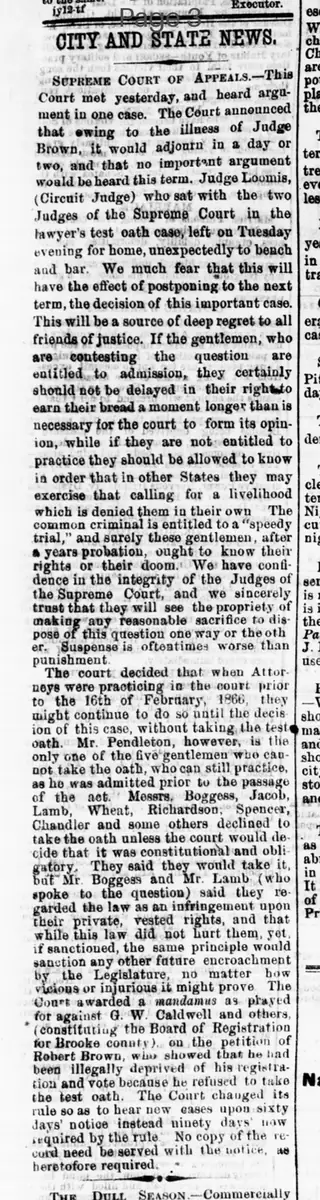
SUPREME COURT OF APPEALS.
This Court met yesterday, and heard argument in one case. The Court announced that owing to the illness of Judge Brown, it would adjourn in a day or two, and that no important argument would be heard this term. Judge Loomis, (Circuit Judge) who sat with the two Judges of the Supreme Court in the lawyer's test oath case, left on Tuesday evening for home, unexpectedly to bench and bar. We much fear that this will have the effect of postponing to the next term, the decision of this important case. This will be a source of deep regret to all friends of justice. If the gentlemen, who are contesting the question are entitled to admission, they certainly should not be delayed in their right to earn their bread a moment longer than is necessary for the court to form its opinion, while if they are not entitled to practice they should be allowed to know in order that in other States they may exercise that calling for a livelihood which is denied them in their own. The common criminal is entitled to a "speedy trial," and surely these gentlemen, after a year's probation, ought to know their rights or their doom. We have confidence in the integrity of the Judges of the Supreme Court, and we sincerely trust that they will see the propriety of making any reasonable sacrifice to dispose of this question one way or the other. Suspense is oftentimes worse than punishment.
The court decided that when Attorneys were practicing in the court prior to the 16th of February, 1866, they might continue to do so until the decision of this case, without taking the test Oath. Mr. Pendleton, however, in the only one of the five gentlemen who cannot take the oath, who can still practice, as he was admitted prior to the passage of the act. Meraru, Boggess, Jacob, Lamb, Wheat, Richardson, Spencer, Chandler and some others declined to take the oath unless the court would decide that it was constitutional and obligatory. They said they would take it, but Mr. Boggess and Mr. Lamb (who spoke to the question) said they regarded the law as an infringement upon their private, vested rights, and that while this law did not hurt them, yet, if sanctioned, the same principle would sanction any other future encroachment by the Legislature, no matter how vicious or injurious it might prove. The Court awarded a mandamus as prayed for against Q. W. Caldwell and others, (constituting the Board of Registration for Brooke county) on the petition of Robert Brown, who showed that he had been illegally deprived of his registration and vote because he refused to take the test oath. The Court changed its rule so as to hear new cases upon sixty days' notice instead of ninety days' now required by the rule. No copy of the record need be served with the notice, as heretofore required.
What sub-type of article is it?
What keywords are associated?
What entities or persons were involved?
Where did it happen?
Domestic News Details
Primary Location
West Virginia
Event Date
Yesterday
Key Persons
Outcome
court to adjourn in a day or two; attorneys practicing prior to february 16, 1866, may continue without test oath until decision; mandamus awarded against brooke county board of registration; court rule changed to 60 days' notice for new cases without record service.
Event Details
The Supreme Court of Appeals met yesterday and heard argument in one case. Due to Judge Brown's illness, it will adjourn soon with no important arguments this term. Judge Loomis left unexpectedly. The court allowed attorneys admitted before February 16, 1866, to practice without the test oath until the decision in the lawyer's test oath case. Mr. Pendleton is the only one among five who can still practice as he was admitted prior. Others declined the oath viewing it as an infringement on rights. Mandamus granted to Robert Brown against Q. W. Caldwell and others for illegal deprivation of registration and vote. Court updated rule to 60 days' notice for new cases, no record service needed.