Thank you for visiting SNEWPapers!
Sign up free
Editorial
July 13, 1850
New England Religious Herald
Hartford, Hartford County, Connecticut
What is this article about?
Editorial criticizes the New York Tribune for advocating abolition of capital punishment, noting its alignment with rumsellers and Democrats who oppose temperance laws. Provides three reasons: sympathy for liquor-influenced crimes, theological ties to Universalism, and the 'cheap' nature of the reform.
Clipping
OCR Quality
98%
Excellent
Full Text
A Fact for the N. Y. Tribune.
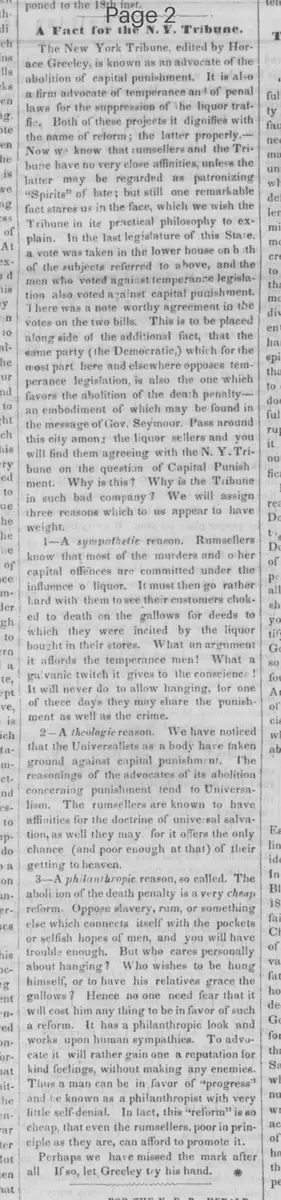
The New York Tribune, edited by Horace Greeley, is known as an advocate of the abolition of capital punishment. It is also a firm advocate of temperance and of penal laws for the suppression of the liquor traffic. Both of these projects it dignifies with the name of reform; the latter properly.—Now we know that rumsellers and the Tribune have no very close affinities, unless the latter may be regarded as patronizing "Spirits" of late; but still one remarkable fact stares us in the face, which we wish the Tribune in its practical philosophy to explain. In the last legislature of this State, a vote was taken in the lower house on both of the subjects referred to above, and the men who voted against temperance legislation also voted against capital punishment. There was a noteworthy agreement in the votes on the two bills. This is to be placed along side of the additional fact, that the same party (the Democratic,) which for the most part here and elsewhere opposes temperance legislation, is also the one which favors the abolition of the death penalty—an embodiment of which may be found in the message of Gov. Seymour. Pass around this city among the liquor sellers and you will find them agreeing with the N. Y. Tribune on the question of Capital Punishment. Why is this? Why is the Tribune in such bad company? We will assign three reasons which to us appear to have weight.
1—A sympathetic reason. Rumsellers know that most of the murders and other capital offences are committed under the influence of liquor. It must then go rather hard with them to see their customers choked to death on the gallows for deeds to which they were incited by the liquor bought in their stores. What an argument it affords the temperance men! What a galvanic twitch it gives to the conscience! It will never do to allow hanging, for one of these days they may share the punishment as well as the crime.
2—A theological reason. We have noticed that the Universalists as a body have taken ground against capital punishment. The reasonings of the advocates of its abolition concerning punishment tend to Universalism. The rumsellers are known to have affinities for the doctrine of universal salvation, as well they may, for it offers the only chance (and poor enough at that) of their getting to heaven.
3—A philanthropic reason, so called. The abolition of the death penalty is a very cheap reform. Oppose slavery, rum, or something else which connects itself with the pockets or selfish hopes of men, and you will have trouble enough. But who cares personally about hanging? Who wishes to be hung himself, or to have his relatives grace the gallows? Hence no one need fear that it will cost him any thing to be in favor of such a reform. It has a philanthropic look and works upon human sympathies. To advocate it will rather gain one a reputation for kind feelings, without making any enemies. Thus a man can be in favor of "progress" and be known as a philanthropist with very little self-denial. In fact, this "reform" is so cheap, that even the rumsellers, poor in principle as they are, can afford to promote it. Perhaps we have missed the mark after all. If so, let Greeley try his hand.
The New York Tribune, edited by Horace Greeley, is known as an advocate of the abolition of capital punishment. It is also a firm advocate of temperance and of penal laws for the suppression of the liquor traffic. Both of these projects it dignifies with the name of reform; the latter properly.—Now we know that rumsellers and the Tribune have no very close affinities, unless the latter may be regarded as patronizing "Spirits" of late; but still one remarkable fact stares us in the face, which we wish the Tribune in its practical philosophy to explain. In the last legislature of this State, a vote was taken in the lower house on both of the subjects referred to above, and the men who voted against temperance legislation also voted against capital punishment. There was a noteworthy agreement in the votes on the two bills. This is to be placed along side of the additional fact, that the same party (the Democratic,) which for the most part here and elsewhere opposes temperance legislation, is also the one which favors the abolition of the death penalty—an embodiment of which may be found in the message of Gov. Seymour. Pass around this city among the liquor sellers and you will find them agreeing with the N. Y. Tribune on the question of Capital Punishment. Why is this? Why is the Tribune in such bad company? We will assign three reasons which to us appear to have weight.
1—A sympathetic reason. Rumsellers know that most of the murders and other capital offences are committed under the influence of liquor. It must then go rather hard with them to see their customers choked to death on the gallows for deeds to which they were incited by the liquor bought in their stores. What an argument it affords the temperance men! What a galvanic twitch it gives to the conscience! It will never do to allow hanging, for one of these days they may share the punishment as well as the crime.
2—A theological reason. We have noticed that the Universalists as a body have taken ground against capital punishment. The reasonings of the advocates of its abolition concerning punishment tend to Universalism. The rumsellers are known to have affinities for the doctrine of universal salvation, as well they may, for it offers the only chance (and poor enough at that) of their getting to heaven.
3—A philanthropic reason, so called. The abolition of the death penalty is a very cheap reform. Oppose slavery, rum, or something else which connects itself with the pockets or selfish hopes of men, and you will have trouble enough. But who cares personally about hanging? Who wishes to be hung himself, or to have his relatives grace the gallows? Hence no one need fear that it will cost him any thing to be in favor of such a reform. It has a philanthropic look and works upon human sympathies. To advocate it will rather gain one a reputation for kind feelings, without making any enemies. Thus a man can be in favor of "progress" and be known as a philanthropist with very little self-denial. In fact, this "reform" is so cheap, that even the rumsellers, poor in principle as they are, can afford to promote it. Perhaps we have missed the mark after all. If so, let Greeley try his hand.
What sub-type of article is it?
Crime Or Punishment
Temperance
Partisan Politics
What keywords are associated?
Capital Punishment Abolition
Temperance Legislation
Rumsellers
New York Tribune
Horace Greeley
Democrats
Universalism
What entities or persons were involved?
New York Tribune
Horace Greeley
Gov. Seymour
Democrats
Rumsellers
Universalists
Editorial Details
Primary Topic
Criticism Of New York Tribune's Advocacy For Abolishing Capital Punishment
Stance / Tone
Critical And Sarcastic
Key Figures
New York Tribune
Horace Greeley
Gov. Seymour
Democrats
Rumsellers
Universalists
Key Arguments
Rumsellers And Anti Temperance Legislators Oppose Capital Punishment Due To Sympathy For Liquor Influenced Crimes.
Abolition Arguments Align With Universalist Theology, Appealing To Rumsellers.
Abolition Is A 'Cheap Reform' That Costs Nothing Personally And Gains Philanthropic Reputation.