Thank you for visiting SNEWPapers!
Sign up free
Virginia Argus
Richmond, Virginia
What is this article about?
A bystander in Albemarle defends President Thomas Jefferson against a misleading report in the Washington Federalist about a land dispute lawsuit in Charlottesville district court. The letter details the full legal history, exposing fraudulent actions by the defendant Johnson and affirming Jefferson's prior rightful purchase and possession of the land.
Clipping
OCR Quality
Full Text
Mr. PLEASANTS,
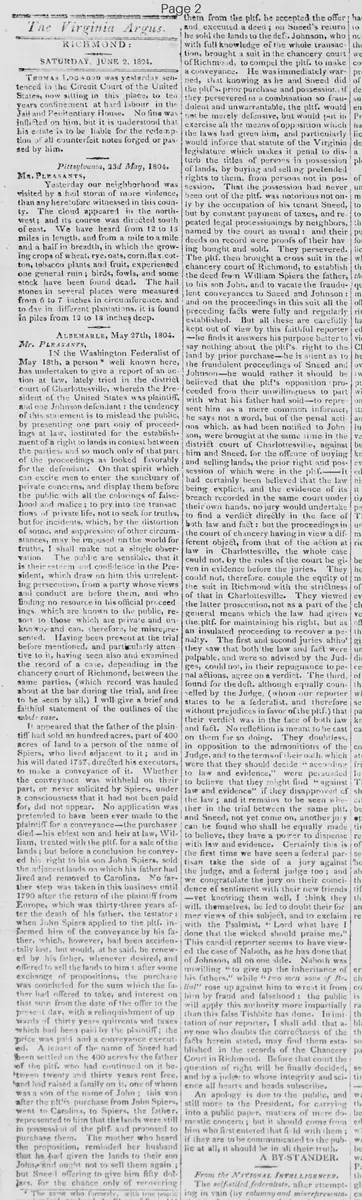
IN the Washington Federalist of May 18th, a person well known here, has undertaken to give a report of an action at law, lately tried in the district court of Charlottesville, wherein the President of the United States was plaintiff, and one Johnson defendant: the tendency of this statement is to mislead the public, by presenting one part only of proceedings at law, instituted for the establishment of a right to lands in contest between the parties, and so much only of that part of the proceedings as looked favorably for the defendant. On that spirit which can excite men to enter the sanctuary of private concerns, and display them before the public with all the colorings of falsehood and malice; to pry into the transactions of private life, not to seek for truths, but for incidents, which, by the distortion of some, and suppression of other circumstances, may be imposed on the world for truths, I shall make not a single observation. The public are sensible, that it is their esteem and confidence in the President, which draw on him this unrelenting persecution, from a party whose views and conduct are before them, and who finding no resource in his official proceedings which are known to the public, resort to those which are private and unknown,—and can, therefore, be misrepresented. Having been present at the trial before mentioned, and particularly attentive to it, having seen also and examined the record of a case, depending in the chancery court of Richmond, between the same parties, (which record was hauled about at the bar during the trial, and free to be seen by all,) I will give a brief and faithful statement of the outlines of the whole case.
It appeared that the father of the plaintiff had sold an hundred acres, part of 400 acres of land to a person of the name of Spiers, who lived adjacent to it: and in his will dated 1757, directed his executors, to make a conveyance of it. Whether the conveyance was withheld on their part, or never solicited by Spiers, under a consciousness that it had not been paid for, did not appear. No application was pretended to have been ever made to the plaintiff for a conveyance—the purchaser died—his eldest son and heir at law, William, treated with the pltf. for a sale of the lands; but before a conclusion he conveyed his right to his son John Spiers, sold the adjacent lands on which his father had lived and removed to Carolina. No further step was taken in this business until 1790 after the return of the plaintiff from Europe, which was thirty-three years after the death of his father, the testator: when John Spiers applied to the pltf. informed him of the conveyance by his father, which, however, had been accidentally lost, but would, as he said, be renewed by his father, whenever desired, and offered to sell the lands to him: after some exchange of propositions, the purchase was concluded for the sum which the father had offered to take, and interest on that sum from the date of the offer to the present day, with a relinquishment of upwards of thirty years quit rents and taxes which had been paid by the plaintiff; the price was paid and a conveyance executed. A tenant of the name of Sneed had been settled on the 400 acres by the father of the pltf. who had continued on it between twenty and thirty years rent free, and had raised a family on it, one of whom was a son of the name of John; this son after the plt's purchase from John Spiers, went to Carolina, to Spiers, the father. represented to him that the lands were still in possession of the pltf. and proposed to purchase them. The mother who heard the proposition, reminded her husband that he had given the lands to their son John, and ought not to sell them again; but Sneed offering to give him fifty dollars, for the chance only of recovering them from the pltf. he accepted the offer and executed a deed: on Sneed's return he sold the lands to the def. Johnson, who with full knowledge of the whole transaction, brought a suit in the chancery court of Richmond, to compel the pitf. to make a conveyance. He was immediately warned, that knowing as he and Sneed did the pltf's prior purchase and possession, if they persevered in a combination so fraudulent and unwarrantable, the pltf. would not be merely defensive, but would join in exercise all the means of opposition which the laws had given him, and particularly would enforce that statute of the Virginia legislature which makes it penal to disturb the titles of persons in possession of lands, by buying and selling pretended rights to them, from persons not in possession. That the possession had never been out of the pltf. was notorious not only by the occupation of his tenant Sneed, but by constant payment of taxes, and repeated legal processions by neighbors, named by the court as usual: and their deeds on record were proofs of their having bought and sold. They persevered. The pltf. then brought a cross suit in the chancery court of Richmond, to establish the deed from William Spiers the father, to his son John, and to vacate the fraudulent conveyances to Sneed and Johnson: and on the proceedings in this suit all the preceding facts were fully and regularly established. But all these are carefully kept out of view by this faithful reporter—he finds it answers his purpose better to say nothing about the pltf's right to the land by prior purchase—he is silent as to the fraudulent proceedings of Sneed and Johnson—he would rather it should be believed that the pltf's opposition proceeded from their unwillingness to part with what his father had sold—to represent him as a mere common informer he says not a word, but of the penal actions which, as had been notified to Johnson, were brought at the same time in the district court of Charlottesville, against him and Sneed, for the offence of buying and selling lands, the prior right and possession of which were in the pltf.—It had certainly been believed that the law being explicit, and the evidence of its breach recorded in the same court under their own hands, no jury would undertake to find a verdict directly in the face of both law and fact: but the proceedings in the court of chancery having in view a different object, from that of the action at law in Charlottesville, the whole case could not, by the rules of the court be given in evidence before the juries. They could not, therefore, couple the equity of the suit in Richmond with the strictness of that in Charlottesville. They viewed the latter prosecution, not as a part of the general means which the law had given the pltf. for maintaining his right, but as an insulated proceeding to recover a penalty. The first and second juries altho' they saw that both the law and fact were palpable, and were so advised by the Judges, could not, in their repugnance to penal actions, agree on a verdict. The third found for the deft. although equally counselled by the Judge, (whom our reporter states to be a federalist, and therefore without prejudices in favor of the pltf.) that their verdict was in the face of both law and fact. No reflection is meant to be cast on them for so doing. They doubtless, in opposition to the admonitions of the Judge, and to the terms of their oath, which were that they should decide "according to law and evidence," were persuaded to believe that they might find "against law and evidence" if they disapproved of the law; and it remains to be seen whether in the trial between the same pltt. and Sneed, not yet come on, another jury can be found who shall be equally made to believe, they have a power to dispense with law and evidence. Certainly this is the first time we have seen a federal partisan take the side of a jury against the judge, and a federal judge too; and we congratulate the jury on their coincidence of sentiment with their new friends—yet knowing them well, I think they will themselves, be led to doubt their former views of this subject, and to exclaim with the Psalmist, "Lord what have I done that the wicked should praise me."
This candid reporter seems to have viewed the case of Naboth, as he has done that of Johnson, all on one side. Naboth was unwilling "to give up the inheritance of his fathers," while "two men sons of Belial" rose up against him to wrest it from him by fraud and falsehood: the public will apply this authority more impartially than this false Tishbite has done. Imitation of our reporter, I shall add that any one who doubts the correctness of the facts herein stated, may find them established in the records of the Chancery Court in Richmond. Before that court the question of right will be finally decided, and by a judge to whose integrity and science all hearts and heads subscribe.
An apology is due to the public, and still more to the President, for carrying into a public paper, matters of mere domestic concern: but it should come from him who first entered that field with them; if they are to be communicated to the public at all, it should be in all their truth.
A BY-STANDER.
What sub-type of article is it?
What themes does it cover?
What keywords are associated?
What entities or persons were involved?
Letter to Editor Details
Author
A By Stander.
Recipient
Mr. Pleasants
Main Argument
the washington federalist's report misleads by omitting key facts of president jefferson's prior purchase and possession of the land, while ignoring the fraudulent actions of defendant johnson and sneed in attempting to claim it through pretended rights, justifying jefferson's legal defenses including penal actions.
Notable Details